
Deciduous shrubs
Kousa Dogwood
Cornus cousa
Synonyms: Japanese dogwood, Benthamia kousa, Japanese Benthamia, Cynoxylon kousa, Cornus kousa, Benthamidia kousa, Cynoxylon kousa
Kousa dogwood (Cornus kousa F.Buerger ex Hance) – a species of deciduous plants of the genus Cornus in the family Cornaceae. It was first described in 1866 in «Annales Musei Botanici Lugduno-Batavi 2(6): 159–160» by the botanists F. Buerger and H.F. Hance. In cultivation since 1907.
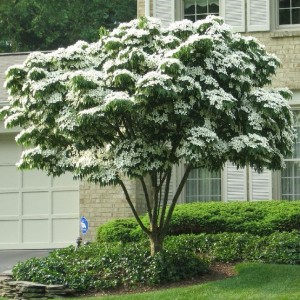
The native range includes China (provinces Anhui, Fujian, Gansu, Guizhou, Henan, Hubei, Hunan, Jiangsu, Jiangxi, Inner Mongolia Autonomous Region, Shaanxi, Shanxi, Sichuan, Yunnan, Zhejiang) and East Asia (Japan (Honshu, Kyushu, Ryukyu Islands, Shikoku); Korea; Taiwan). They grow in mixed forests, on shaded slopes, and by roadsides. They ascend into mountains at altitudes of 400-2200 m above sea level.
It is a deciduous tree or shrub 5-7 m tall and up to 5 m in diameter. Crown broadly ovate, irregular. Branches straight, ascending. Shoots glabrous.
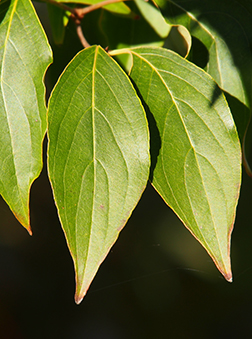
Leaves opposite, 4-9 cm long, broadly ovate or ovate, shortly acuminate, with a sharply drawn-out apex, margins wavy, base cuneate, coarsely serrated, dark green above, glaucous-green beneath, thinly leathery, glossy. In autumn the leaves acquire bright red tones.
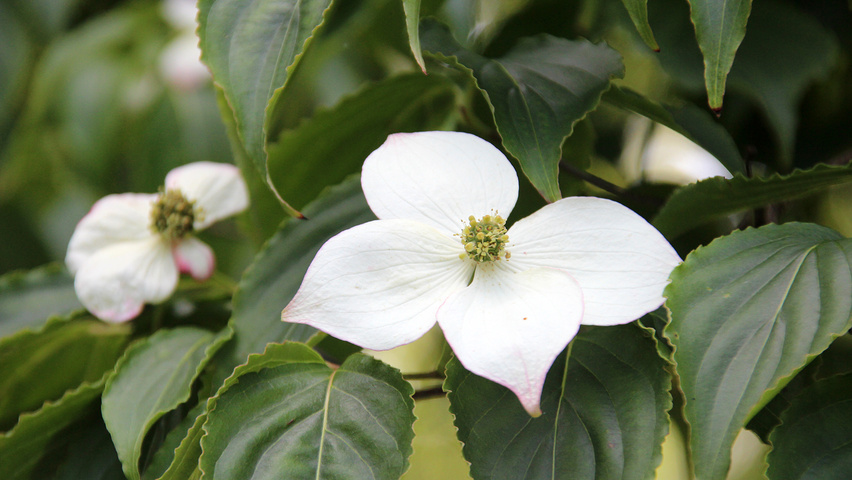
Flowers very small, sessile, grouped 20-25 per inflorescence in convex hemispherical head-like clusters about 1 cm in diameter on a thin peduncle 5-9 cm long. Inflorescences are surrounded by 4 bracts which enlarge the flower display to 5-8 cm in diameter. Bracts 2.5-4 cm long, lanceolate-ovate, tapering to a point, creamy-white, thick. Flowers in June.
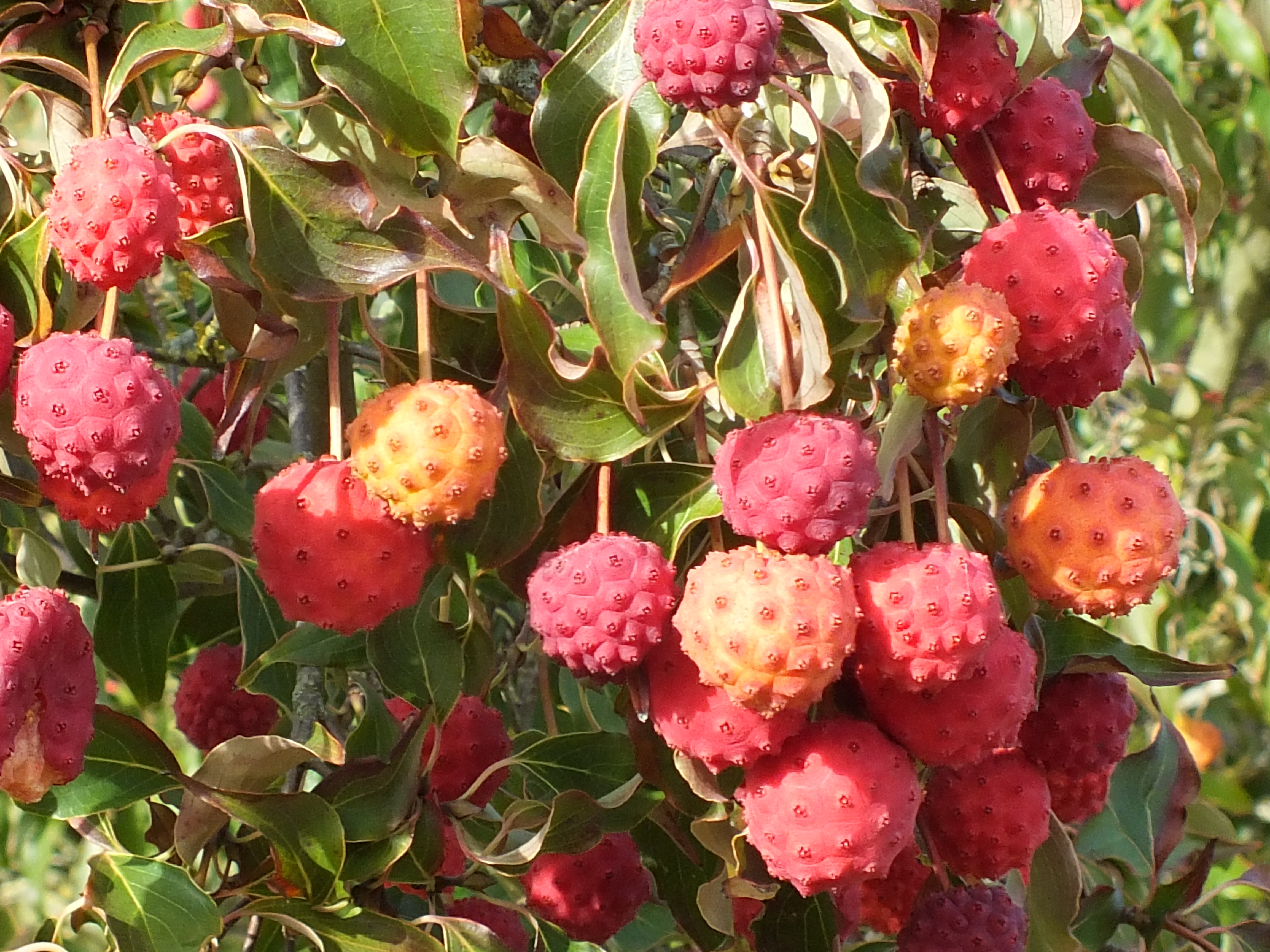
Fruits consist of individual drupes fused together by their outer flesh to form a fleshy globose syncarp up to 2 cm in diameter, scarlet-red in color, with numerous stones inside. The syncarp is edible, with a consistency similar to strawberry, fragrant. Fruits ripen from September to October.
Cultivars: 'Miss Satomi', 'Satomi', 'Wolf Eyes'
Hybrids: Cornus kousa Hance subsp. Kousa
Cornus kousa Hance subsp. Chinensis – Chinese kousa dogwood
Hardiness zone: 4a (-29°C)
Position: can be planted in full sun or partial shade. Preferably plant in locations protected from cold winds, as shoot tips may freeze in cold winters.
Soil: prefers fresh, sandy loam, fertile, from acidic to neutral. Does not tolerate lime. Suffers from drought, waterlogging and soil compaction.
Planting: Add compost or humus to the prepared planting hole and mix with the topsoil. For planting it is best to use 4-year-old seedlings.
Pruning: requires regular pruning after 3 years of age. For a compact and tidy appearance remove every 3-4 shoots (choosing the oldest and weakest shoots). Such pruning is carried out twice a year, in autumn and spring. To create a hedge pruning is done twice a year – in July and August, after active shoot growth.
Care: practically no care is needed. You can feed with a mineral fertilizer in spring (100-150 g per shrub) and organic fertilizer in summer (5-7 kg compost or humus in the root circle of each shrub).
Pests and diseases: practically unaffected.
Propagation: propagated by cuttings and seeds. Seeds retain viability for 5 years. Seeds are sown in autumn (for winter) or in early spring after stratification for several months. For stratification use a substrate of sand, moss, sawdust and shredded peat (the amount of mixture should be 3-4 times the amount of seeds). Mix the seeds with this substrate and keep at a temperature up to 5 °C. Then sow 5-15 g of stratified seeds per square meter on the chosen site, with a planting depth not exceeding 5 cm. With seed propagation Cornus germinates in 2-3 years. Easily propagated by cuttings. For this, take green, slightly lignified cuttings and plant them in early June.
Companion plants: looks striking with conifers and groundcover perennials.
Uses: used as a specimen plant, in compositions, and for creating hedges.