
Flowers for the garden
Coreopsis
Coreopsis
Name derives from two Greek words 'koris' — bug and 'opsis' — appearance; the fruits — achenes — resemble a bug in appearance.
The genus comprises about 120 species, originating mainly from North America, and less often from tropical Africa and the Hawaiian Islands. Showy-flowering annual and perennial rhizomatous herbaceous plants, sometimes subshrubs. Stems erect, branched. Leaves opposite, palmately divided or pinnately dissected. Inflorescences are heads (capitula) on long peduncles. Ray florets are ligulate, yellow, brownish-yellow or pink; disc (tubular) florets are small, yellow or brown. Fruit is an achene. Up to 500 seeds per gram.
Large-flowered coreopsis — Coreopsis grandiflora Hogg
Native range — North America. A perennial, but short-lived, herbaceous plant with erect, strongly branched stems 90-100 cm tall. Upper leaves pinnately divided, lower leaves entire. Inflorescences are solitary heads on sturdy peduncles up to 8 cm in diameter. Ray florets golden-yellow, disc florets dark yellow. Blooms from July for 70-80 days. Sets seed. In cultivation since 1826. Plants are short-lived. They may persist in one place no longer than about 3 years.
Lanceleaf coreopsis — Coreopsis lanceolata L. Native range — central regions of North America.
A perennial herbaceous plant. Stems branched, up to 60 cm tall. Leaves petiolate, lanceolate or nearly linear, gradually diminishing up the stem. Inflorescences up to 6 cm in diameter, nodding. Ray florets golden-yellow up to 3 cm long, disc florets dark yellow. Blooms from July for 60-70 days. Sets seed. In cultivation since 1724.
Whorled coreopsis - Coreopsis verticillata L. Native range — the southeastern states of North America.
A perennial plant with repeatedly branched stems up to 100 cm tall. Leaves sessile, very narrow, needle-like, light green. Inflorescences are numerous, radiating, star-shaped heads up to 3 cm in diameter. Ray florets pale yellow, narrow; disc florets small, yellow. Blooms from mid-July for 65-70 days. In cultivation since 1750. Plants are more long-lived, flowering well without transplanting for up to 6 years.
Auriculate coreopsis — Coreopsis auriculata L. Native range — southeastern USA.
A perennial herbaceous plant 10-30 cm tall (sometimes up to 60 cm). Leaves (1 to 6 cm long) basal and stem leaves cover up to 1/4-1/2 of the plant height. Flowers are daisy-like, bright yellow, with a corolla up to 4.5 mm long and ray florets up to 20 mm long. If flowers are cut off immediately after blooming, the flowering period is considerably extended. Easily propagated by seed and by division. Flowers keep well as cut flowers and are attractive to butterflies and bees.
Cultivars:
'Nana' - a dwarf cultivated variety forming a compact, dense, slowly spreading mound of short, broadly ovate green leaves. Numerous bright orange-yellow daisy-like flowers with yellow toothed petals and a yellow disk in the center appear in late spring to early summer. Occasional and inconsistent flowering may continue through summer and autumn.
'Zamphir' - attractive low mounds of small, rounded green leaves; upright stems with flowers the color of golden orange. Flowers have ruffled petals that smooth out with age. Slightly taller than the 'Nana' variety. Suitable for sunny spots, containers or rock gardens. Flowers attract butterflies.
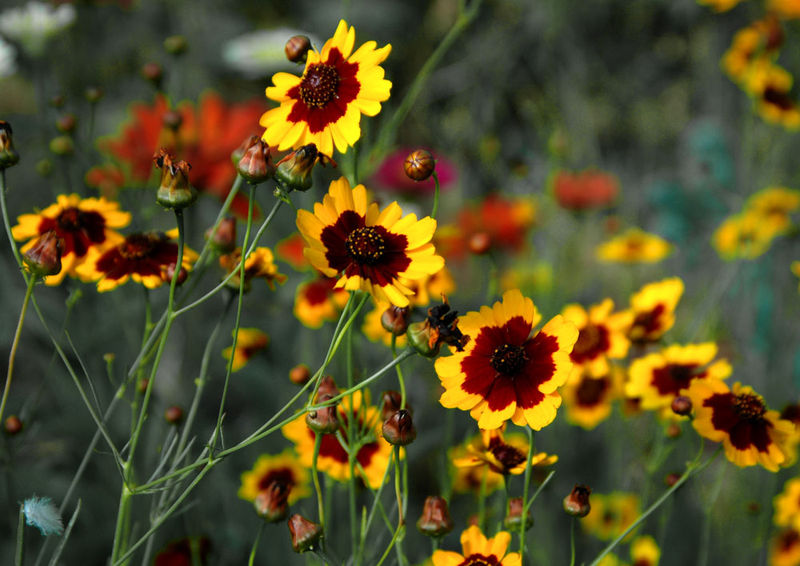
Location: perennial coreopsises prefer open sunny sites; Coreopsis verticillata tolerates some shading. Hardy to frost. In the northern part of Ukraine they require light winter protection.
Light: sun-loving, they develop best in open, well-lit locations. Some species tolerate slight shading and grow well under the canopy of open-crowned trees.
Soil: grow better on fertile, sufficiently moist soils. On excessively fertilized soils they lose decorative value. Coreopsis grandiflora prefers moderately dry, fresh soil with a moderate nutrient level. The heavier and more fertile the soil, the less robust the plant will be.
Care: respond well to fertilization. Intolerant of winter waterlogging. Require watering in dry weather. Plants are pruned after flowering. Exception — Coreopsis grandiflora. If the plant is cut immediately after the flowering period, this will increase its susceptibility to frost. Plants are recommended to be divided and transplanted every 3-4 years.
Propagation: by seed, by division. Sow seeds in April in open ground or a cold frame. For early sowings in a greenhouse, seedlings are pricked out twice. First into boxes at a spacing of 2 x 2 cm, second time into 11 cm pots, 4 per pot. Transplant into open ground at 20-30 cm spacing. Can be sown in autumn. Self-seeding occurs. Divide clumps in autumn.