
Flowers for the garden
Bindweed
Convolvulus
Bindweed (lat. Convolvulus) — a genus of herbs and shrubs of the bindweed family (Convolvulaceae).
The scientific name of the genus comes from Latin 'convolvere' — «to coil», since the stems of many species of the genus twine around other plants. The Ukrainian name of the plant is 'Берізка'.
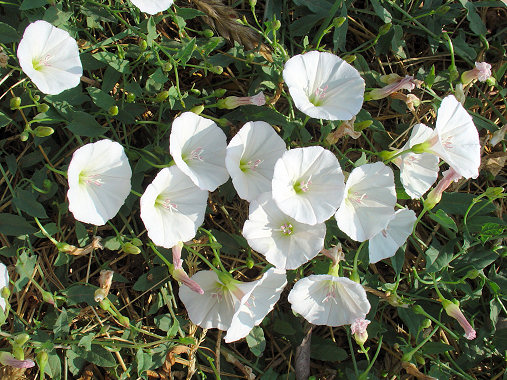
A climbing or prostrate annual or perennial herbaceous plant. This is an attractive trailing or ground-cover plant with long shoots. It twines very well when supports are available. Leaves are simple, alternate, bright green. Flowers are large, funnel-shaped, 4-5 cm in diameter, in a wide range of colors - white, pink, blue, violet, purple. Bindweed flowers have a peculiar feature: in low light during gloomy or rainy weather they do not open. They bloom from mid-July until late autumn.
In cultivation:
Three-coloured bindweed — Convolvulus tricolor
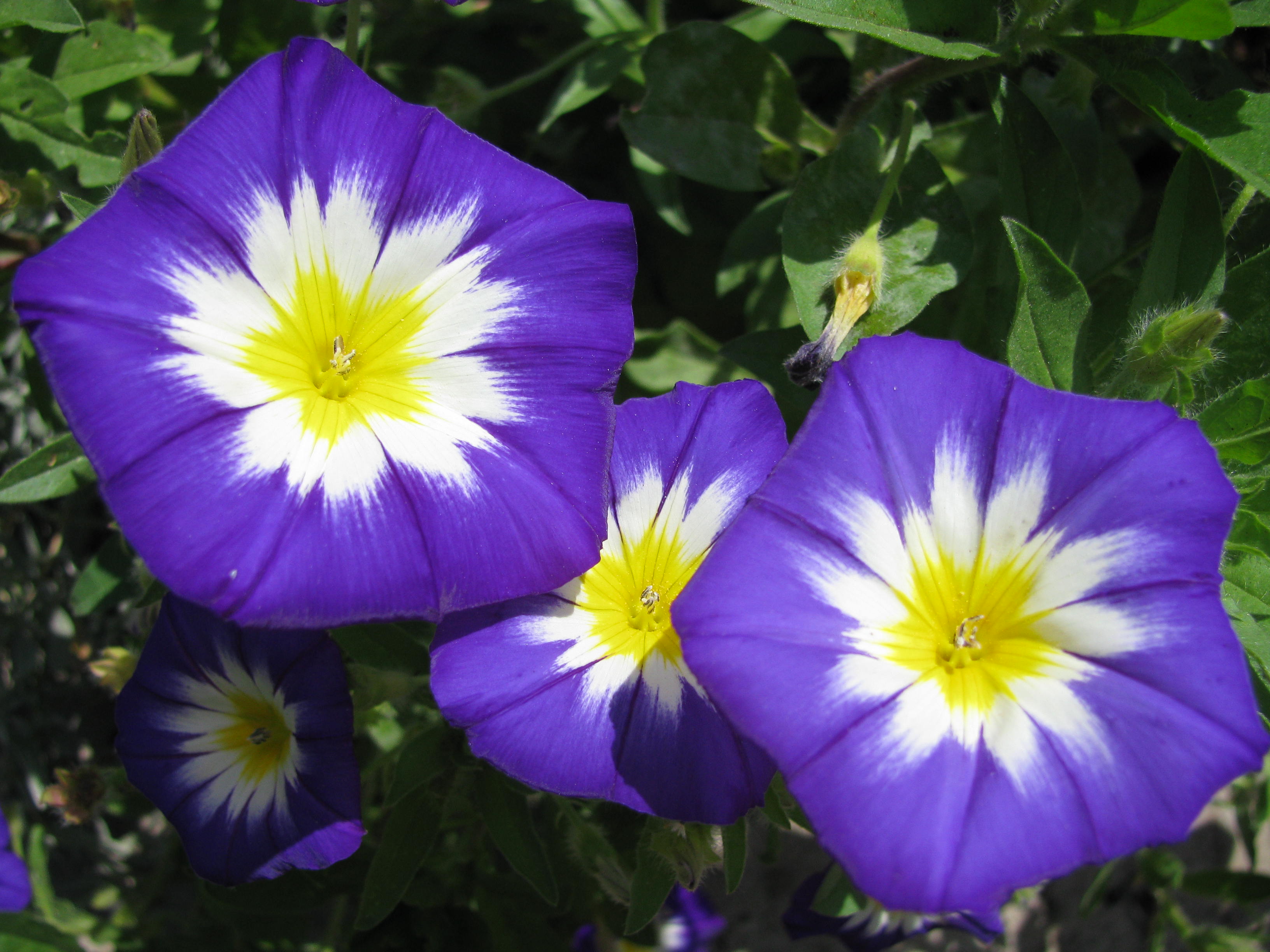
An annual herbaceous, densely branched plant up to 50 cm tall, with prostrate and ascending pubescent shoots. Leaves linear-lanceolate, pointed, glabrous or slightly rough, dull green. Flowers on short peduncles, solitary in the leaf axils, actinomorphic, funnel-shaped, up to 4 cm in diameter, tricolored. Blooms abundantly from June to August. Flowers are open all day, closing only at night and in cloudy weather. Fruit is a dry capsule with two trigonous seeds up to 0.3 cm in diameter, brownish in color. Self-seeds.
Mauritanian bindweed — Convolvulus mauritanicus
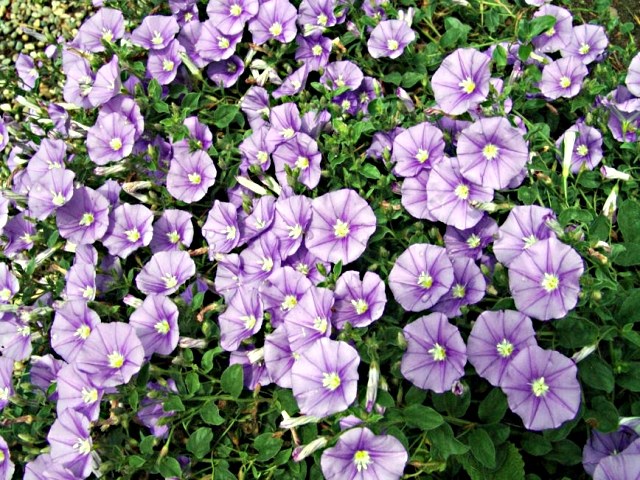
An annual plant with numerous branched, prostrate and ascending stems, up to 1 m tall. Leaves silvery-green. Flowers funnel-shaped, pale blue, solitary, axillary, on short peduncles, opening in sunny weather.
Used to decorate containers and hanging baskets. The foliage of a single plant can cover an area of more than one square meter. Plants are undemanding and can be cultivated in ordinary garden soil or even poorer soil. The only condition that must be carefully monitored is sufficient watering.
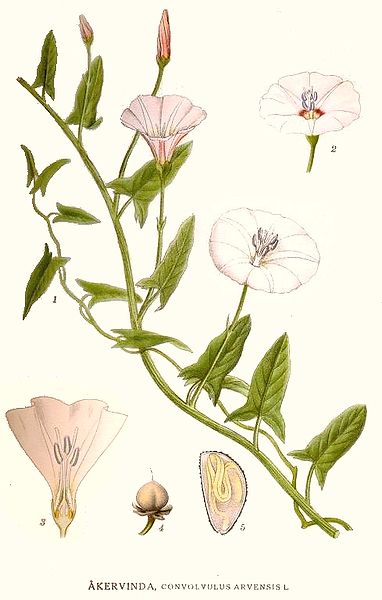
Location: develops well and flowers abundantly in well-lit sites. Cold-hardy.
Soil: well-worked loam, non-acidic.
Care: consists of regular watering and fertilization.
Propagation: by seeds, which are sown in March into pots or in mid-April into open ground.
Zone: 7-10