
Flowers for the garden
Autumn Crocus or Colchicum
Colchicum
Colchicum, or autumn crocus (lat. Colchicum) — a genus of perennial flowering plants of the family Colchicaceae (Colchicaceae). The Latin name derives from the Greek name of a region in western Georgia (Colchis), where some species of this genus occur. The Russian name "bezvremennik" is linked to the characteristic of many species flowering in late autumn. In the Middle Ages it was called in Latin "Filius ante patrem", which translates as "son before the father".
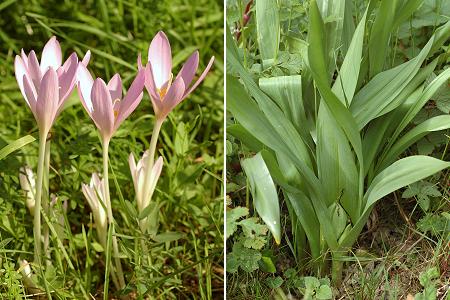
The genus includes about 70 species of cormous perennials distributed in Europe, North Africa, and Western and Central Asia. Early in spring the plants usually produce large, elongated-lanceolate leaves that die back by early summer. Flowering mainly occurs in autumn, when only solitary funnel-shaped flowers of various colours emerge from the ground. Colchicum flowers can reach 20 cm in height if one counts the perianth fused into a narrow tube, much of which lies below ground. The fruit is a low-positioned three-chambered capsule with round seeds.
Dioscorides already noted that these are extremely poisonous plants. Damaged corms release the alkaloid colchicine, which can cause burns on the hands. But not only the corms, the above-ground parts also contain various alkaloids. Poisonings can be very severe: within a few hours a burning sensation in the throat appears, accompanied by dizziness and nausea, which may later progress to colic, paralysis and collapse. Since all parts of the plant, and even the water in which the flowers have stood, are poisonous, colchicum should be handled carefully and work should be done wearing gloves.
Colchica have earned their name because of their unusual growth rhythm. Unlike most bulbous plants, in spring most species produce only leaves, while flowers appear in autumn, some even just before the first snow. However, there are several species of Colchicum that flower in early spring.
Location: members of the genus are undemanding ornamental plants that perform well in sunny positions. They grow in the same place for quite a long time without transplanting. They can be placed near shrubs or tall herbaceous plants, but only on the south side.
Soil: they prefer loose, light soils. Good garden soil rich in nutrients is required.
Planting: the planting depth of corms depends on their size and varies from 8 to 20 cm depending on the corm diameter. D. G. Hessayon in his book "All About Bulbs" describes Colchicum as a plant for enthusiasts. He bases his opinion not only on the fact that all parts of this plant are poisonous, but also on the view that the large leaves produced in spring look rather untidy, and the flowers can be knocked down by heavy rain. For this reason D. G. Hessayon advises planting corms close together at a distance of 10-15 cm. Czech gardener Anna Jakabova in the book "Rock Garden in Your Garden" recommends increasing the spacing between corms to 20 cm. Corms of autumn-flowering Colchicum are planted in August.
Care: flowers of autumn-flowering Colchicum are heavily affected by slugs (to combat them it is recommended to weed, loosen the soil and sprinkle the soil surface with superphosphate).
Propagation: by division of corm clumps and by seed.
The most common species in cultivation, the autumn Colchicum, develops as follows. Early in spring elliptical leaves appear, gathered in a low rosette on a short false stem (pseudostem) surrounded by the sheath of the lower leaf. At this time the plants reach a height of 20-40 cm. From the lower internodes of the stem a corm is formed, covered with brown membranous or leathery dry tunic scales, continuing into a long neck. The formed corm bears a shoot with a renewal bud. The old, exhausted corm decomposes. After fulfilling their role, the leaves also die back. In autumn the Colchicum flowers. After a short flowering period the seeds and fruit begin to develop slowly, hidden in the corm at the base of the flower tube. Only the following spring, together with the leaves, do the fruits appear above the soil surface. The seeds ripen by early summer.
Colchicum readily propagates by daughter corms. Sometimes so many form that the plants stop flowering. Therefore the corms must be dug up and separated. Considering the plant's life cycle, corms are divided at the beginning of the vegetative dormancy period. Corms are dug up in mid-summer, in July, after the above-ground parts have completely died back, but before the appearance of flowers, and they are replanted immediately after division. Wild species can be propagated by seed. When propagating from seed, fresh seeds are sown in June-July. Seedlings appear the following spring, and plants flower in 5-7 years.
Uses: the main advantage of autumn Colchicum—its reliability in flowering—makes it a welcome guest in autumn floral compositions. The plants are excellent in group plantings along paths, borders, around ponds, on lawns, on rockeries, and in rock gardens. On terraces and balconies their delicate beauty is particularly charming. It is sufficient to plant corms in a suitable container, in sand, expanded clay or gravel. Colchicum flowers look very attractive in small terracotta pots or in glass vessels where their corms are visible. An important condition is not to water them. The corms should be dry, and then they will start to flower on their own. After flowering they are planted out in the open ground. Corms are often sold already in flower. Such corms must also be planted without delay, otherwise they may die.
In the garden Colchicum are used for group plantings against a lawn background, in mixed beds, and on rockeries. Clumps that expand over the years create a captivating display during flowering. They frame flower beds nicely and look good in light shade under shrubs. Remember that leaves will appear in spring where the flowers stood. They wither by early summer, so it is good if they are covered by nearby perennials. Colchicum flowers are suitable for cutting—cut flowers last fairly long in a vase. It is important to know that Colchicum are mildly poisonous! All parts of the plant contain colchicine, which can cause severe poisoning.