
Flowers for the garden
Cleome
Cleome
Cleome or Cleoma (lat. Cleome) — a genus of annual or biennial plants of the family Cleomaceae (Cleomaceae). Occurs in temperate and warm regions of the globe.
Perennial and annual herbaceous or semi-shrubby plants. Stems mostly branched, shortly glandular-hairy. Leaves simple or compound with elongated-linear, entire leaflets, arranged alternately. Apical leaves entire, small.
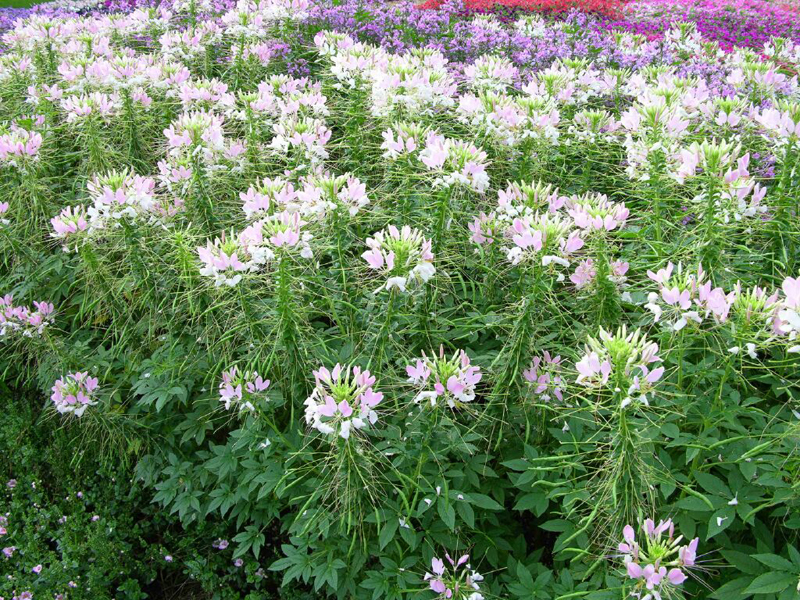
Flowers regular, in terminal racemes on long pedicels, white, yellow, pink or purple.
Fruit — one-chambered, many-seeded, pod-like capsule up to 3 cm long.
In cultivation:
Spiny cleome - Cleome spinosa
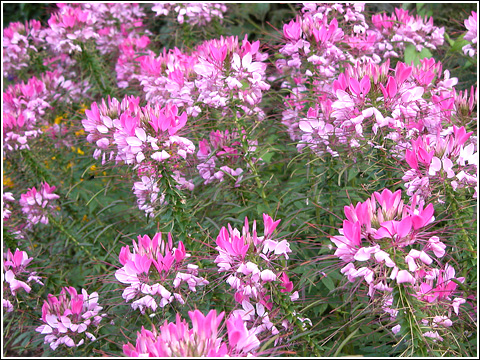
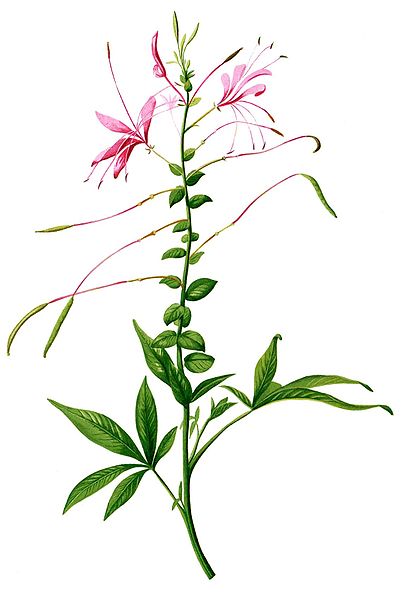
A perennial plant grown as an annual. Stem robust, branching in the upper part, woody at the base, up to 1.5 m tall. Stems, shoots and leaves are covered with sticky glandular hairs. Leaves petiolate, arranged alternately, pinnate with an odd number of leaflets, light green.
Flowers pink-purple or white, four-petaled, 3 cm in diameter, on long pedicels, with long blue or purple stamens. Flowers are gathered in a terminal many-flowered raceme, opening from the bottom upward and the raceme gradually elongates. From faded flowers elongated pods form, directed to the sides on long pedicels, not spoiling the plant's appearance and not affecting the flowering duration. Blooms abundantly from June to September. Flowers have a distinctive fragrance. Sets seed well. Fruit — an elongated, pod-like capsule. Seeds small, black, retain viability for 2-3 years.
Location: the plant is light- and heat-loving, fairly drought-tolerant.
Soil: prefers neutral soils and poorly tolerates waterlogging.
Care: responds well to fertilization and moderate watering during very prolonged drought.
Propagation: by seeds, which are sown in March in a greenhouse or sown in autumn at a depth of 1-1.5 cm.
Zone: 8-9