
Climbing plants
Clematis patens
Clematis patens
Synonyms: клематис раскидистый, ломонос раскидистый, ломонос патенс, Atragene patens Decne., Clematis azurea var. grandiflora Sieber ex Loudon, Clematis coerulea Lindl., Clematis coerulea var. grandiflora Hook., Clematis florida var. standishii T.Moore, Clematis gablenzii (Courtin) Rehder, Clematis luloni K.Koch, Clematis monstrosa K.Koch, Clematis patens f. alba Makino, Clematis patens f. coerulescens Makino, Clematis patens var. gablenzii Courtin, Clematis patens var. pallida Regel, Clematis patens var. patens , Clematis patens var. revoluta Regel, Clematis patens var. sophia Van Houtte, Clematis patens var. standishii (T.Moore) Regel, Clematis standishii (T.Moore) T.Moore
Clematis patens (Clematis patens C.Morren & Decne.) – a species of perennial woody plants of the genus Clematis (Clematis) in the family Ranunculaceae. It was first described in the Belgian journal «Bulletins de l'Academie Royale des Sciences et des Belles-Lettres de Bruxelles» in 1836. It was introduced to Europe by the German Japan researcher Philipp Franz von Siebold in the second half of the twentieth century, which led to a boom in the cultivation of clematis among gardeners worldwide.
In the wild it occurs in China (Liaoning, Shandong, Zhejiang), Japan, and North Korea. It is found in forests, shrub thickets and on slopes. In the mountains it rises to an altitude of 200-1000 m above sea level.
It is a deciduous climber up to 4 m in height. Stems are longitudinally ridged with 5-6 grooves, sparsely hairy. Climbs by leaf petioles attaching to supports.
Root system superficial, roots fleshy, thin, little branched.
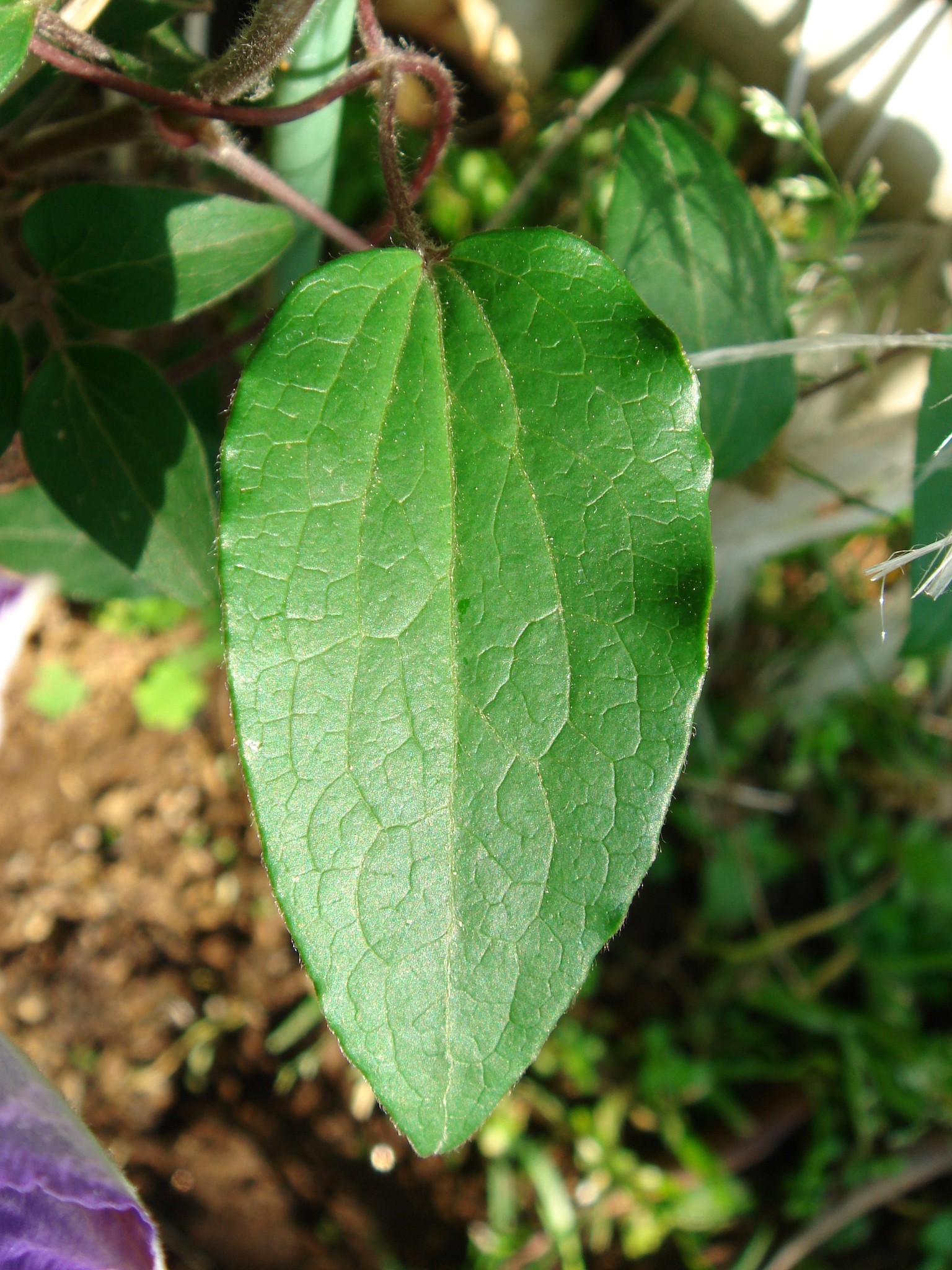
Leaves pinnately compound, composed of 3-5 leaflets, borne on petioles 4-8 cm long. Leaflets 4-10 cm long, ovate-lanceolate or narrowly ovate in shape, gradually and wedge-shaped tapered at the apex, base rounded, broadly cuneate or cordate, margins entire. Upper surface of the blade glabrous, grayish-green, underside sparsely pubescent.
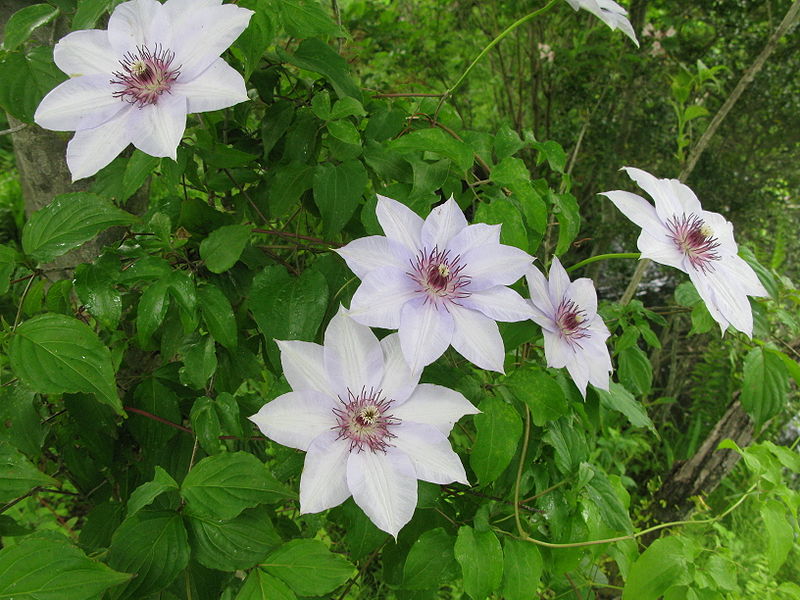
Flowers solitary, terminal or axillary, 10-15 cm in diameter, cream-white, light or lilac-blue, often with a darker longitudinal stripe in the center of the petals. Peduncles thin, long, unbranched, pubescent. Perianth flat, widely open, disk-shaped. Perianth segments about 6-8 in number, up to 8 cm long, elliptic-obovate in shape, acute, tapering to a thin, acuminate apex. Anthers purple-brown. Sepals number 5, 6, or 8, they are obovate to almost elliptic in shape, 3.5-6 × 1.5-3.5 cm, pubescent along the central basal veins and velvety along the lateral ones. Filaments 1.2-2 cm, glabrous. Anthers purple-brown, linear, 6-8 mm long, apices blunt or acuminate. Ovary pubescent. Style about 9 mm long, densely covered with hairs from the base to the middle. Flowering is intermittent, in May-June.
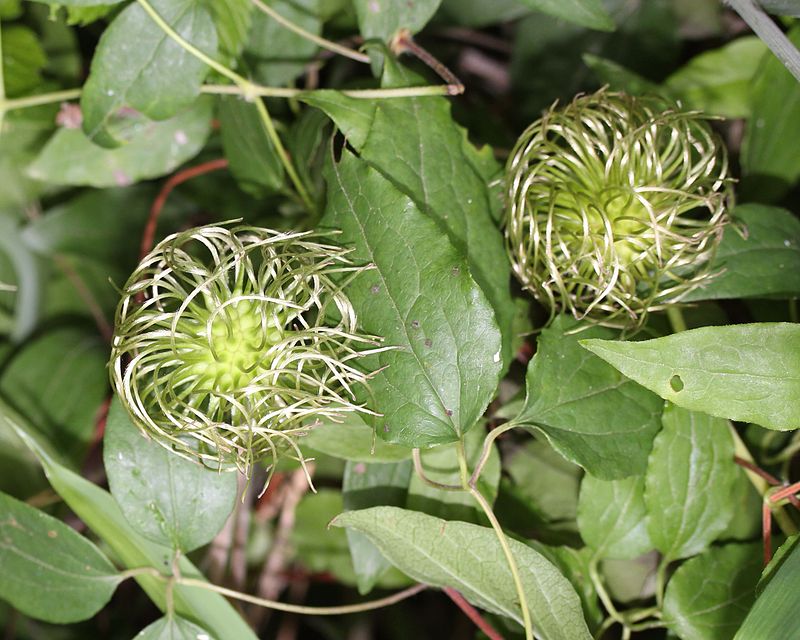
Fruits achenes broadly ovate, 3.5-5 × 3-4.5 mm, appressed-pubescent. Beak 3-3.8 cm long, yellow, feathery. Fruits ripen in June-July.
Forms: Clematis patens subsp. tientaiensis M.Y.Fang
Hybrids: often used in breeding and is the parent of many hybrids. Some of them:
- Clematis patens C.Morren & Decne. × Clematis viticella L. = Clematis × guascoi Lem. & Verschaff.
- Clematis lanuginosa Lindl. & Paxton × Clematis patens C.Morren & Decne. = Clematis × lawsoniana Anderson-Henry ex T.Moore & Jackman
- Clematis florida Thunb. × Clematis patens C.Morren & Decne. = Clematis × standishii (T.Moore) T.Moore
- Clematis lanuginosa Lindl. & Paxton × Clematis patens C.Morren & Decne. × Clematis viticella L. = Clematis × zanonii Noble ex Kuntze
- Clematis × imperialis Carré ex T.Moore & Jackman
- Clematis × insignis T.Moore & Jackman
Cultivars: Cultivars of the Patens group were classified by their origin in the book by M. A. Beskaravaina «Clematis» (1991). Some of them: 'Sophia Plena', 'Sophia', 'Margaret Hunt', 'Abilène' , 'Angélique', 'Asao', 'Bernardine', 'Cézanne', 'Chantilly', 'Xerxes', 'Diamantina', 'John Gould Veitch', 'Manshuu Ki', 'Rebecca', 'Sunset', 'Zomoa', 'Zosumdre'.
Hardiness zone: 5a (-23°C)
Site: prefers fairly moist, humus-rich loose neutral or alkaline soil. Grows well in sunny locations, even in southern regions. Drought-resistant.
Planting: Clematis seedlings are planted in spring. Planting pit dimensions - 60×60×60 cm. Soil mix – topsoil is mixed with 2-3 buckets of compost or humus, 1 bucket of peat, 1 bucket of sand, 100-150 g superphosphate, 200 g complete mineral fertilizer, preferably 100 g bone meal, 150-200 g lime or chalk, 200 g ash. When planting in light soils it is recommended to add more peat. If the soil is wet, clayey or heavy it is necessary to add a 1015 layer of gravel for drainage. In southern regions planting is carried out in late September – early October, in the middle zone – in September, in the north – in spring (late April or early May) or early autumn. In containers they can be planted throughout the growing season. For group plantings the distance between plants should be at least 1 m. For autumn planting the planting material should have developed vegetative buds, for spring planting - at least one shoot. Seedlings should have at least 3 roots shorter than 10 cm in length.
Care: in early spring clematis can be watered with lime milk (200 g lime per 10 l water per sq.m). In dry hot periods water the plant infrequently but deeply, avoiding directing the stream into the center of the bush. Feed clematis at least four times per season after watering with complete mineral fertilizer with microelements at a rate of 20-40 g per 10 l of water or with diluted fermented cow manure (1:10). Alternate mineral and organic feeds. In summer once a month plants are watered with a weak solution of boric acid (1-2 g) and potassium permanganate (2-3 g per 10 l of water), and bushes are also sprayed with urea (0.5 tablespoon per 10 l of water). In spring after feeding and watering it is recommended to mulch the soil with peat or humus (northern regions) and sawdust (southern regions). To protect from overheating, annuals can be planted near clematis. For winter it is recommended to cover with peat or sawdust.
Pruning: blooms in spring on last year's shoots, rarely in mid-summer flowering is observed on current year's shoots. In autumn remove the generative (finished-flowering) part of the shoot and cover for winter.
Propagation: when propagated by seed varietal traits are lost. Propagated by division of the bush in October or in late April – early May. Layering is used in autumn or spring – from last year's shoots, in July – from new shoots. Green cuttings are propagated in June-July. Hardwood cuttings are taken from shoots cut in autumn (cuttings are stored in boxes in the cellar until spring). Grafts onto the roots of 2-3 year old grafted clematises of other species (for example, the purple clematis) propagate well.
Diseases: gray rot, powdery mildew, rust, wilt, ascochyta, septoria.
Pests: nematodes, spider mite, beet aphid, scale insects, bugs, snails and slugs, rodents (field vole, gray rat).
Companion plants: pairs well with Virginia creeper
Uses: used for vertical decoration of trellises, supports, arches, gazebos, posts, walls. Looks impressive in prominent locations by entrances, on supports and trellises on lawns. Can be used to decorate the lower tiers of trees and old vines. Used to decorate squares, open areas of parks or gardens, near residential houses, front gardens, educational or medical institutions. Can be used as a container plant to decorate lobbies, halls, verandas, foyers, exterior window decorations, on balconies or loggias.