
Climbing plants
Woolly clematis
Clematis lanuginosa Lindl. & Paxton
Synonyms: woolly lomonos, Clematis Lanuginosa, lomonos Lanuginosa, Clematis florida Thunberg var. lanuginosa (Lindley) Kuntze., Clematis lanuginosa var. pallida Planch
Woolly clematis (Clematis lanuginosa Lindl. & Paxton) – a species of perennial woody plants of the genus Clematis (Clematis) in the family Ranunculaceae. It was found in 1850 near the port city of Ningbo by the Anglo-Scottish botanist Robert Fortune, was sent by him to England and immediately introduced into cultivation. After the First World War (approximately in 1825) the species was destroyed, but was found at the same place by Yu Liangliang in 2008. It was first described in 18353 in the book «Paxton's Fl. Gard» authored by John Lindley and Joseph Paxton.
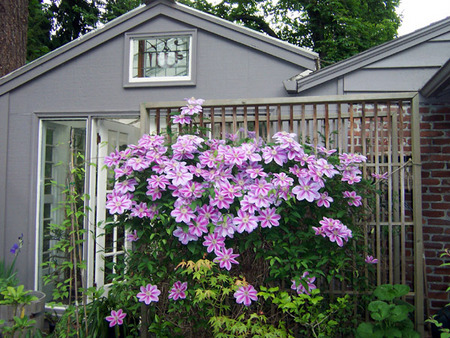
'Nelly Moser'
Endemic to Zhejiang Province (eastern China). It grows in shrub thickets, along streams and in valleys. In the mountains it occurs at elevations of 100-400 m above sea level.
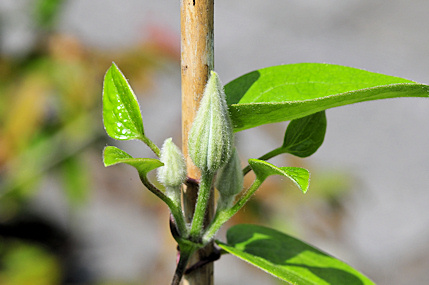
It is a woody climber 2-3 m tall. Stems climbing, thin, branched, 6-angled, glabrous; young shoots pubescent.
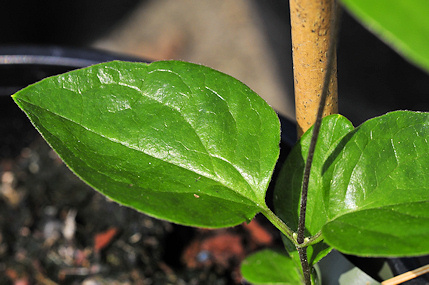
Leaves simple or trifoliate, ovate or ovate-lanceolate in shape, 6-12 cm long. Leaflets acute, with a rounded or slightly cordate base, margins entire, leathery, firm. Upper surface of the blade glabrous, silky-pubescent when unfolding; lower surface softly gray-pubescent. Petiole pubescent, 4-8 cm long.
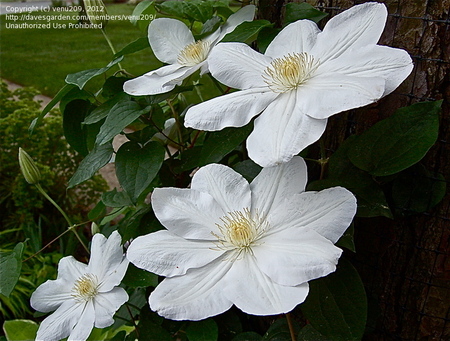
'Candida'
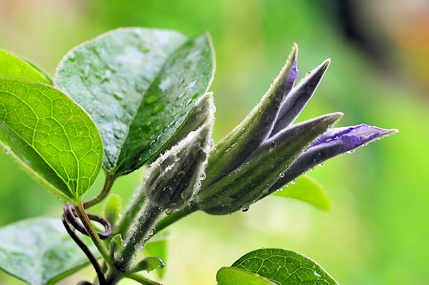
Flowers borne singly, less often up to 3, terminal, 10-20 cm in diameter, white or pale lilac, arranged in semi-umbels on long peduncles 5-10 cm long. Perianth widely open to almost flat. Perianth segments 6-8 in number, ovate or obovate in shape, overlapping like shingles at the edges, pubescent beneath. Stamens 1.3-2 cm long, glabrous. Anthers linear, 6-10 mm long, acute. Ovary pubescent. Blooms from July to September. Flowers on previous year’s shoots. In late summer or autumn repeat flowering of solitary flowers on the current year’s growth can be observed.
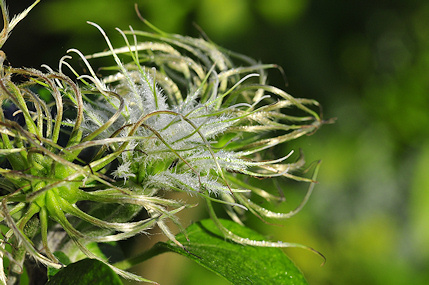
Fruits achenes rhombic in shape, 4-5 (-8) × 4 (-6) mm, with a feathery yellowish beak up to 3 cm long. Fruits in August–September.
Hybrids: frequently used in breeding and is a parent of many large-flowered cultivars. Some of them:
- Clematis lanuginosa Lindl. & Paxton × Clematis viticella L. = Jackman clematis - Clematis × jackmanii T.Moore
- Clematis lanuginosa Lindl. & Paxton × Clematis patens C.Morren & Decne. = Clematis × lawsoniana And.-Henry ex T.Moore & Jackman
- Clematis lanuginosa × Clematis texensis × Clematis viticella = Clematis × pseudococcinea C.K.Schneid.
- Clematis integrifolia L. × Clematis lanuginosa Lindl. & Paxton × Clematis viticella L. = Clematis × rubro-violacea Van Houtte
- Clematis lanuginosa Lindl. & Paxton × Clematis patens C.Morren & Decne. × Clematis viticella L. = Clematis × zanonii Noble ex Kuntze
- Clematis lanuginosa × Clematis patens C.Morren & Decne. = 'Hybrida Sieboldiana'
Cultivars: 'Nelly Moser', 'Candida', 'Mrs. Bush', C. 'Mrs. Hope', C. 'Sieboldia', C. 'Prins Hendrik'
Hardiness zone: 4b (-23°C)
Site: prefers sufficiently moist, humus-rich loose neutral to alkaline soil. Grows well in sunny locations, even in southern regions. Drought-tolerant.
Planting: Clematis seedlings are planted in spring. Planting pit dimensions - 60×60×60 cm. Soil mix: topsoil mixed with 2-3 buckets of compost or humus, 1 bucket of peat, 1 bucket of sand, 100-150 g superphosphate, 200 g complete mineral fertilizer, preferably 100 g bone meal, 150-200 g lime or chalk, 200 g ash. When planting in light soils it is recommended to add more peat. If the soil is wet, clayey or compacted, it is necessary to add a 10–15 cm layer of gravel for drainage. In southern regions planting is carried out in late September – early October, in the middle zone – in September, in the north – in spring (late April or early May) or early autumn. In containers planting can be done throughout the growing season. For group plantings the distance between plants should be at least 1 m. For autumn planting the planting material should have developed vegetative buds; for spring planting at least one shoot. Seedlings should have a minimum of 3 roots less than 10 cm long.
Care: Early in spring clematis can be watered with lime milk (200 g lime per 10 l water per sq.m). In dry hot periods water the plant infrequently but abundantly, avoiding directing the stream into the center of the bush. Feed clematis at least four times per season after watering with a complete mineral fertilizer with microelements at a rate of 20-40 g per 10 l of water or with diluted fermented cow manure (1:10). Alternate mineral and organic feedings. In summer once a month plants are watered with a weak solution of boric acid (1-2 g) and potassium permanganate (2-3 g per 10 l of water), and the bushes are sprayed with urea (0.5 tablespoon per 10 l of water). In spring after feeding and watering it is recommended to mulch the soil with peat or humus (northern regions) and sawdust (southern regions). To protect from overheating, annuals can be planted near the clematis. For winter it is recommended to cover with peat or sawdust.
Pruning: Second pruning group. In autumn cut stems to a height of 1 m. For rejuvenation pruning the plant is cut lower to the first true leaf.
Propagation: varietal traits are lost with seed propagation. Propagated by dividing the bush in October or in late April – early May. Layering is done in autumn or spring from last year’s shoots, in July from new shoots. Softwood cuttings are propagated in June-July. Hardwood cuttings are taken from shoots pruned in autumn (cuttings are stored in boxes in a cellar until spring). Grafts onto the roots of 2-3 year old named clematis of other species (for example purple clematis) also propagate well.
Diseases: gray mold (Botrytis), powdery mildew, rust, wilt, ascochytosis, septoria.
Pests: nematodes, spider mite, beet aphid, scale insects, bugs, snails and slugs, rodents (field mouse, brown rat).
Companions: pairs well with Virginia creeper
Uses: used for vertical decoration of trellises, supports, arches, gazebos, posts, walls. Looks impressive in prominent places at entrances, on supports and trellises on the lawn. Can be used to decorate the lower tiers of trees and old vines. Used for decorating squares, open areas of parks or gardens, near residential buildings, front gardens, educational or medical institutions. Can be used as a container plant to decorate lobbies, halls, verandas, foyers, exterior window decoration, on balconies or loggias.