
Climbing plants
Clematis Jackmanii
Clematis Jackmana L.
Synonyms: Jackman's lomonos, Clematis Jackman, Clematis × jackmanii var. rubroviolacea Regel
Clematis vitalba (Clematis vitalba L.) – a species of perennial woody plants of the genus Clematis (Clematis) in the Ranunculaceae family. This is an interspecific hybrid of the woolly clematis, the red form of the purple clematis and the early garden hybrid Clematis Henderson (Clematis × hendersonii). The hybrid was produced in 1858 at the well-known nursery Jackman & Sons in Woking, Surrey, England. It was first described by George Jackman together with T. Moore in 1872 in the monograph «The Clematis as a Garden Flower», which was dedicated to Princess Mary, Duchess of Teck, as this flower was her favorite. In cultivation since 1862.
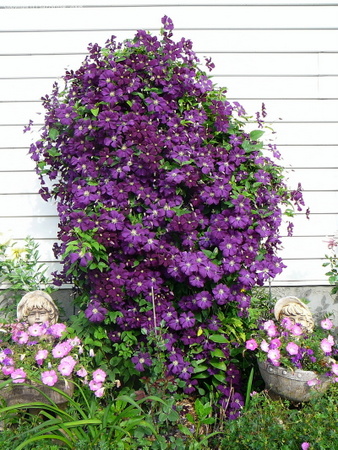
It is a woody, robust shrub-like climber up to 3 (4.5) m tall. It forms stems in a single growing season. It climbs supports by means of twisted leaf petioles. Stems are brownish-gray, ribbed, pubescent.
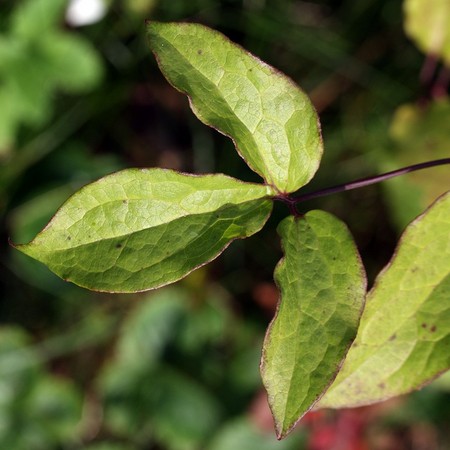
Leaves are compound, imparipinnate, consisting of 3-5 leaflets, often simple on the upper part of the stem. Leaflets 5-12 cm long, ovate or broadly ovate, acute, cordate at the base, glabrous above, dark green and densely so, lighter and slightly pubescent beneath, pale green. Petioles up to 3 cm long.
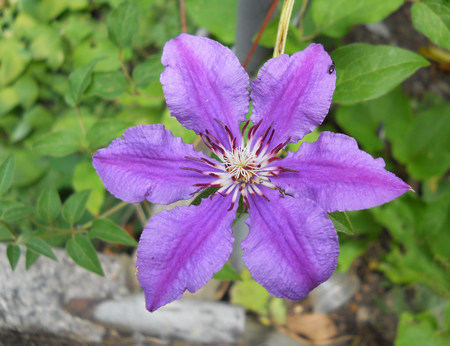
Flowers appear from the first to the seventh axillary nodes on the shoots of the current year. Gathered in threes in axillary semi-umbels, 10-12 cm in diameter, velvety, purple-violet or pink, widely open. Perianth discoid or cross-shaped. Perianth segments 4-6 in number, up to 6 cm long, broadly obovate in shape, pubescent on the outside. There are 4 sepals, they are broadly obovate. Staminal filaments are short or of unequal length, rarely slightly pubescent at the base. Flowers from May to September, abundant and prolonged. Flowers are scentless.
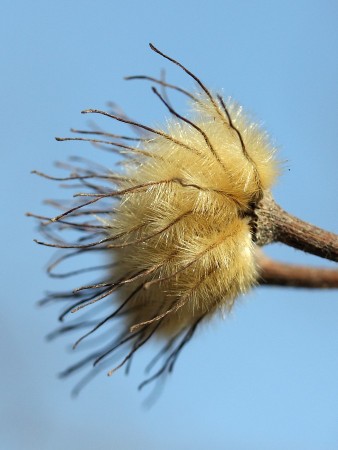
Fruits - achenes with one seed per achene. Seeds with a feathery tail 2-5 cm long with silky hairs. Seeds practically do not set without artificial pollination.
Cultivars: Andre Leroy, Comtesse de Bouchaud, Gypsy Queen, Madame Baron, Weiland, President, Alenushka, Anastasia Anisimova, Cosmic Melody, Moonlight, Luther Burbank, Fantasia, Jackmani Rubra, Star of India. These are cultivars for which Clematis Jackmanii is the parent plant.
In modern classification, the Jackmanii group also includes the subgroup Large-Flowered Late, which includes cultivars of other origin. This was done because many inter-varietal hybrids appeared that are difficult to assign to a specific group. A common feature of these cultivars is flowering on shoots of the current season from June or July, and the need for severe pruning. The most popular among them are Ville de Lyon, Barbara Harrington and Rouge Cardinal.
There is also a subgroup Large-Flowered Early, which unites cultivars that flower abundantly in May-July on last year's shoots. Widespread: Anna German, Barbara Jackman, Josephine, H.F. Young, Multi Blue, Nelly Moser, Piilu, The President. New introductions: Ice Blue, Grefve Erik Ruuth, Julka, Kingfisher, Rosemoor.
Hardiness zone: 4a (-29°C)
Location: prefers sufficiently moist, humus-rich loose neutral or alkaline soil. Grows well in sunny locations, even in southern regions. Drought-tolerant.
Planting: Clematis seedlings are planted in spring. Planting hole dimensions – 60x60x60 cm. Soil mixture – topsoil mixed with 2-3 buckets of compost or humus, 1 bucket of peat, 1 bucket of sand, 100-150 g of superphosphate, 200 g of complete mineral fertilizer, preferably 100 g of bone meal, 150-200 g of lime or chalk, 200 g of ash. When planting in light soils it is recommended to add more peat. If the soil is wet, clayey or compact, it is necessary to add a 1015 layer of crushed stone for drainage. In southern regions planting is carried out in late September – early October, in the midlands – in September, in northern regions – in spring (late April or early May) or early autumn. In containers, planting can be done throughout the growing season. For group plantings the distance between plants should be at least 1 m. With autumn planting the planting material should have developed vegetative buds, with spring planting at least one shoot. Seedlings should have a minimum of 3 roots longer than 10 cm.
Care: In early spring clematis can be watered with lime milk (200 g of lime per 10 l of water per sq.m). In dry hot periods the plant should be watered not often but abundantly, avoiding directing the stream into the center of the bush. Clematis are fed at least four times per season after watering with a complete mineral fertilizer with microelements at a rate of 20-40 g per 10 l of water or with diluted fermented cow manure (1:10). Alternate mineral and organic feedings. In summer, once a month, plants are watered with a weak solution of boric acid (1-2 g) and potassium permanganate (2-3 g per 10 l of water), and bushes are also sprayed with urea (0.5 tablespoon per 10 l of water). In spring after feeding and watering, it is recommended to mulch the soil with peat or humus (northern regions) and sawdust (southern regions). To protect from overheating, annuals can be planted near the clematis.
Pruning: Clematis Jackmanii flowers on current-season shoots. The first pruning should be done in early summer: weak shoots are cut out to enhance flowering on the main shoots. After that, in late June, 1\3 or 1\4 of the shoots are cut back above the 3rd-4th node to extend the flowering period. After such pruning, second-order shoots grow from the upper buds of the upper nodes, from which new flowers appear in 45-60 days. After the first frosts all shoots are cut back to a height of 0.2-0.3 m above ground level. Without such pruning the vines are highly susceptible to disease and flower less well.
Propagation: varietal traits are lost with seed propagation. Propagated by division of the bush in October or in late April – early May. Layering is done in autumn or spring from last year's shoots, in July from new shoots. Softwood cuttings are taken in June-July. Hardwood cuttings are taken from shoots pruned in autumn (cuttings are stored in boxes in a cellar until spring). Grafting onto the roots of 2-3 year old cultivar clematis of other species is successful (for example onto the roots of the purple clematis.
Diseases: gray rot, powdery mildew, rust, wilt, ascochytosis, septoria.
Pests: nematodes, spider mite, beet aphid, scale insects, bugs, slugs and snails, rodents (field vole, brown rat).
Companion plants: pairs well with Virginia creeper
Uses: used for vertical decoration of trellises, supports, arches, gazebos, posts, walls. Looks impressive in prominent places at entrances, on supports and trellises on lawns. Can be used to decorate the lower tiers of trees and old vines. Used for decorating squares, open areas of parks or gardens, near residential buildings, front gardens, educational or medical institutions. Can be used as a container plant to decorate lobbies, halls, verandas, foyers, exterior window treatments, on balconies or loggias.