
Climbing plants
Clematis florida
Clematis florida
Synonyms: flowering clematis, flowering lomonos, lomonos florida, Anemone japonica Houtt., Atragene florida Pers., Atragene indica Desf., Atragene polypetala Thunb., Clematis anemonoides Kuntze, Clematis bicolor Steud., Clematis hakonensis Franch. & Sav., Clematis japonica (Houtt.) Makino, Clematis polypetala DC., Clematis sieboldii D.Don ex Steud., Eriocapitella japonica (Thunb.) Nakai, Sieboldia florida Hoffmanns. ex Heynh., Viticella florida Bercht. & J.Presl.
Clematis florida (Clematis florida Thunb.) – a species of perennial woody plants of the genus Clematis (Clematis) in the family Ranunculaceae. It was first found by the Swedish scientist and naturalist Carl Peter Thunberg in Japan, where this species had long been cultivated in gardens. Introduced into cultivation in 1776. A wild form was found by the English botanist A. Henry near Yichang (Hubei), and later by Wilson in approximately the same area. The species was described in the book «Systema Vegetabilium: secundum classes ordines genera species cum characteribus et differentiis. Editio decima quarta. Gottingae» («Syst. Veg.», ed. 14) in 1784 by the Swedish botanist J.A. Murray.
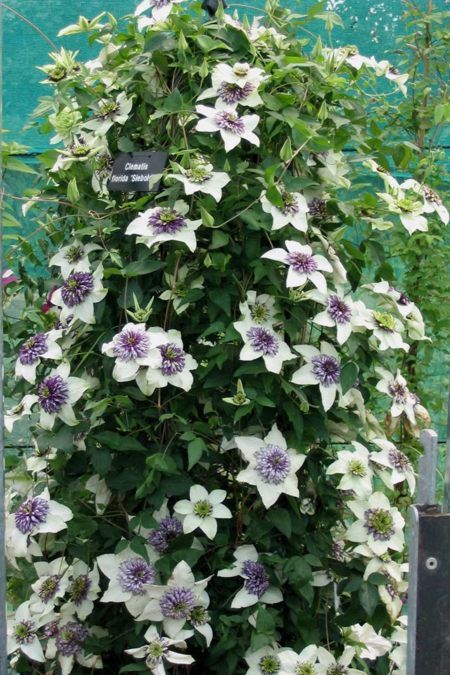
Clematis florida Thunb. var. sieboldii D.Don
In the wild it occurs in China in the provinces Guangdong, Guangxi, Hubei, Hunan, Jiangxi, Yunnan, Zhejiang, where it is found in shrub thickets and along streams. It rises to mountains up to 1700 m above sea level.
It is a deciduous or semi-evergreen shrubby climber. On a support it can climb to a height of up to 4 m. Stems thin, climbing, rigid yet flexible, shallowly 4–6-ribbed, becoming glabrescent.
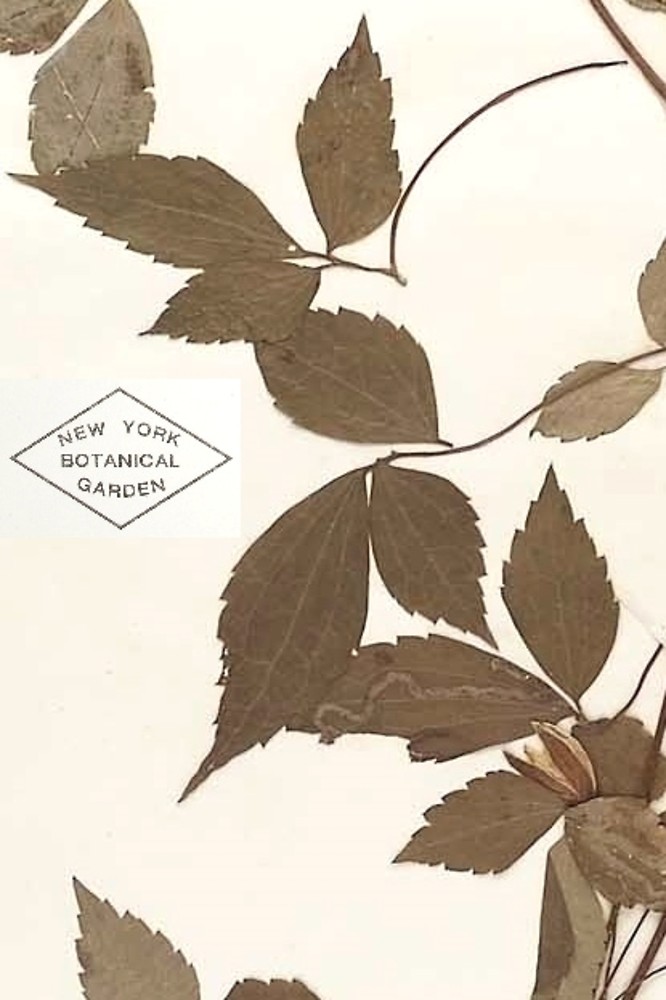
Leaves ternate or twice-ternate, up to 12.5 cm long. Petiole 2–4 cm long. Leaflets up to 1–5 cm long and 0.4–2 cm wide, ovate or lanceolate, with an attenuate acuminate apex, margins entire, sparsely coarsely serrate or lobed, base rounded or broadly cuneate. Upper surface of the blade glabrous, bright green; underside sparsely pubescent.
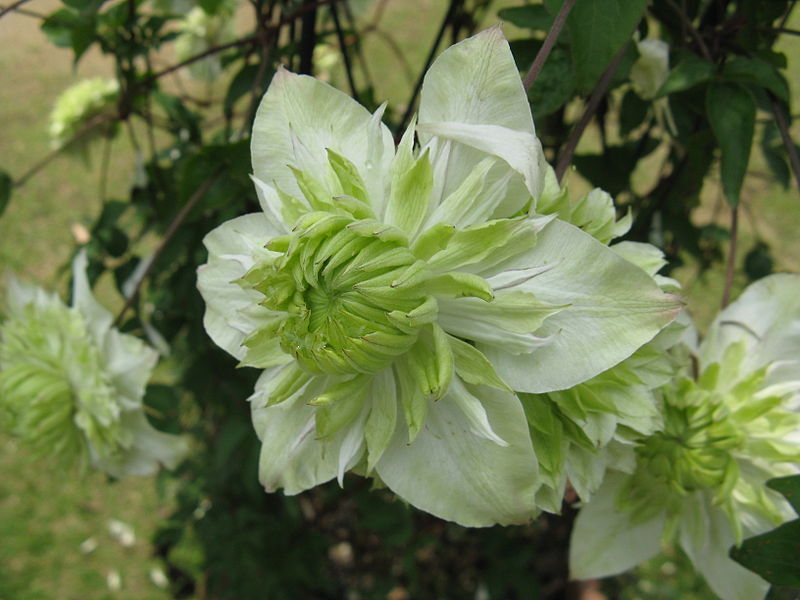
Clematis florida 'Alba Plena'
Flowers solitary, 5.5–7.5 cm in diameter, widely open, white or creamy-white, externally with a pale green stripe. Pedicels 3.7–8.5 cm long, pubescent, with 2 sessile or almost sessile bracts about mid-length, broadly ovate or ovate-triangular, 1.4–3 cm long. Perianth segments 6 in number, obovate or rhombic-obovate, 2–3 cm long and 1–1.5 cm wide, acute. Stamens, if fertile, 4–8 mm long, glabrous; anthers elongated, almost linear, 2.5–3.5 mm long, apices obtuse. Stamens (if staminodes) 1–1.2 mm long, glabrous. Anthers purple, filaments white. Ovary slightly pubescent. Flowering in flushes, April–June, on last year’s shoots. Sometimes repeat flowering occurs on current year shoots from June to October.
Achenes obovate or broadly rhombic-rounded, 3.5 mm long and up to 3 mm wide. Styles long, pubescent, up to 8 mm long.
Hybrids: often used in breeding to obtain large-flowered cultivars.
Clematis florida Thunb. × Clematis patens C.Morren & Decne. = Clematis × standishii (T.Moore) T.Moore
Forms:
- Clematis florida var. flore-plena G.Don
- Clematis florida var. hakonensis (Franch. & Sav.) Huth
- Clematis florida var. plena D.Don
- Clematis florida Thunb. var. sieboldii D.Don
- Clematis florida Thunb. var. standishii T.Moore
- Clematis japonica Thunb. var. simsii Makino
Cultivars: 'Alba Plena','Best Wishes', 'Cassis', 'Geoffrey Tolver', 'Peppermint', 'Pistachio', 'Utopia', 'Viennetta'. There are bicolor and double-flowered cultivars.
Hardiness zone: 4b (-23°C)
Location: prefers fairly moist, humus-rich loose light sandy or loamy soil. Grows well in sunny positions, even in southern regions. Drought-tolerant. Requires sheltered-from-wind sites. Soil pH 6.0–7.5.
Planting: Clematis seedlings are planted in spring. Planting hole size: 60×60×60 cm. Soil mix – mix topsoil with 2–3 buckets of compost or well-rotted manure, 1 bucket of peat, 1 bucket of sand, 100–150 g superphosphate, 200 g of complete mineral fertilizer, preferably 100 g bone meal, 150–200 g lime or chalk, 200 g ash. When planting in light soils it is recommended to add more peat. If the soil is wet, clayey or dense, it is necessary to add a 10–15 cm layer of crushed stone for drainage. In southern regions planting is carried out in late September – early October, in the temperate zone in September, in northern regions in spring (late April or early May) or early autumn. In containers planting can be done throughout the growing season. For group plantings the distance between plants should be at least 1 m. For autumn planting the planting material should have developed vegetative buds; for spring planting at least one shoot. Seedlings must have a minimum of 3 roots less than 10 cm long.
Care: Early in spring clematis can be watered with lime milk (200 g of lime per 10 L of water per m²). In dry hot periods water the plant infrequently but thoroughly, avoiding directing the stream into the center of the bush. Feed clematis at least four times per season after watering with a complete mineral fertilizer with trace elements at a rate of 20–40 g per 10 L of water, or with diluted fermented cow manure (1:10). Alternate mineral and organic dressings. In summer once a month water plants with a weak solution of boric acid (1–2 g) and potassium permanganate (2–3 g per 10 L of water), and also spray the bushes with urea (0.5 tbsp per 10 L of water). In spring after feeding and watering it is recommended to mulch the soil with peat or humus (northern regions) and sawdust (southern regions). To protect from overheating annuals can be planted near clematis. Winters under shelter. Before the first frosts lay the clematis stems on conifer boughs and cover from above with conifer boughs or non-woven material.
Pruning: Shoots are cut in half, since it flowers first on last year’s shoots and secondarily on current year shoots. With hard pruning flowering is weak and occurs only in the second half of summer on current year shoots.
Propagation: propagated by division of the bush, cuttings and layering. Division of the bush is carried out in October or late April – early May. Layering is prepared in autumn or spring – last year's, or in July – on current year shoots. Green cuttings are prepared in July. Hardwood cuttings are taken from shoots pruned in autumn (boxes with cuttings are stored in the cellar until spring). Can be propagated by grafting onto other Clematis species, for example onto purple clematis.
Diseases: gray rot, powdery mildew, rust, wilt, ascochyta, septoria.
Pests: nematodes, spider mite, beet aphid, scale insects, bugs, snails and slugs, rodents (field vole, brown rat).
Companions: pairs well with Virginia creeper
Uses: used for vertical decoration of trellises, supports, arches, gazebos, posts, walls. It looks impressive in prominent locations at entrances, on supports and trellises on lawns. Can be used to decorate lower tiers of trees and old vines. Used for decorating squares, open areas of parks or gardens, near residential houses, front gardens, educational or medical institutions. Can be used as a container plant to adorn lobbies, halls, verandas, foyers, exterior window treatments, balconies or loggias.