
Conifers
False cypress
Chamaecyparis
False cypress (lat. Chamaecyparis) — a genus of evergreen monoecious coniferous trees of the family Cupressaceae (Cupressaceae). The genus is represented by 7 species occurring naturally in North America and East Asia.
Evergreen, monoecious coniferous plants. The crown is most often conical with drooping or spreading branches. The trunk is covered with scaly brownish-brown bark. In natural conditions may reach up to 70 m in height. Young shoots are strongly flattened; in mature plants the leaves are scale-like, pointed, and appressed.
Mature cones are no more than 12 mm in diameter, woody, their scales shield-like and closely appressed to each other, moving apart at maturity (similar to the cones of the genus Cupressus — cypress). Seeds of almost all species mature in the first year.
In cultivation:
Lawson cypress - Chamaecyparis lawsoniana
A coniferous tree up to 60—70 m tall, with a narrowly conical crown that broadens downward and a narrow apex, usually inclined to one side. When grown in the open, branches may droop to the ground. The bark is thick, reddish-brown, cracking into rounded plates. Foliage glossy green above, with indistinct white stomatal bands on the underside at the base of the leaves. Flat leaves blunt, without a keel on the back, usually with a gland. Lateral leaves strongly compressed and nearly twice as long. Cones ovoid to globose, 8—10 mm in diameter, light brown, often with a slight bluish bloom.
One of the most beautiful representatives of conifers, but used limitedly due to insufficient frost hardiness. In regions with milder climates it is a very valuable ornamental tree for alleys, groups, and solitary plantings. Produces a very large number of cultivars.
Shade-tolerant, wind-resistant, moisture-loving, not demanding to soil, tolerates urban conditions satisfactorily. Little affected by pests and diseases. Prefers evenly moist soil, dislikes drying out. Root system shallow, in the upper soil horizon. Plant in spring in a sunny spot or partial shade, do not deepen the root collar.
Sawara cypress — Chamaecyparis pisifera
A coniferous tree up to 30 m high with a conical crown and horizontally spreading branches. Bark reddish-brown, peeling into thin strips. Foliage dark green above, with white stomatal bands on the underside. Flat leaves ovate, sabre-shaped, slightly keeled on the back, with an indistinct gland. Lateral leaves equal in length to the flat leaves, strongly flattened from the sides. Cones on short peduncles, small, globose, 4—8 mm in diameter, brown, made of 7—12 centrally depressed, wrinkled scales.
Has many cultivars that grow successfully in a temperate climate. The variety of forms and high frost hardiness of some cultivars allow wide use of this attractive species in landscape architecture in moderately cold, humid regions, while more drought-tolerant juvenile forms are suitable for dry regions. Due to the abundance of ornamental forms its uses are diverse.
Light-loving. In the first years of life grows slowly, accelerating with age. In cultivation requires fertile soils and periodic watering. Poorly tolerates dry air, responds well to sprinkling. Does not tolerate smoke and calcareous soils. Prone to snow breakage, especially with wet snow accumulation.
Nootka cypress — Chamaecyparis nootkatensis
A slow-growing coniferous tree reaching 30—40 m in height. Crown dense, graceful, conical. Tips of twigs droop, forming a fan. Bark brownish-gray, peeling off in large plates. Foliage dark green, without white stomatal bands on the underside and without resin glands, with an unpleasant smell when crushed. Flat leaves from narrowly rhombic to lanceolate, keeled on the back, suddenly pointed at the tip. Lateral leaves almost twice as large.
Cones globose, 10—12 mm in diameter, purplish-brown, maturing, unlike other species, in the second year. Consist of 4(-6) hooked or convex scales. Two seeds per scale. Unlike other species, the seeds of this species lack resin glands. Lives up to 500—600 years.
Light-loving, drought-tolerant, winter-hardy, but may suffer in severe winters. Introduced to Western Europe in 1850. Ornamental in small lawn plantings and various park and garden compositions.
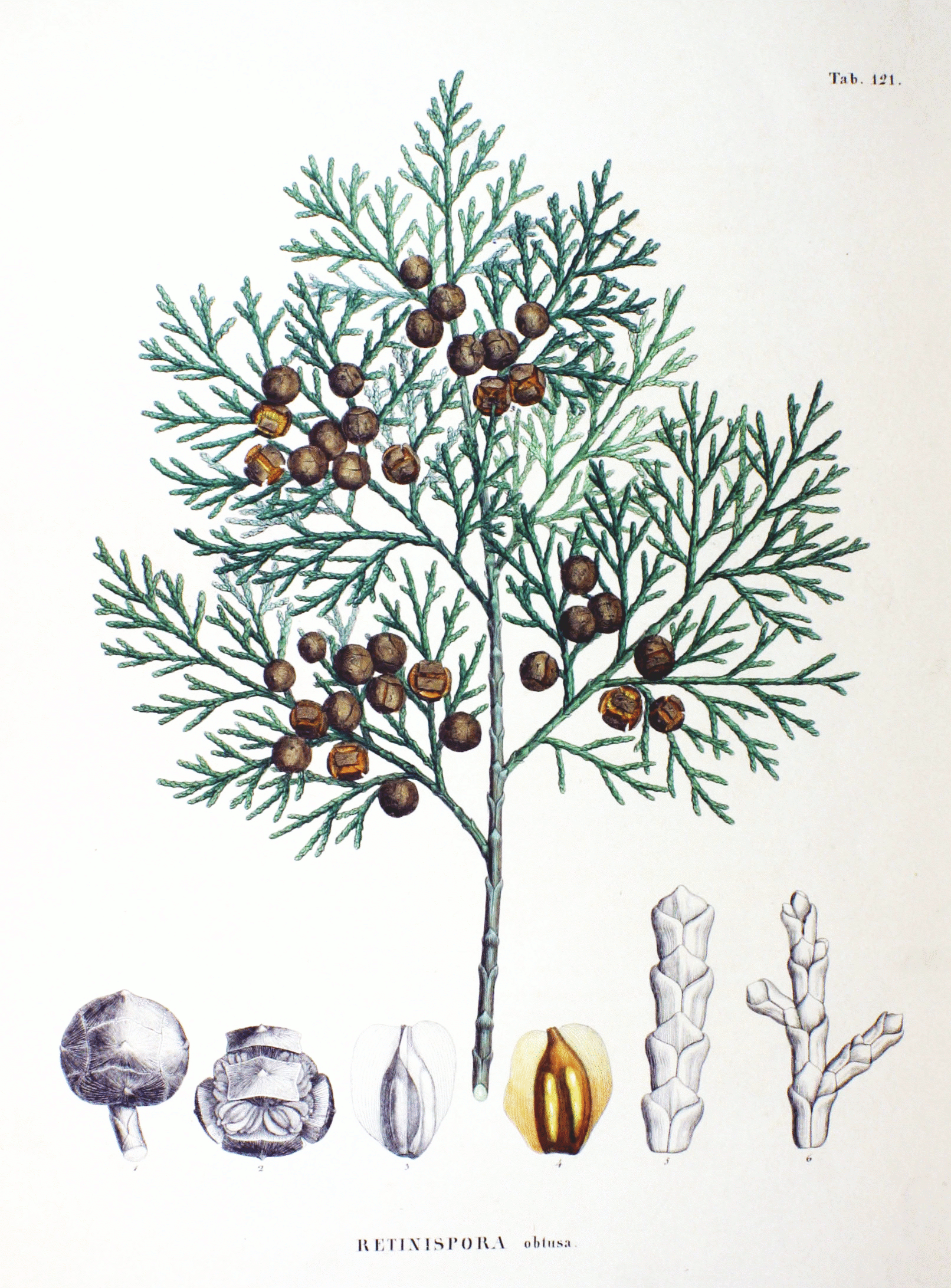
Hinoki cypress — Chamaecyparis obtusa
A coniferous tree up to 30 m high, with a dense conical crown. Bark reddish-brown, fairly smooth; twigs repeatedly and densely branched, compressed, with tips slightly drooping. Shoots short, rather thick. Foliage glossy, green or yellowish-green above, with distinct white stomatal bands on the underside. Scale-like leaves appressed to the shoots. Flat leaves blunt, keeled on the back, with a clearly visible gland. Lateral leaves only slightly longer than the flat leaves, not compressed, the outer edge also nearly straight. Cones on short twigs, globose, 8—10 mm in diameter, composed of 8—10 wrinkled scales. Each scale bears 2-3 seeds with a narrow wing.
Prefers fertile soils. Light-loving. Winter-hardy. In cultivation since 1861. Reaches best development in regions with cool, moist summers and mild winters, on rich soils and with good illumination. Of interest for dendrological collections; when planted in the most sheltered locations and protected in winter, especially in the first years.
Placement: best planted in partial shade, while forms with yellow foliage should be planted only in full sun. Do not plant in low-lying areas where cold air accumulates.
Soil: prefer moist soils, avoid calcareous soils, do not tolerate heavy clay. Drainage of broken brick and sand up to 20 cm thick. When planting in a hole add a complete mineral fertilizer, 5 - b kg of peat-compost and mix it with the soil
Care: in spring spread "Kemira" near the trunk circles at a rate of 100 - 150 g/m2, incorporate it into the soil, and water. Plants are sensitive to lack of moisture in the soil and air. Regular spraying once a week is recommended. Watering: 8 - 10 L of water per plant; in dry periods the amount and frequency should be doubled. In spring removal of dead branches is mandatory. Crown shaping if necessary. Easily amenable to shaping. Pruning is usually carried out in early spring.
Propagation: by seeds, cuttings, and layering.
Zone: 5-10