
Deciduous trees
Japanese katsura
Cercidiphyllum japonicum Sieb.et Zucc.
Synonyms: kruglolistnik, Katsura, cercidiphyllum
Japanese katsura (Cercidiphyllum japonicum Sieb.et Zucc.) – a species of deciduous dioecious plants of the genus Багрянник (Cercidiphillum) of the family Багрянниковые (Cercidiphyllaceae). It was first described in 1846 in Abh. Math.-Phys. Cl. Königl. Bayer. Akad. Wiss. 4(3): 238. by F.F. Zabol'dom and J.G. Tsukkarini. In cultivation since 1864.
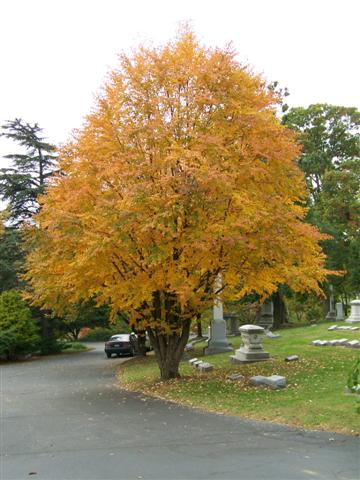
In nature it occurs in deciduous and mixed forests of Japan. It rises into the mountains to an altitude of 600-2700 m above sea level.
It is a deciduous dioecious plant, often multi-stemmed, growing in a bushy form. It reaches 10-30 m in height and 4-8 m in diameter, with a massive broad-pyramidal crown and a slender, graceful top. Branches are arranged very evenly, steeply ascending, horizontal or slightly drooping. Bark is gray-brown, fissured. Shoots glossy, red-brown or red, thin.
Leaves on long growth shoots are opposite, near the tip – alternate, 5-12 cm long and 3-7.5 cm wide, broadly ovate to elliptic, with a slightly cordate base, entire or occasionally slightly toothed, with pinnate venation. On short shoots leaves are always alternate, broadly ovate to reniform, with a deeply cordate base, with a finely crenate or obtusely toothed margin, with palmate venation, very shortly acuminate or obtuse, glabrous, at budburst purple-pink, glossy, in summer dark, bluish-green or deep green above, bluish-green or whitish below with reddish veins, turning bright yellow or apricot-yellow or crimson and scarlet in autumn. Before leaf fall the leaves acquire a characteristic aroma, similar to the smell of candies or honey gingerbreads, which disappears after the leaves dry. Petioles thin, 3-6 cm long.
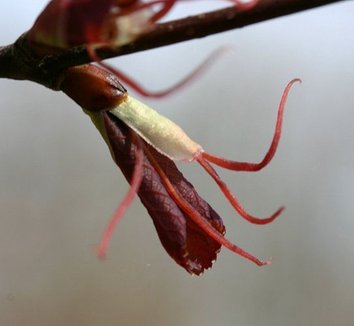
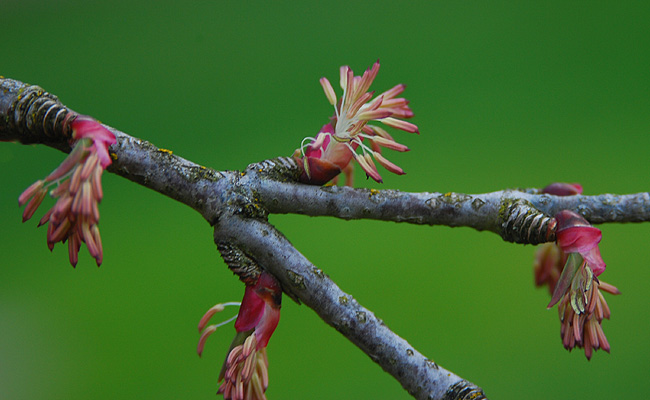
Flowers small, inconspicuous, unisexual, arranged several together in reduced, compact racemes in the axils of buds on short twigs. Male flowers lack a perianth, consisting of a cluster of stamens. There are 8-13 stamens with long thin pendulous filaments and reddish long anthers. Female flowers consist of a single pistil, tapering above into a long purplish-red style with a rounded stigma. Flowers before or at the beginning of leaf emergence, in April-May.
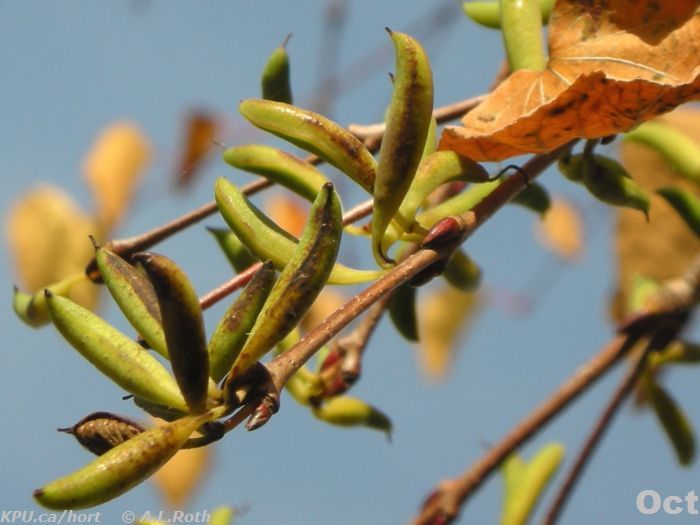
Fruits are aggregate, consisting of several pod-like, many-seeded, claw-curved, glossy, dehiscent single-seeded follicles. Seeds small, winged.
Varieties:
- var.sinense – Chinese katsura
- var.magnificum – magnificent Japanese katsura
- Cercidiphyllum magnificum f. pendulum
Hardiness zone: 4a-7b (-29°C).

Exposure: light-loving, but can grow in partial shade. Moisture-loving, relatively drought-tolerant
Soil: not demanding in fertility, grow on ordinary garden soils, but are most decorative on well-drained, fertile, slightly acidic loamy soil.
Soil mix: leaf soil, peat-compost and sand in ratio 2:1:1.
Planting: Do not tolerate deep planting of the root collar, which should be taken into account when planting, especially with large specimens.
Care: in hot and dry summers, watering is recommended to maintain decorativeness. Winter hardiness is fairly high, but it is recommended to cover the trunk circles with peat, peat-compost or wood chips for the winter, as well as a layer of fallen leaves.
Pruning: tolerates pruning well
Propagation: readily propagated by green cuttings and by seed. About 60% of summer cuttings root. Ground germination does not exceed 10 - 20%. Spring sowing is preferred with seeds sown to a depth of 0.5 - 1.0 cm, lightly pressed and mulched with sawdust or peat with sand. In spring and summer regular feeding with mineral fertilizers is useful in the following doses: 10 g nitrogen, 15 g phosphorus and 20 g potassium per 1 sq. m of plantings, or apply a complex fertilizer "Kemira-Universal". Overall plants develop fairly quickly, and with good cultivation their height by the end of the first growing season can reach 40 cm. In mid-September seedlings of the first year should be spaced 15–20 cm apart.
Diseases and pests: practically not affected.
Uses: ornamental for its original crown, ornamental leaves, brightly colored both at budburst and in autumn before falling. Used for solitary and group plantings in gardens and parks.