
Encyclopedia - Plants for ponds
Hornwort
Ceratophyllum
Hornwort (lat. Ceratophýllum) — a genus of perennial herbaceous aquatic plants with thin branches, the sole genus in the family Ceratophyllaceae.
Hornworts are distributed throughout the globe — from the Arctic Circle to the tropics.
The depth at which hornwort grows varies. This is because the plant is shade-loving and sensitive to light (experiments have shown that under bright illumination the plant dies), and therefore «chooses» the depth that is optimal for it in a given body of water. Maximum recorded depth — 9 m. Under favorable conditions hornwort can expand strongly, forming underwater thickets and displacing other plants.
The root is absent in the plant. To anchor in bottom sediments the plants develop special stem branches — the so-called rhizoid branches. They are whitish, with very finely dissected leaves; by penetrating into the silt they perform both anchoring and absorbing functions.
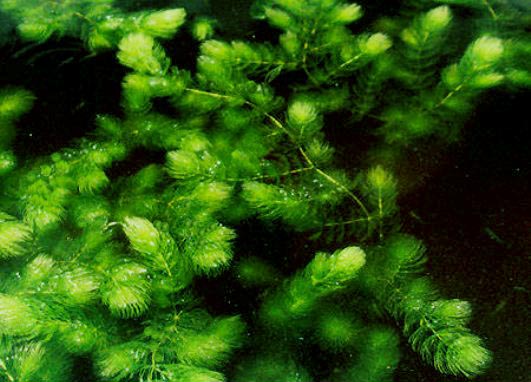
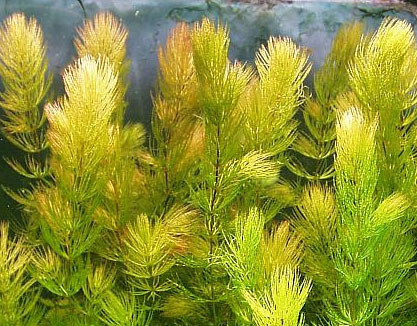
Stem is well developed, rising from the water. A characteristic feature of hornwort stems is the very weak development of the conducting system; absorption of mineral substances is carried out over the entire surface of the plant. The stem growth points by autumn are covered by closely appressed and darker leaves — and can be regarded as analogues of winter buds.
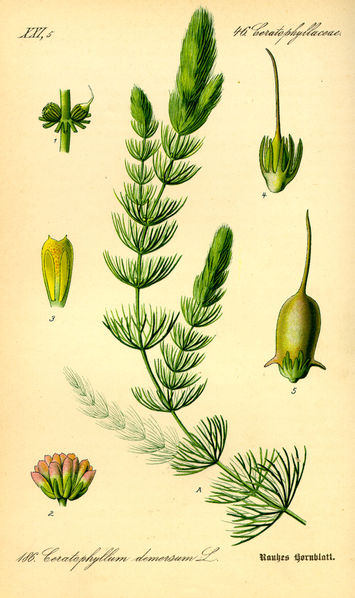
Leaves are sessile, repeatedly dichotomously divided two, three or more times, arranged in whorls. The terminal lobes of the leaves are often finely toothed, have a rigid texture, contain lime, and break on contact. Both the leaves and other parts of hornworts are covered with hairs.
Flowers are small (about 2 mm long), sessile, unisexual, without petals; gathered into reduced inflorescences. Hornworts are monoecious. Pollination occurs under water, which is a rare phenomenon for flowering plants.
Fruit — a nutlet. The fruits bear spine-like appendages. Seed — with a large embryo; without endosperm and perisperm; all reserve nutrients are located in the thick cotyledons.
Habitat: grows both in sun and in shade, does not like bright sunlight. It tends to "move" into deeper water or into the shade of trees growing on the shore. Hornworts inhabit bodies of standing or slow-flowing water.
Planting: planting consists of simply throwing cuttings into the water.
Care: hornwort requires almost no care. If the plants have overgrown excessively, it is sufficient to remove part of them from the pond using a net or a fan rake.
Propagation: by cuttings or by dividing a clump of shoots in summer.
Source: www.wikipedia.org