
Fruit trees
Sour cherry
Cerasus vulgaris
Sour cherry (Cerasus vulgaris, synonyms - Prunus cerasus, Prunus vulgaris) is a species of the genus Plum, subgenus Cherry, which belongs to the family Rosaceae.
Sour cherry is a tree or shrub, reaching up to 10 m in height.
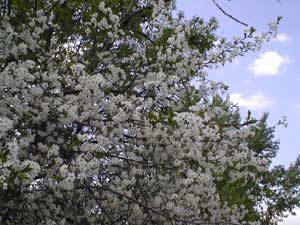
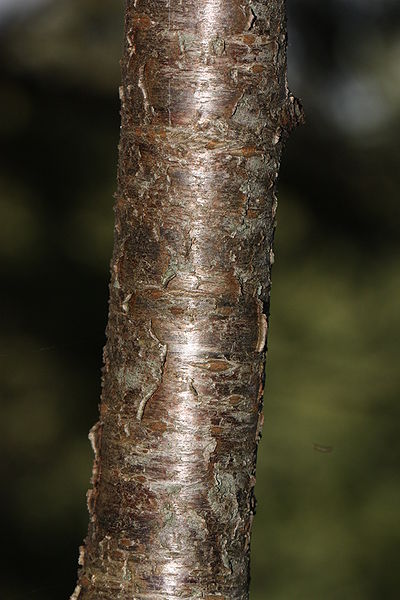
Leaves are petiolate, broadly elliptic, pointed, dark green above, lighter below, reaching up to 8 cm in length. Bark brown, smooth, glossy, decorative.
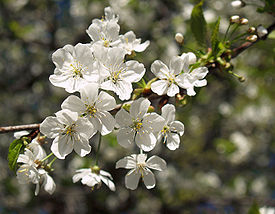
Flowers are white, gathered in umbels of 2—3 flowers. Five sepals and five petals, 15—20 stamens, one pistil.
Blooms in late March — early April, fruits from the second half of May.
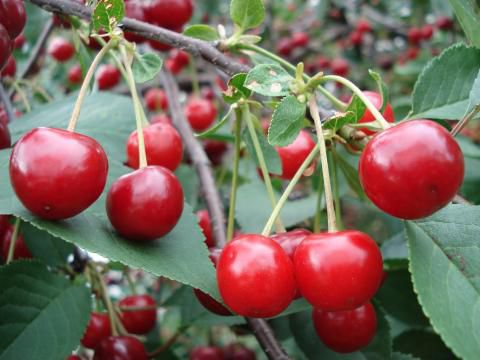
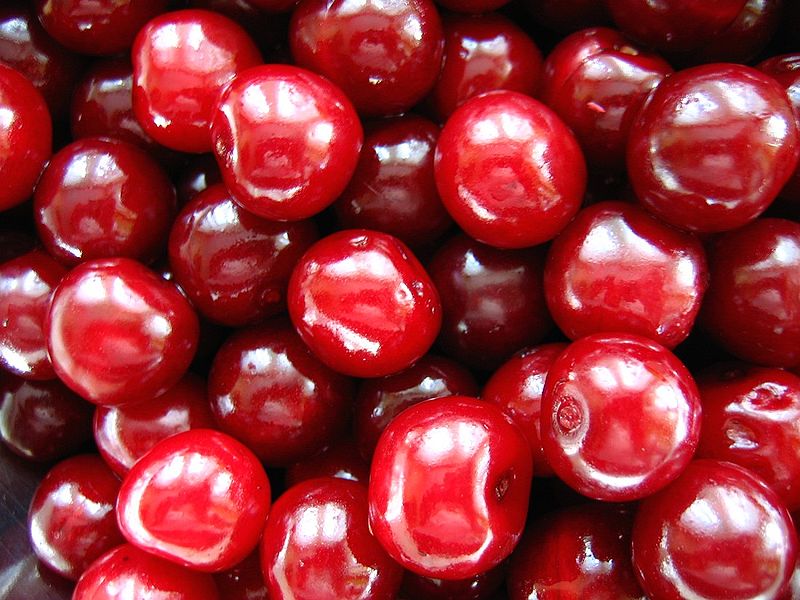
The fruit is an edible sour-sweet, spherical drupe, up to 1 cm in diameter.
Frost hardiness is high: critical temperature -45-50°C; flowers are killed at -2°C, fruit set is lost at -1°C.
Size and growth habit. Tall-growing cultivars (5-6 m) - Anadolskaya, Podbelskaya, Turgenevka. Medium-growing cultivars (3-4 m) - Amorel, Bolotovskaya, Vladimirskaya, Volochaevka, Zhukovskaya. Dwarf cultivars (up to 2.5 m) - Apukhtinskaya, Bagryanaya, Lyubskaya, Malinovka, Molodezhnaya, Polevka.
Self-fertile cultivars (pollinated by their own pollen) - Amorel, Apukhtinskaya, Bulatnikovskaya, Brunetka, Bolotovskaya, Volochaevka, Lyubskaya, Molodezhnaya, Oblachinskaya, Pamyat Yenikeeva, Plodorodnaya Lavrushina, Rastorguevskaya, Rusinka. Partially self-fertile cultivars - Bagryanaya, Saniya, Shchedraya. Self-sterile cultivars: Vladimirskaya, Griot Moskovsky, Zhukovskaya, Malinovka, Polevka, Shubinka.
Ripening periods. Early - Amorel, Bagryanaya, Pamyat Yenikeeva (end of June - beginning of July). Mid-season - Apukhtinskaya, Bulatnikovskaya, Brunetka, Vladimirskaya, Volochaevka, Griot Moskovsky, Rastorguevskaya, Saniya (second half of July). Late - Bolotovskaya, Zhukovskaya, Lyubskaya, Malinovka, Molodezhnaya, Oblachinskaya, Polevka, Plodorodnaya Lavrushina, Rusinka, Shchedraya, Shubinka (end of July - beginning of August).
Earliness. High: begin fruiting in 3-4 years - Amorel, Apukhtinskaya, Bulatnikovskaya, Griot Moskovsky, Lyubskaya, Oblachinskaya, Saniya, Shchedraya.
Average - begin fruiting in 4-5 years: Bagryanaya, Brunetka, Vladimirskaya, Volochaevka, Zhukovskaya, Malinovka, Molodezhnaya, Plodorodnaya Lavrushina, Rastorguevskaya, Rusinka, Shubinka.
Fruit size: Large-fruited cultivars: Apukhtinskaya, Bagryanaya, Zhukovskaya, Lyubskaya, Malinovka, Polevka (fruits weighing 3.0-4.5 g). Cultivars with medium-sized fruits - Vladimirskaya, Volochaevka (fruits weighing 2.5-2.9 g). Small-fruited cultivars: Amorel, Bolotovskaya, Plodorodnaya Lavrushina, Shchedraya, Shubinka (fruits weighing up to 2.4 g).
Taste qualities of the fruits: sour - Apukhtinskaya, Lyubskaya, Shubinka. Sour-sweet - Amorel, Bagryanaya, Brunetka, Bulatnikovskaya, Vladimirskaya, Volochaevka, Zhukovskaya, Molodezhnaya, Oblachinskaya, Rastorguevskaya, Rusinka, Saniya. Sweet-and-sour - Bolotovskaya, Griot Moskovsky, Shchedraya. Sweet: Pamyat Yenikeeva.
Use of the fruits. Table cultivars - Amorel, Rastorguevskaya. Processing cultivars - Apukhtinskaya, Bolotovskaya, Lyubskaya, Malinovka, Oblachinskaya, Plodorodnaya Lavrushina. Universal cultivars - Bagryanaya, Bulatnikovskaya, Brunetka, Vladimirskaya, Volochaevka, Zhukovskaya, Molodezhnaya, Pamyat Yenikeeva, Polevka, Saniya, Shubinka, Shchedraya. Cultivars with easily detachable stones - Bagryanaya, Vladimirskaya, Volochaevka, Griot Moskovsky, Zhukovskaya, Malinovka, Molodezhnaya, Lyubskaya, Oblachinskaya, Polevka, Saniya. Cultivar with semi-detachable stone – Shchedraya.
Sour cherry fruits have a sour-sweet taste. The fruits contain organic acids (citric acid, malic acid, quinic acid, succinic acid, salicylic acid).
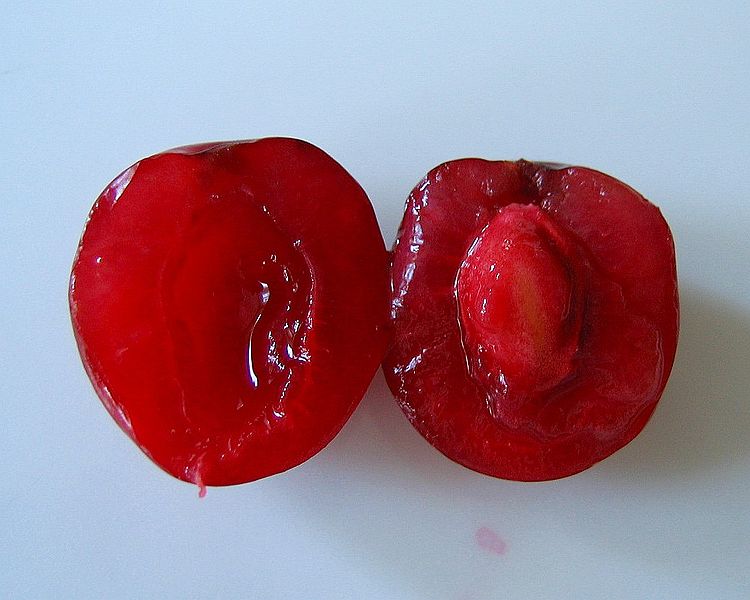
Sour cherry fruits contain macroelements (potassium, calcium, phosphorus, magnesium), microelements (copper, iron), as well as pectic substances, tannins, enzymes, anthocyanins, sugars (glucose, fructose), vitamins A, C, B2, PP, P, folic acid, coumarin.
Location: In one place, a cherry can grow well and bear fruit for 15-16 years. Grows excellently on slopes, with abundant sunlight, dry soil and absence of shallow groundwater (minimum groundwater depth - 2-2.5 m). Prefers neutral or slightly alkaline soil, grows better on light soils.
Planting: distance to neighboring trees for vigorous cultivars - 4 m, for dwarf cultivars - 3 m.
Diseases and pests: main diseases: brown spot, witch's broom, gummosis of stone fruits, shot-hole disease, false bracket fungus, moniliosis, scab, Steklenberg virosis, coccomycosis. Pests: brown fruit mite, cherry fruit fly, cherry shoot moth, cherry sawfly, cherry slime sawfly, cherry twig borer, cambium borer, western bark beetle, winter geometrid, ringed silk moth, red apple mite, gypsy moth, fruit moth (codling moth), cherry leafroller, tussock moth, "pyadenița obdiralo" (local geometer moth name), fruit striped moth, cherry aphid. Relatively resistant to coccomycosis - Antratsitovaya, Assol, Ashinskaya, Bulatnikovskaya, Volochaevka, Zhukovskaya, Oblachinskaya, Silva, Rastorguevskaya, Shchedraya. Resistant to cytospora canker and verticillium wilt – Oblachinskaya.
Care: cultivation of the tree circle under the trees, watering (autumn soil-moisture charging irrigation), application of fertilizers, disease and pest prevention, pruning of branches, whitewashing of trunks. It is recommended to perform autumn loosening of the soil near the trunk to a depth of up to 8 cm and around the crown perimeter - up to 20 cm.
Propagation: cherry propagates by root suckers and cuttings.
Use: the fruits of sour cherry are consumed fresh. They are also suitable for various types of processing: producing juices, compotes, fruit wine, making preserves and jam.