
Conifers
Himalayan cedar Robusta Glauca
Cedrus deodara Robusta glauca
Himalayan cedar Robusta Glauca – the most graceful cultivar of Himalayan cedar. It was obtained in 1850 in France.
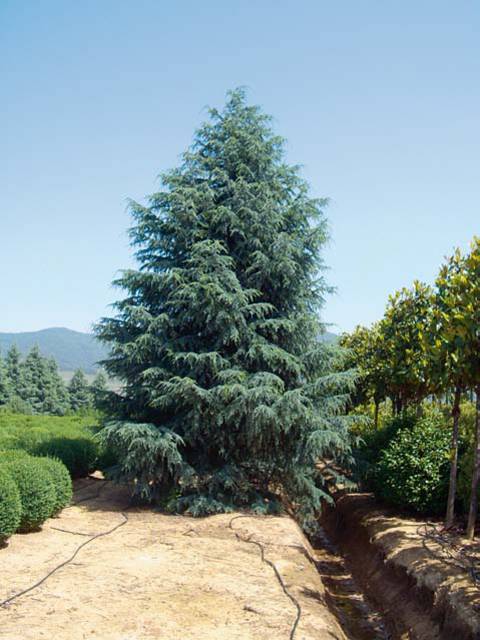
It is a tall evergreen tree reaching 13–15 m in height and about 7 m in width. The plant is fast-growing, with an annual increment of 80–100 cm. The crown is symmetrical, pyramidal or conical. Lateral branches grow from the trunk at an angle of 90° or less. Branches are strong and thick. Young shoots are slightly pendulous.
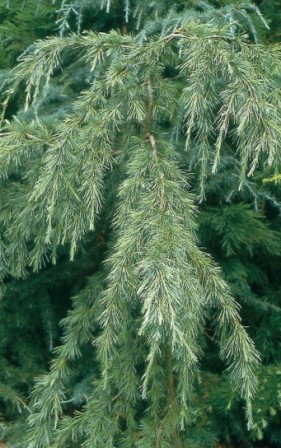
Foliage long, 5–6 (8) cm in length, thick, straight, densely set; color ranges from blue-green to almost silvery-blue. New growth is soft and green.
Cones ovoid, bluish in color, becoming reddish-brown at maturity, borne at the top of the crown.
Hardiness zone: 5b (-27°C).
Site: Prone to windthrow and requires clearing of snow from branches during winter. Tolerates shading well. Prefers high air and soil humidity. Undemanding to soil, can grow even on calcareous soils, but performs better on loams. In cultivation prefers well-drained, deep, slightly calcareous soils, as well as sites with humid air and adequate warmth. Low tolerance to urban conditions. Does not like waterlogging.
Planting: Recommended spacing between plants is 4–8 m. When planting in clay soil it is recommended to add sand to the planting hole. Planting hole size: 50–70 x 70 cm. Fill the hole with a mixture of turf soil and humus in a ratio of 3:1, and add a cup of wood ash or 200–250 g of a compound mineral fertilizer. After planting it is recommended to stake/tie the plant for several years because the root system is weakly developed.
Care: young plants need winter protection.
Pruning: tolerates formative pruning well.
Diseases: mottled-red trunk rot, seed moulding, rust fungi, "pischukha" (local disease name), brown central and prism rot, Schweinitz's polypore, white root rot, chlorosis.
Pests: adelgids, flower-eating beetles, lesser black chafer, cone gall midge, conifer geometer moth, spruce fruit/seed moth, tortrix moths, Siberian silk moth, gypsy moth, "monk" silk moth, conifer moths, cedar leafroller, black-and-yellow and red pine sawflies, six-toothed bark beetle, large black spruce longhorn beetle, Siberian engraver beetle, Siberian spruce longhorn beetle, cedar bark borer.
Propagation: by seed, cuttings, grafting. Seeds require stratification.
Conservation status: not listed under protection.
Uses: used in group plantings and for creating avenues in parks. Tolerates clipping well and can be used to create shaped hedges. Makes an impressive solitary specimen due to its beautiful blue-green or silvery-blue foliage and symmetrical crown.