
Conifers
Himalayan cedar 'Golden Horizon'
Cedrus deodara 'Golden Horizon'
Himalayan cedar 'Golden Horizon' – a beautiful form of Himalayan cedar. The form was obtained in 1975 at the Van Vliet brothers' nursery in Boskoop (Netherlands). The cultivar was first described in 1975 by H. J. van de Laar. It received the Award of Garden Merit.
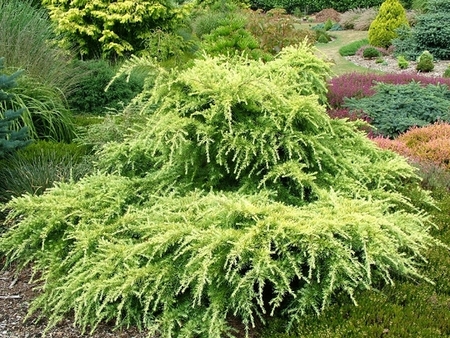
It is an evergreen tree. The ultimate height is unknown; at 5 years it reaches 40 cm in height, and it is estimated to reach 4-6 (6-9) m in height and 2-3 m in width. Annual growth – 20-30 cm. In youth it lacks a clearly defined trunk, resembling a shrub with horizontal and slightly upturned branches. With age it develops a vertical straight trunk with arching, drooping branches and shoots.
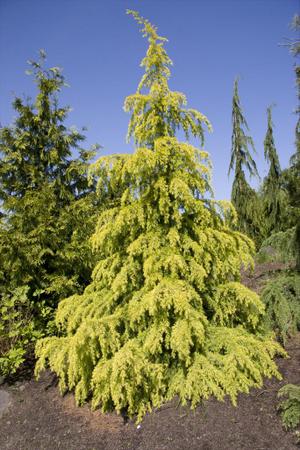
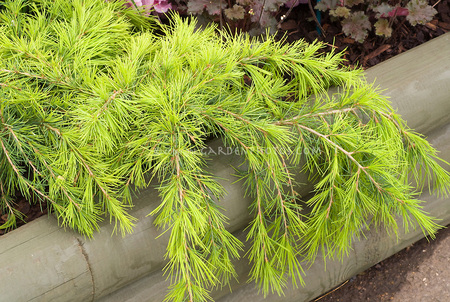
Foliage is soft and longer than that of other cedar species, golden-yellow in spring and summer, turning yellow-green and gray-green in autumn. On long shoots the needles reach 2-2.5 cm, on short shoots up to 4 cm.
Cones are conical, 3-4 cm high, occur singly or in pairs, reddish-brown when mature.
Hardiness zone: 5b (-27°C).
Position: Susceptible to windthrow and requires branches to be cleared of snow during winter. Prefers sunny locations. Likes increased humidity of air and soil. Not demanding regarding soil, it can even grow on calcareous soils, but grows better on loams. In cultivation it prefers well-drained, fertile, slightly calcareous soils, as well as sites with humid air and sufficient warmth. Tolerance to urban conditions is low. Does not like waterlogging.
Planting: Recommended spacing between plants – 4-8 m. When planting in clay soil it is recommended to add sand to the planting hole. Size of the planting hole – 50-70x70 cm. Fill the hole with a mixture of topsoil and humus in a 3:1 ratio, and also add a cup of wood ash or 200-250 g of complex mineral fertilizer. After planting it is recommended to stake the plant for several years, as the root system is weakly developed.
Care: Young plants need winter protection.
Pruning: Requires sanitary pruning.
Diseases: variegated red trunk rot, seed mould, rust fungi, blight, brown central and prismatic rot, Schweinitz's polypore, white root rot, chlorosis.
Pests: adelgids, flower beetles, small black chafer, cone gall midge, conifer geometer (looper), spruce seed moth, tortrix moths, Siberian silk moth, gypsy moth, monk moth, conifer wave moth, cedar leafroller, conifer geometer, black-and-yellow and red pine sawflies, six-toothed bark beetle, large black spruce longhorn beetle, Siberian engraver, Siberian spruce longhorn beetle, cedar bark beetle.
Propagation: by seeds, cuttings, grafting. Seeds require stratification
Conservation status: Not under protection.
Uses: used in rock and alpine gardens, on flower beds, in compositions with other conifers or shrubs.