
Conifers
Himalayan cedar
Cedrus deodara
Synonyms: Deodar, Devadaru, deodar cedar
The Himalayan cedar – a species of the genus Cedrus in the family Pinaceae. In nature it occurs in East Asia, in the northwestern Himalayas, in the mountains of Pakistan, Afghanistan, India and Nepal. It ascends to elevations of up to 3600 m above sea level. It grows alongside pine, spruce and fir. In 1905 the German botanist Karl Fuchs collected seeds of a high-mountain race of Himalayan cedar in the Afghan province of Paktia (3500 m above sea level). In cultivation since 1822. Lives up to 1000 years; under favorable conditions can reach 3000 years.
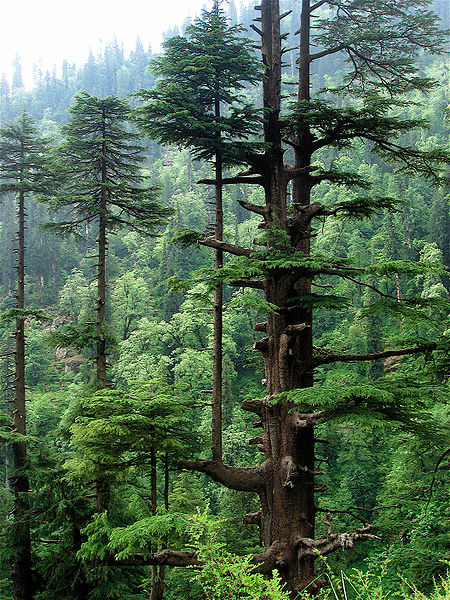
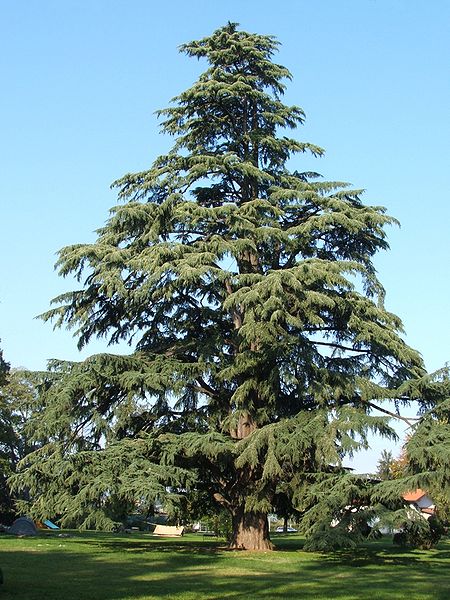
It is a tall tree up to 50 m in height, with a trunk diameter up to 3 m. The tree is fast-growing when young, with a moderate growth rate at maturity. The crown is broadly conical with horizontally arranged branches, the shoot tips drooping in an arch.
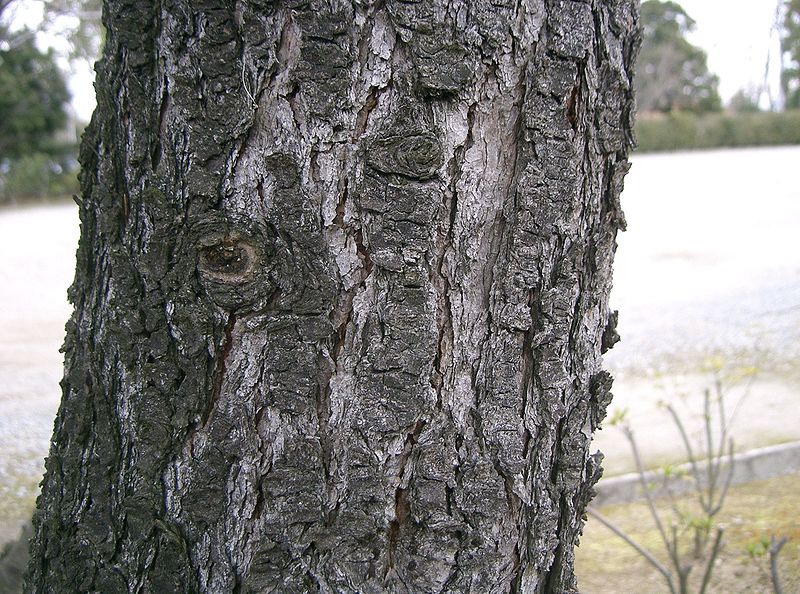
The wood is strong, fragrant and soft; the sapwood is light yellow, the heartwood reddish-brown. Young shoots are thin, pubescent. Bark grey-brown, fissured. The root system is superficial and highly susceptible to windthrow.
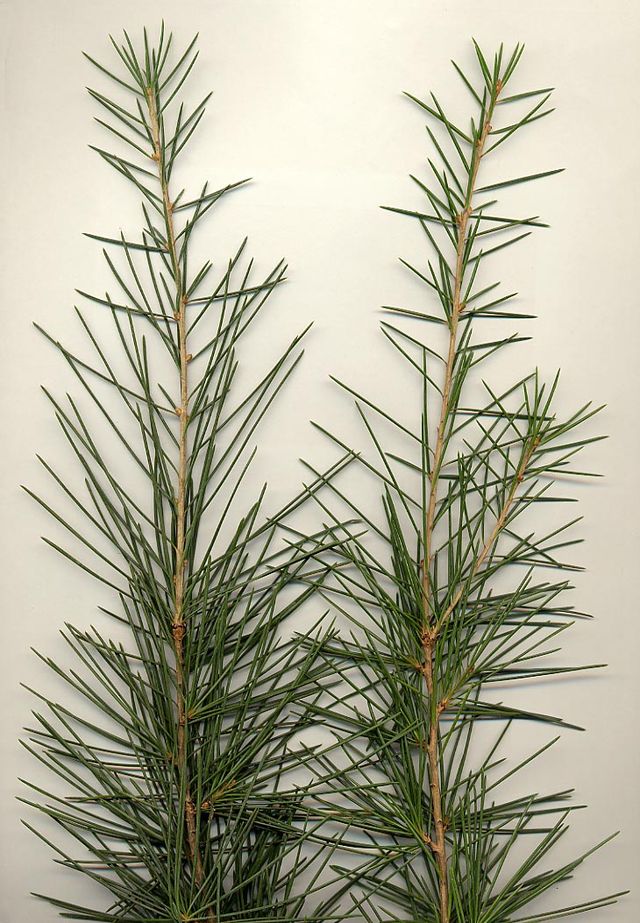
Needles are thin, soft, light gray-green with a glaucous tint; on short shoots they are gathered in bundles of 30-40 needles, on long shoots they are arranged spirally. Needles are three- or four-sided, up to 5 cm long, and persist on the tree for 3-6 years.
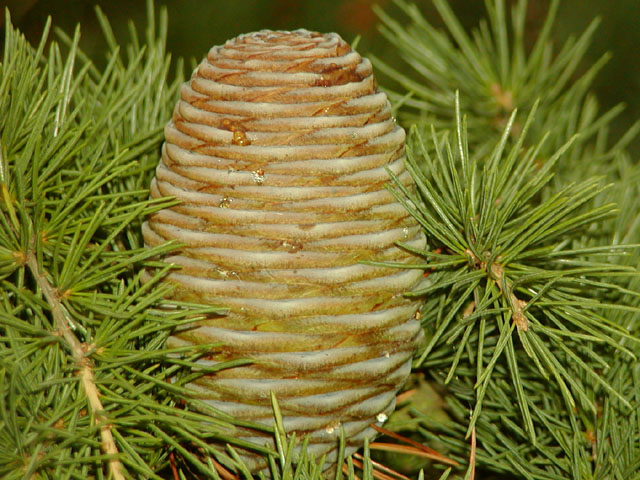
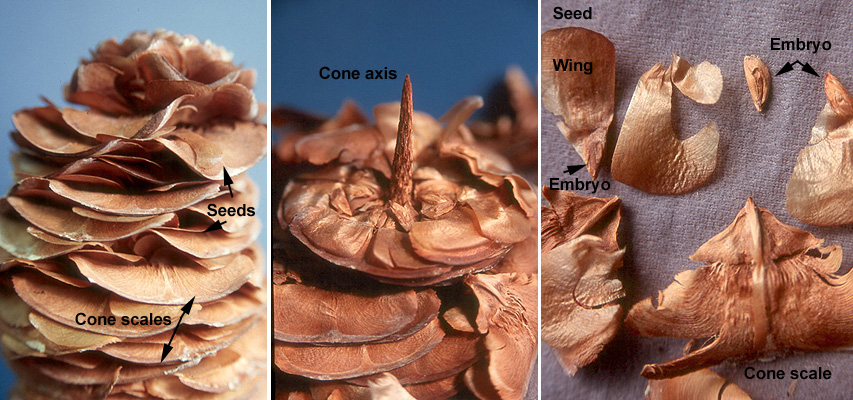
Pollen is shed in late October – November. Cones are ovoid, less convex than those of the Lebanon cedar, up to 10 cm long, borne at the top of the crown; bluish when young, turning reddish-brown at maturity. Cones mature over 1.5 years and, after ripening, disintegrate and fall off in the 2nd-3rd year. Seed scales are flat, almost woody, numerous, wedge-shaped with a narrowed base, 5-6 cm wide; the upper edge is almost rectangular, entire, slightly pubescent or glabrous; the margins of the scales are free because they are not overlapped by other scales.
Seeds are 1.6-1.7 cm long and 0.6-0.7 cm thick, obovoid, strongly narrowed at the base, whitish, resinous, practically inedible, with a light-brown obovoid or triangular wing up to 4 cm long and 3 cm wide.
Cultivars: Cedrus deodara ‘Gold Cone’, f. Crassiflora, f. Robusta, f. Compacta, f. Fastigiata, f. Pendula, f. Aurea, f. Argentea, «Аlbocpica», «Аurea», «Glauca», «Karl Fuchs», «Kashmir», «Paktia», «Prostrata», «Pygmy», «Robusta», «Robusta glauca», «Verticillata glauca», «Viesemannii», «Prostrate Beauty», «Golden Horizon».
Hardiness zone: 6-8 (down to -25°C). Needles frost-damaged in winter regrow in spring.
Site: Susceptible to windthrow. Better tolerates shade than other cedars. Prefers high air and soil humidity. Not demanding about soil, can even grow on calcareous soils, but grows better on loams. In cultivation prefers well-drained, deep, slightly calcareous soils, as well as sites with humid air and adequate warmth. Tolerance to urban conditions is low. Does not tolerate waterlogging.
Planting: Recommended spacing between plants – 4-8 m. When planting in clay soil it is recommended to add sand to the planting hole. Planting hole size – 50-70 x 70 cm. Fill the hole with a mixture of topsoil and humus in a 3:1 ratio, and also add a cup of wood ash or 200-250 g of a complex mineral fertilizer. After planting it is recommended to stake the plant for several years, as the root system is weakly developed.
Care: Young plants need to be sheltered for the winter.
Pruning: Tolerates formative pruning well.
Diseases: mottled-red trunk rot, seed mold, rust fungi, shoot blight, brown central and prismatic rot, Schweinitz's polypore, white root rot, chlorosis.
Pests: adelgids, flower-feeding beetles, small black chafer, cone gall midge, coniferous inchworms/loopers, spruce seed moth, various moths, Siberian silk moth, gypsy moth, tussock moth (Orgyia monacha), conifer sawflies, cedar leafroller, conifer geometrids, black-yellow and red pine sawflies, six-toothed bark beetle, large black spruce longhorn beetle, Siberian engraver (bark beetle), Siberian spruce longhorn beetle, cedar bark beetle.
Propagation: By seeds, cuttings, grafting. Seeds require stratification.
Conservation status: Not under protection.
Uses: Widely used in landscape and park planting. Tolerates pruning well and can be used to create shaped hedges. Striking in solitary plantings as well as in park avenues. Used in groups, where it stands out with its characteristic crown contours and dark-green needles. Can be grown in bonsai style.