
Conifers
Atlas Cedar Glauca Pendula
Cedrus atlantica Glauca Pendula
Synonyms: Weeping Atlas Cedar
Atlas Cedar Glauca Pendula – a weeping form of the Atlas cedar. Introduced into cultivation in France before 1900. Widely cultivated in Boscop (France) and in Germany.
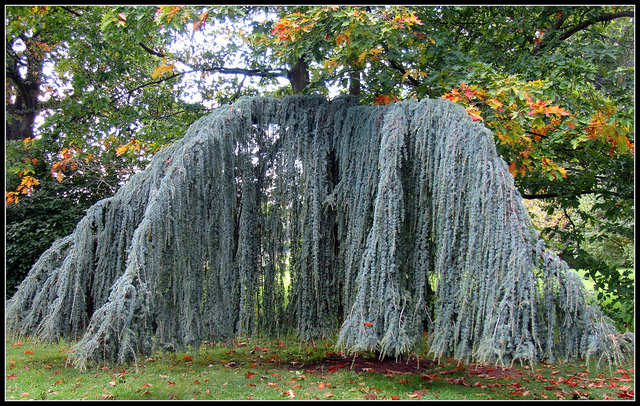
On an upright trunk it can reach 4.5-6 (7), more rarely 2 m in height. The crown is rounded. Scaffold branches hang in arches, lateral branches resemble a dense mane that hangs vertically down. The root system is taproot-type, roots are weakly developed. The tree is slow-growing, annual increment reaches 30-45 cm per year.

Needles are gray-blue, 2-2.5 cm long, on long shoots they grow spirally, on short shoots gathered in cluster-rosettes.
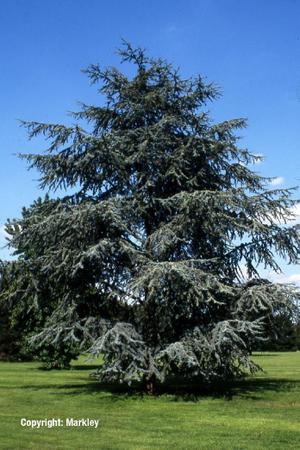
Cones are barrel-shaped, 5-7 cm long and 4 cm wide, green when opening, later turning brown. They ripen in 2-3 years.
Hardiness zone: 6-8 (-20 °C). Needles damaged by frost in winter regrow in spring.
Location: sun-loving. Not demanding to soil, but prefers moderately dry, fertile, moist or fresh, well-drained, calcareous soils. Also grows on slightly acidic sandy soils. Winter precipitation is necessary. Tolerant of heat and summer drought, as well as air pollution. Not wind-resistant.
Planting: Recommended spacing between plants – 4-8 m. When planting in clay soil it is recommended to add sand to the planting hole. Planting hole size – 50-70x70 cm. The hole is filled with a mixture of turf soil and humus in a ratio of 3:1, and also a cup of wood ash or 200-250 g of a complete mineral fertilizer. After planting it is recommended to stake/tie the plant for several years, as the root system is weakly developed.
Care: in the first year after planting it is recommended to cover the seedling with a thin layer of gauze or covering material from March to April. If a white coating appears on the shoots it is recommended to use a weak solution of onion skins or household soap; special fungicides can also be used. If webbing appears on the shoot tips, treat with insecticides (Actellic, Decis).
Pruning: the crown of young plants grown in open sites should be thinned.
Diseases: mottled-red trunk rot, seed mold, rust fungi, pishchuha, brown central and prismatic rot, Schweinitz's polypore, white root rot.
Pests: adelgid, flower beetles, small black chafer, cone gall midge, conifer looper, spruce fruit moth, moths, Siberian silk moth, gypsy moth, nun moth, conifer wave moth, cedar leafroller, conifer geometrid, black-and-yellow and red pine sawflies, six-toothed bark beetle, large black spruce longhorn beetle, Siberian engraver, Siberian spruce longhorn beetle, cedar bark-borer.
Propagation: by seeds, cuttings, grafting. Seeds require stratification
Conservation status: not under protection.
Uses: widely used as a specimen tree in large gardens, parks and home plots, for creating arches, and can also be grown in bonsai style.