
Conifers
Atlas cedar
Cedrus atlantica
Synonyms: atlas cedar
Atlas cedar – a species of coniferous trees of the genus Cedrus in the family Pinaceae. Among botanists there is debate whether Atlas cedar is a distinct species of the genus Cedrus or a subspecies of the Lebanon cedar. In 1855 the French botanist Élie-Abel Carrière first classified it as a separate species. But the botanist J. D. Hooker considered that Atlas cedar is a variety of the Lebanon cedar. It differs from the Lebanon cedar by a different crown, shorter needles and smaller cones. In the wild it grows in Africa in the Atlas Mountains in Algeria and Morocco, where it rises to 1300-2000 m above sea level. In cultivation since 1842. Popular among gardeners in the southern parts of Europe, in the Caucasus and China. Lives 800 years.
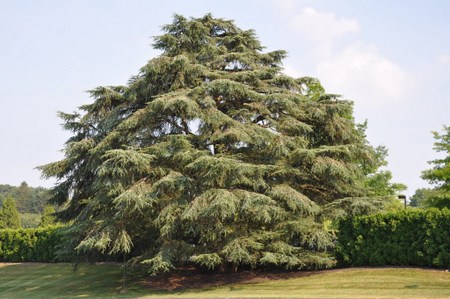
It is a tall tree 40-50 m in height with a trunk diameter of 1.5-2 m. Fast-growing when young. Crown loose, pyramidal; with age the apex becomes more flattened. Wood resinous, has a strong sandalwood scent.
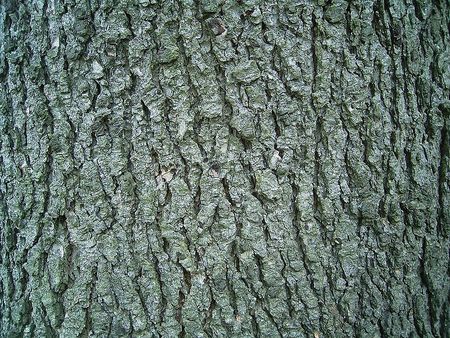
Bark dark gray, fissured. Buds conical. Shoots pale yellow-brown, pubescent in the first year, later becoming dark gray.
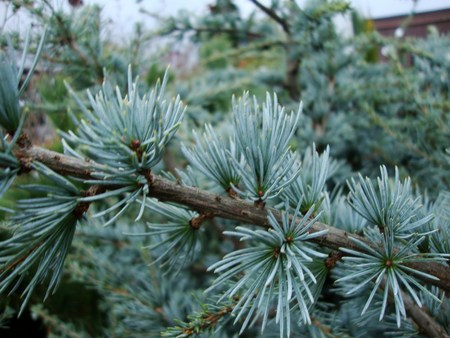
Needles stiff, bluish-green or silvery-gray, 2.5 cm long, clustered on short densely pubescent shoots, curved toward the shoot, borne on leaf cushions.
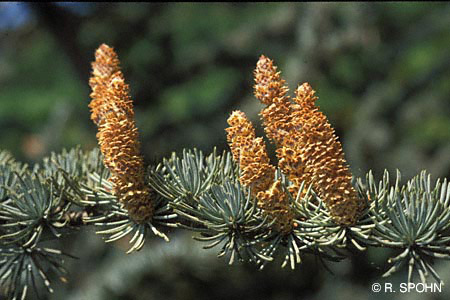
Flowers in autumn. The plant is monoecious. Male catkins are located lower on the plant, reaching 5-6 cm in length.
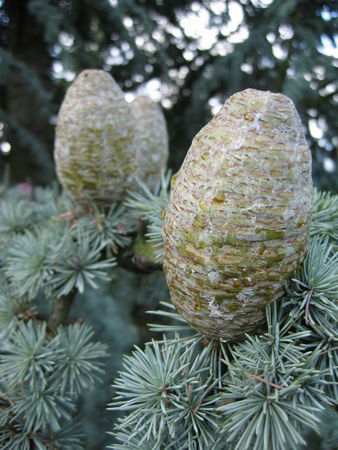
Cones 7-10 cm long, ovoid or cylindrical, glossy, dense, light brown, located at the top of the tree. Cones mature over 3 years.
Seeds up to 12 mm long, wing up to 15 mm long.
Ornamental forms: columnar (f. columnaris), pyramidal (f. pyramidalis), upright pyramidal (f. fastigiata), weeping (f.pendula), blue weeping (f. glauca pendula), silvery (f. argentea), blue (f. glauca), golden (f. aurca), Aurea, Aurea robusta, Fastigiata, Glaucaа, Glauca horizontalis.
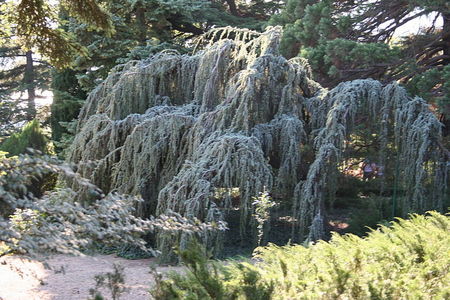
Weeping form of Atlas cedar from the Nikitsky Botanical Garden.
Hardiness zone: 6-9 (-20 °C)
Site: light-loving, tolerant of smoke, dust and gases. Does not tolerate the presence of lime in the soil, nor waterlogging. Drought-tolerant.
Planting: Recommended spacing between plants – 4-8 m. When planting in clay soil it is recommended to add sand to the planting hole. Planting hole size – 50-70x70 cm. Fill the hole with a mixture of turf soil and humus in a ratio of 3:1, and also a cup of wood ash or 200-250 g of a complex mineral fertilizer.
Care: In the first year after planting it is recommended to cover the seedling with a thin layer of gauze or covering material from March to April. If a white coating appears on the shoots it is recommended to use a weak solution of onion skins or household soap; special fungicides can also be used. If webbing appears on the shoot tips, treat with insecticides (Actellic, Decis).
Pruning: do not remove lateral branches
Diseases: mottled-red trunk rot, seed mold, rust fungus, blight, brown central and prismatic rot, Schweinitz's polypore, white root rot.
Pests: chermes, flower beetles, small black chafer, cone gall midge, conifer looper, spruce seed moth, moths, Siberian silk moth, gypsy moth, nun moth, coniferous tortrix, cedar leafroller, conifer looper, black-yellow and red pine sawflies, six-toothed bark beetle, large black spruce longhorn beetle, Siberian engraver, Siberian spruce longhorn beetle, cedar bark borer.
Propagation: by seed, cuttings, grafting. Seeds require stratification
Conservation status: not under protection.
Uses: used for creating groups, stands, solitary, loose-group and allee plantings. Widely used in park landscaping. Local people in Africa use the wood as fuel. The oil has antiseptic properties and is widely used in the manufacture of cosmetic products. Can be grown in bonsai style.