
Flowering shrubs
Cassiope
Cassiope
Cassiope (lat. Cassiope) — a genus of the heath family (Ericaceae), consisting of 9—12 species. Named after the ancient Greek mythological figure — Cassiopeia. The genus Cassiope is the only one in the subfamily Cassiopoideae (Cassiopeae).
The species of the genus grow in regions of the Northern Hemisphere with arctic and alpine climates, including the Himalayas.
They grow on moist, fertile, acidic soils. Sun-loving. As with all ericaceous plants, they have mycorrhiza on the roots (a symbiosis of the plant with fungi).
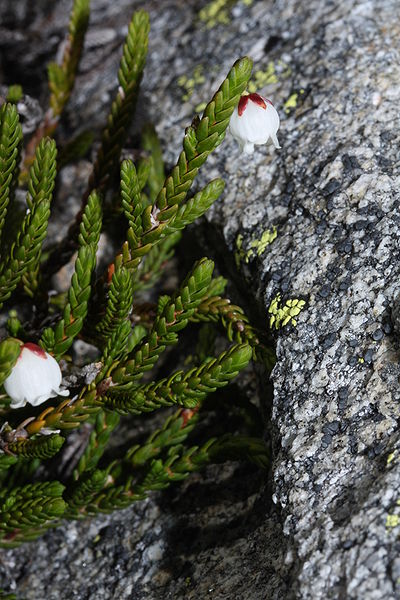
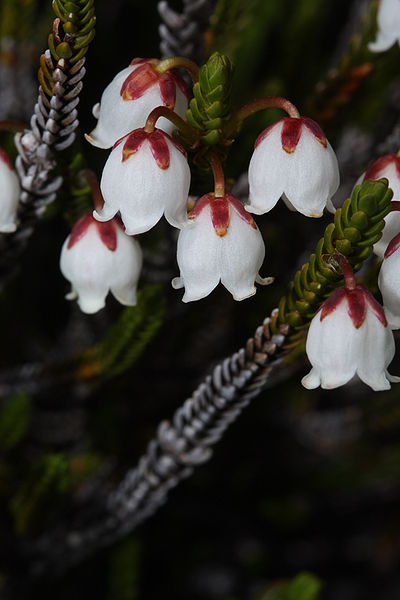
Low-growing evergreen creeping subshrubs 10—25 cm high. Stems thin, creeping, branched.
Leaves small, scale-like, lanceolate, very tightly clasping the stem. Flowers terminal or on lateral axillary pedicels, solitary, white or pink, bell-shaped. Flowering period — May—June.
In cultivation the following species are most often encountered:
Crested Cassiope — Cassiope pectinata
A shrub reaching 10-20 cm in height. Young stems solitary, becoming heavily branched with age. Branches densely covered in four rows with appressed leaves. Leaves lanceolate-elongated, green, leathery, boat-shaped, very small. The flower is fairly large, white or pink, bell-shaped up to 2.5 cm long. Flowers in July-August.
Lycopodium-like Cassiope — Cassiope lycopodioides
A very low shrub reaching only 5-8 cm in height, forming a dense mat 30-50 cm in diameter. Roots are shallow, with mycorrhiza. Leaves sessile, scale-like, very small. The cord-like stems are strewn with tiny 0.7 cm white flowers with red calyces that resemble little bells. Solitary, axillary, nodding, on long pedicels. Flowers in May-June, rarely in August.
Location: prefer well-lit places, can tolerate partial shade.
Soil: requires soil rich in organic matter, moist and acidic. Drainage is essential.
Propagation: cuttings in a cold frame, less often by seeds, which are sown in spring on the surface of moist peat.