
Flowering shrubs
Caryopteris
Caryopteris
Caryopteris (lat. Caryopteris) — a genus of perennial plants of the family Lamiaceae (Fabaceae), previously placed in the family Verbenaceae (Verbenaceae). Includes about 15 species of deciduous shrubs, of which two are cultivated.
Herbaceous plants or small shrubs up to 1-4 m tall. Leaves opposite, simple, oval or lanceolate, toothed at the margin, aromatic. Flowers blue or white. Flowers are pollinated by butterflies and bumblebees, an excellent nectar source. Fruit - a capsule, four seeds.
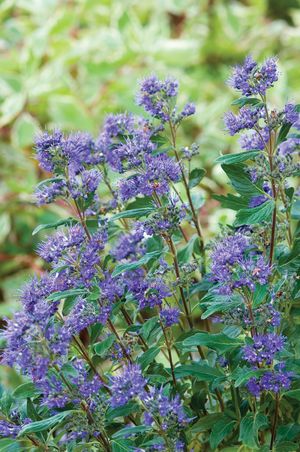
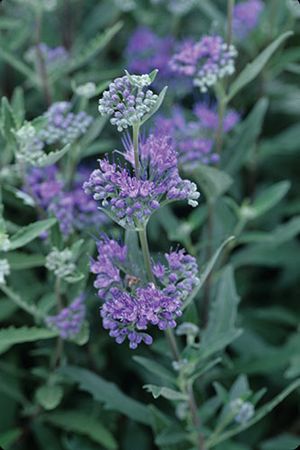
In cultivation: Кариоптерис седой (Caryopteris incana) - a hardy shrub up to 1.5 m tall and Кариоптерис кландоненсис (Caryopteris х dandonensis) obtained by crossing кариоптерис седой and кариоптерис монгольский (С. mongolica). The shrub is bushy, leaves oval, pubescent, dark brown-green in color. Flowers tubular, lilac-blue, gathered in terminal and axillary inflorescences. They bloom from mid-summer to early autumn. The species is fairly hardy, reaching up to 1 m in height.
Caryopteris belongs to the group of "express" perennials. This name is given to plants that, when sown early, bloom in the same year. Since the plant produces abundant self-seeding, it can be sown in late autumn or very early spring so that the seeds are exposed to cold.
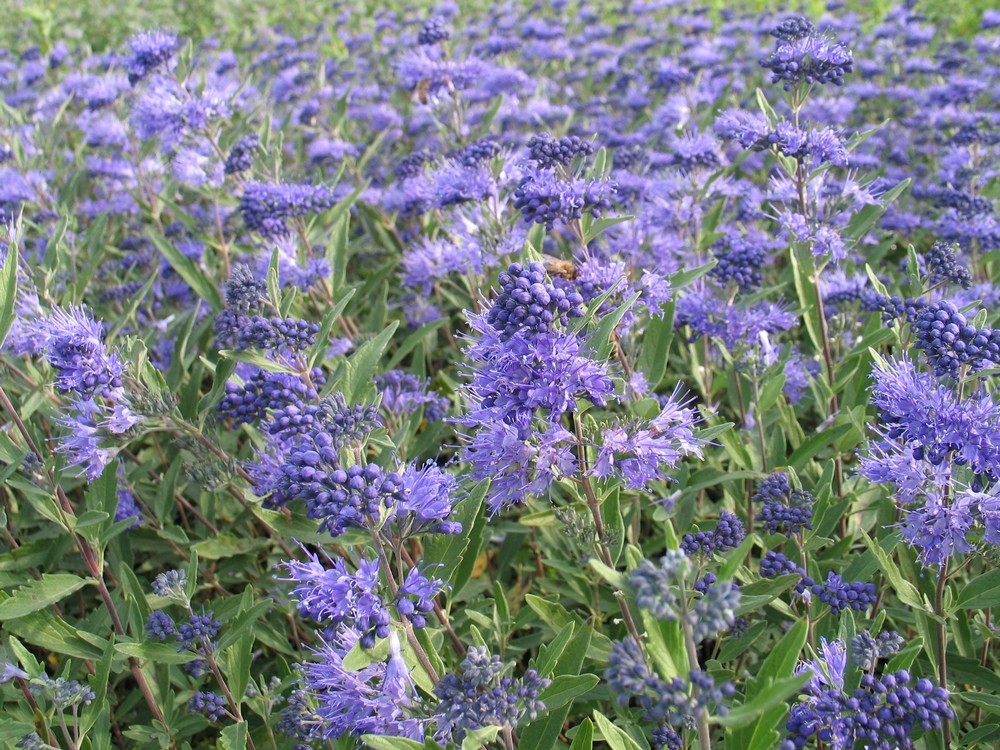
Location: open sunny site, but if the area is well sheltered from winds, it can be grown in partial shade. Not demanding to soil, but poorly tolerates very wet, acidic and sandy soils.
Care: quite drought-tolerant, needs watering only with very strong drying of the soil. In spring and summer the plant is fed with organic or mineral fertilizers. In March the strongest shoots are cut back significantly, leaving two buds on each, and the weakest are removed completely. Requires good winter protection.
Propagation: by semi-hardwood cuttings at the end of summer, less often by seeds.
Zone: 5-6