
Flowering shrubs
Campsis × tagliabuana 'Madame Galen'
Campsis × tagliabuana 'Madame Galen'
Synonyms: campsis tagliabuana mme galen, campsis madame galen, campsis tagliabuana madame galen
Campsis × tagliabuana 'Madame Galen' (Campsis × tagliabuana 'Madame Galen') – a cultivar of the hybrid species Campsis × tagliabuana from the genus Campsis (Campsis) of the family Bignoniaceae (Bignoniaceae). The cultivar was raised at the Tagliabuana nursery in Lainate near Milan (Italy) in 1889 (according to another source the cultivar was obtained at the Sahut nursery, Montpellier, France). It received the Royal Horticultural Society's Award of Garden Merit in 1959.
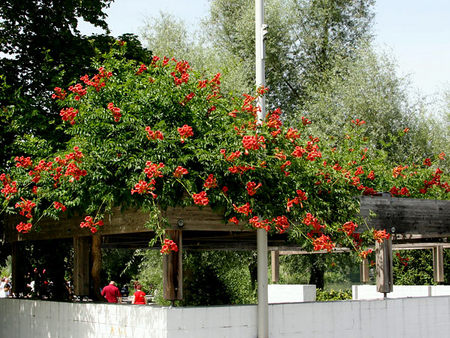
It is a fast-growing climber or shrub with spreading branches up to 4 m tall. Annual growth can reach 1–2 m.
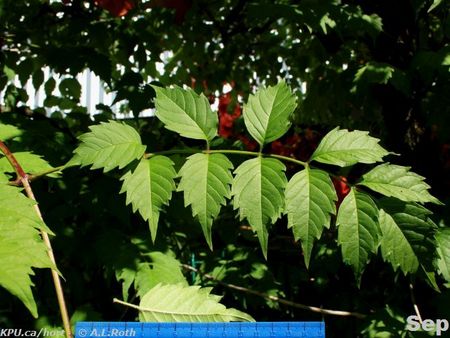
Leaves are compound, imparipinnate, dark green above and paler beneath. They reach 25–40 cm in length and consist of 7–13 small oval leaflets 7–10 cm long and 3–4 cm wide.
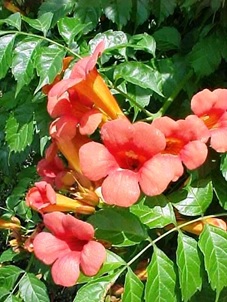
Blooms in the second half of summer and into autumn. Flowers are funnel-shaped, up to 8 cm long and 5–7 cm wide, of striking orange-red color.
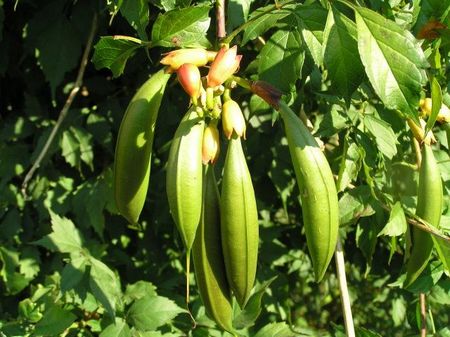
Fruits – leathery elongated pod-like capsules containing several flat, two-winged seeds inside.
Hardiness zone: 4b (-29°C)
Site: sun-loving, but in warm climates can grow in light partial shade. Prefers moderately moist, rich, loose loam, but can also grow in ordinary garden soil; does not like prolonged waterlogging or stagnant moisture. The best location is on the south or southeast side of a house. Does not like heavily waterlogged soils. Does not tolerate prolonged heat. An optimal place is a young wall, as well as areas protected from strong winds and cold air stagnation.
Planting: planting is carried out in early spring, before the plants flower.
Care: In the first summer it is recommended to grow Campsis in a container and move it to a cool cellar for the winter. In most of Ukraine it is recommended to make the support removable (for example from synthetic cord). Before frosts the plant is removed together with the support and laid on the ground. The plant is covered with spruce boughs and a polyethylene film is spread over them, on which dry plant debris can be piled. Young plants are recommended to be tied to the support; in maturity the support is not required.
Pruning: tolerates pruning well, but in cold regions this is not recommended, because after pruning the plant flowers late and does not have time to complete its vegetation.
Propagation: mainly by winter and summer green cuttings, as well as by layering and seeds. Seeds are sown in early May in the open ground. Blooms in the 3rd year after sowing. In northern regions seeds often do not have time to mature.
Diseases and pests: not affected by diseases. From pests – aphids.
Companions: clematis, mountain clematis, wisteria, five-leaf akebia, woodland sage, narrow-leaved lavender, Faassen's catmint, herbaceous peony, geranium, cypress-leaved santolina, tall sedum, shrubby potentilla, Thunberg barberry, Japanese spirea.
Uses: used for vertical greening of walls, fences, arbors, pergolas, trellises; looks good on ornamental supports (sphere, pyramid) on lawns. Decorative for its large pinnate leaves, distinctive flowers, and long flowering period.