
Indoor plants
Japanese camellia
Camellia japonica L.
Synonyms: household camellia, winter rose
Japanese camellia (Camellia japonica L.) – a species of evergreen plants of the genus Camellia of the Tea family (Theaceae). It was first brought to Europe by the Jesuit priest George Kamel, after whom it was named. The epithet «japonica» was given by Carl Linnaeus in 1753, since the first description of the plant was made in Japan by the German traveler and naturalist Engelbert Kaempfer.
In the wild it occurs in mainland China (Shandong, eastern Zhejiang), Taiwan, South Korea and southern Japan. It grows in forests at elevations of about 300–1,100 meters.
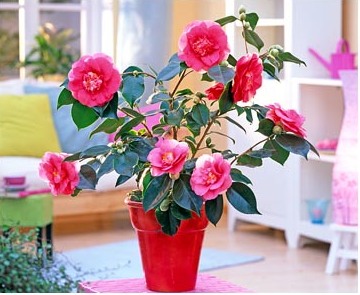
It is an evergreen shrub or tree 1.5–6 (11) m tall; the height of plants grown indoors usually does not exceed 1 m. Shoots are sparse, sparsely leaved; in the wild they form an irregular crown. Young branches are gray-brown, current-year shoots are purplish-brown, glabrous. It has two growth periods. The first occurs in February: new leaves appear and young shoots begin to grow. The second period is in summer, when buds form that will grow after flowering.
Leaves are leathery, glossy, up to 11 cm long and 6 cm wide, arranged alternately on the shoots on short petioles. The leaf blade is simple, broadly lanceolate or elliptic with a slightly elongated and pointed tip and a finely serrated margin. The upper surface of the blade is dark green, the underside somewhat lighter.
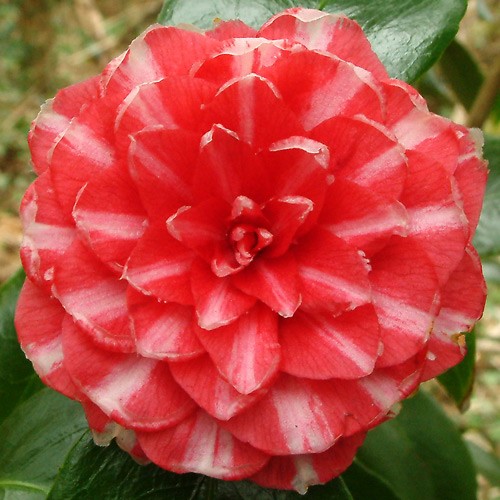
Flowers are solitary or paired, variable in shape and size, rose-like, scentless. Peduncles are practically absent; large bud clusters form directly in the leaf axils. Each flower remains on the branch for almost a month.
Fruits – dry globular capsules with 3–5 compartments containing large seed kernels; they appear in September-October.
Varieties:
- Camellia japonica var. japonica
- Camellia japonica var. rusticana
Cultivars: ‘Vittorio Emanuele II’, 'Guilio Nuccio', ‘Double White’, ‘Desire’, ‘Margaret Davis’, ‘Lady Vansittart Pink’, ‘Lady Campbell’, ‘Chandlers Red’, ‘Asahi-No-Mai’, ‘Linda Rosazza’, ‘Tricolor’, ‘Pink Perfection’.
Hardiness zone: 8b (-10°C).
Temperature: keep at 12–15°C in summer, 8–10°C in winter. At higher temperatures camellias drop their flowers.
Lighting: prefers bright light with shading from direct sunlight in summer. In summer it can be placed outdoors in a semi-shaded spot. Moving and changing its position is harmful to the plant.
Watering: abundant, but does not like waterlogging. For watering it is preferable to use warm, settled water (left to stand) for at least 12 hours. The water should not contain lime impurities.
Fertilization: apply fertilizers throughout the year except during the dormancy period in July-August.
Humidity: requires misting; stop misting during flowering.
Repotting: after the end of the first growth in June-July, young plants are repotted annually, mature plants every 2-3 years. Camellias prefer acidic soils. Potting for young plants consists of a mixture of 1 part leaf mold, 1 part coniferous (needle) soil, 1 part peat and 0.5 part sand. For mature and old plants add a part of turf soil to this mixture, and instead of two parts coniferous soil use only one part. When buying soil for camellias, mixes for rhododendrons are best suited. Use a wide pot with good drainage. Camellias are shaped by pruning and removing weak shoots.
Propagation: by cuttings using rooting hormones and bottom heating of the soil to 25°C. Rooting lasts about 2 months.
Diseases: powdery mildew, root rot, sooty mold fungus.
Pests: mealybugs, aphids, single leaf miner.