
Flowers for the garden
Camassia
Camassia
Camassia (lat. Camassia) is a genus of perennial herbaceous bulbous plants of the family Agavaceae; the genus previously belonged to the family Liliaceae (Liliaceae). The genus includes about 6 species native to the temperate regions of North America.
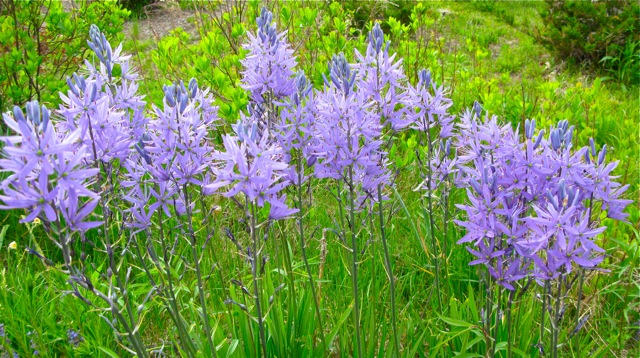
Perennial bulbous plants with an erect stem and a cluster of basal leaves pointing upwards, emerging long before the inflorescences appear. The bulb is tunicate, consisting of numerous fleshy and dry protective scales, up to 5 cm in diameter. Leaves are elongate-lanceolate or strap-shaped, glaucous-green, up to 60 cm long.
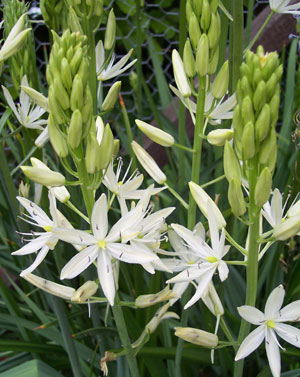
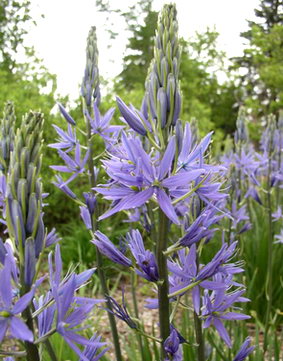
Flowers are gathered in terminal racemose inflorescences. Flowers are white, cream, light blue, blue or purple, with six petals. The fruit is a three-angled capsule with numerous black seeds. Camassias were introduced to Europe relatively recently, only at the beginning of the 19th century, and appeared in gardens.
In cultivation:
Camassia quamash — Camassia quamash
Bulb broadly ovoid or globose, up to 5 cm in diameter, black or brown. Stem about 40–60 cm tall. Leaves linear, up to 50 cm long, underside lighter. Raceme 10–20 cm long, bearing up to 35 flowers. Flowers blue-violet, light blue or white. Fruit a capsule, oblong-ovoid; in the locule 5–10 small black seeds. Blooms in late spring–early summer for 10–15 days.
Camassia leichtlinii — Camassia leichtlinii
Bulb broadly ovoid, up to 4 cm in diameter, edible. Stem 20–100 cm high. Leaves linear, 20–60 cm long, keeled. Inflorescence a raceme, 10–20 cm long, may bear from 4 to 60 flowers. Flowers actinomorphic, from light to dark blue and purple or cream-white. Capsule oblong or ovoid, 1–3 cm long; in the locule 6–12 seeds. Camassia leichtlinii blooms in early summer, sometimes even in late spring. Flowering duration up to 20 days. In cultivation since 1837.
Location: prefers a well-lit site, can tolerate partial shade.
Soil: any moisture-retentive soil. It performs well on heavy soils, although prolonged waterlogging in winter can lead to the plant rotting.
Care: watering is necessary in dry summers. Early in spring, plantings should be fed with a complete mineral fertilizer. In autumn, at the end of September–October, plantings are mulched with peat or humus to protect them for the winter.
Propagation: by bulbs and seeds. Camassia seeds require a long cold stratification (4–5 months), because not only germination but also the early development of the seedling (up to the first leaf) occurs at low temperatures.