
Flowers for the garden
Callistemon
Callistemon
Synonyms: beautiful-stamen, red-stamen
Callistemon (Callistemon R.Br.) – a genus of evergreen plants in the family Myrtaceae. The genus was first described by the Scottish botanist Robert Brown in 1814 in his work «Voyage to Terra Australis 2, App. III, 547». The lemon-yellow Callistemon was first introduced in 1789 by Joseph Banks into the Royal Botanic Gardens, Kew. The name comes from the Greek «kallos» — beautiful and «stemon» — stamen.
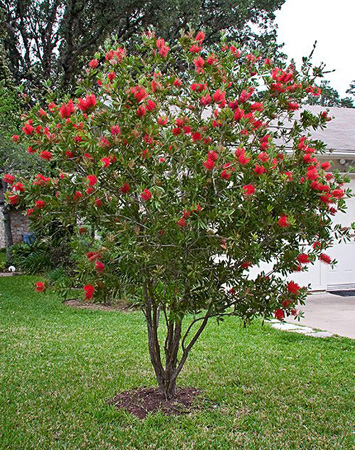
Callistemon, lemon-yellow form
The range covers all of Australia. Introduced to many countries with warm climates. Grows along riverbanks.
Represents an evergreen shrub or small tree 0.5–15 m in height. Growth rate is high; in one year the plant can spread up to 1 m in diameter. Shoots are pubescent, becoming glabrous, light brown.
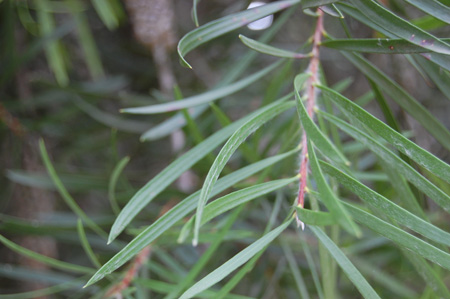
Leaves alternate, stiff, narrow, leathery, mostly lanceolate, with sharp margins, gray-green in color.
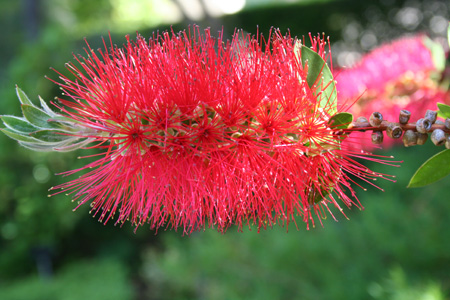
Flowers are small, gathered at the ends of branches in dense cylindrical inflorescences resembling a bottle brush, 5–12 cm long and 3–6 cm wide. The tip of the inflorescence ends with a leaf-bearing shoot. The main part of the flower consists of numerous long brightly colored stamens in red, pink, yellow, green, white or cream. Each flower has a five-parted calyx and corolla and a lower 3–4-chambered ovary. Pollinated by birds.
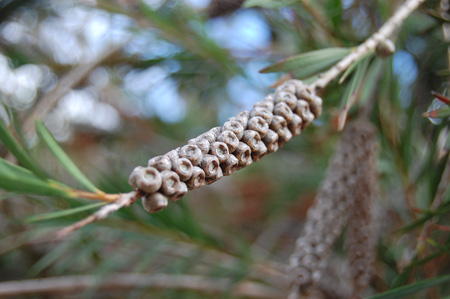
Fruits — woody, many-seeded capsules, spherical or ovoid.
Species: the genus includes about 50 species. The most popular are:
- Pale callistemon (Callistemon pallidus (Bonpl.) DC.)
- Weeping callistemon (Callistemon salignus Colv. ex Sweet)
- Lance-leaved callistemon (Callistemon lanceolatus DC.)
- Lemon-yellow callistemon (Callistemon citrinus Stapf)
- Linear callistemon (Callistemon linearis Colv. ex Sweet)
- Showy callistemon (Callistemon speciosus (Sims.) DC.)
- Willow-leaved callistemon (Callistemon viminalis (Soland ex Gaerth) G. Don ex Loud)
- Phoenix callistemon (Callistemon phoeniceus Lindl.)
- Pine-leaved callistemon (Callistemon pinifolius Sweet)
- Bright red callistemon (Callistemon coccineus F.Muell.)
Frost hardiness: 8a (-12°C).
Location: from mid-May it is best placed outdoors in a sunny spot. In winter kept in a bright, cool room. The plant tolerates dry air. Does not tolerate calcareous (lime-rich) soil.
Light: bright light. With poor lighting the plant does not flower.
Temperature: in summer it is best to move outdoors, as Callistemon very much likes fresh air. In winter preferably keep at 10–12°C.
Watering: in summer the soil should be constantly slightly moist. Water only with soft water. In winter water very little.
Air humidity: on hot days it is recommended to spray the plant with settled (standing) water.
Fertilization: feed during the period of active growth (use a fertilizer for flowering plants) once every two weeks. Do not fertilize in autumn and winter.
Pruning: branching in the plant begins when it reaches 20–25 cm in diameter. First the bud swells, in which all the leaves and (sometimes) the buds are already formed. That is, as soon as the bud opens, the primordia of all the leaves that will be on the shoot appear. If buds are not visible next to the leaves, that shoot will not flower. For abundant branching pinch the tips of the shoots.
Care: when grown in pots it is recommended to regularly prune the plant in spring so that it does not become too tall and forms a good bushy habit.
Propagation: in summer by terminal cuttings, except C. citrinus. Its seedlings grow slowly and for a long time before flowering. Cuttings root in sand while being covered from above with a glass jar, as they require high air humidity.
Transplanting: in spring if necessary. Soil mix of equal parts leaf mold, turf (sod) soil, humus soil, peat and sand.
Pests: spider mite, aphids, whitefly.
Usage: in the conditions of Ukraine it is grown only as a houseplant.