
Indoor plants
Calanthe
Calanthe
The genus Calanthe includes over 150 terrestrial, rarely epiphytic species, distributed from South Africa and the island of Madagascar to Japan, the tropical regions of Asia, the islands of the Malay Archipelago and Australia. Calanthe, from Greek, means 'beautiful flower'.
A few Calanthe species occur in Mexico, Central America and the Antilles. Calanthes are divided into two groups: deciduous and evergreen. Species from the deciduous group are better suited for indoor cultivation.
Calanthe vestita (Calanthe vestita Lindl.) A terrestrial plant with conical or ovate blunt-ribbed pseudobulbs covered with thin membranous silvery-white scales. Leaves 3—4, broadly lanceolate, herbaceous, folded, 30—40 cm long, 8—10 cm wide. Calanthe flower stalks are erect, curved in an arc near the top, densely pubescent, many-flowered; 1—2 appear at the base of a pseudobulb.
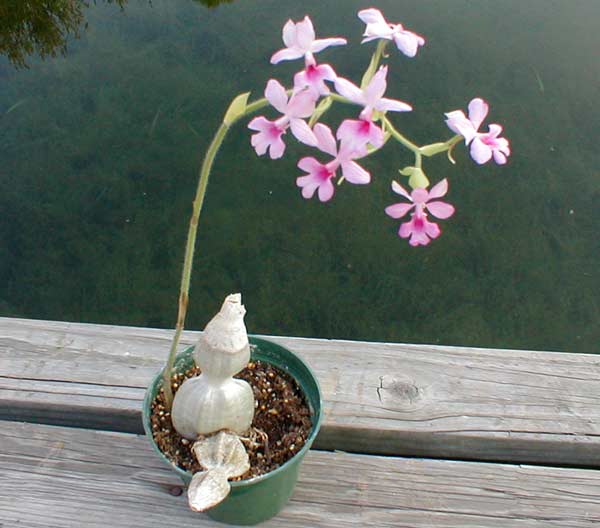
The flowers are 5—7.5 cm in diameter, tiny white with a yellow or cream spot at the base of the lip and a thin greenish spur. Sepals and petals are oval or obovate-elongated. The lip is 3-lobed with large lateral lobes and a broad, deeply notched middle lobe.
Calanthe vestita flowers in November—February, when leafless. Native to Southeast Asia and the islands of the Malay Archipelago; grows on limestone rocks covered with coarse humus and moss. In cultivation since 1848.
Location: requires a warm (summer 20—26 °C, winter 16—22 °C), well-ventilated room with high air humidity. To successfully grow them it is essential to observe the dormancy period, which begins at the end of winter after flowering and lasts 1—2 months.
Light: diffused light.
Watering: in summer - regular and abundant. In winter during the dormancy period - limited. The soil should dry out on the surface between waterings.
Air humidity: moderate.
Feeding: from spring to autumn apply a flowering fertilizer every 2 weeks.
Propagation: mainly by dividing old plants in spring, before growth begins.
Important: Leafless pseudobulbs of Calanthe are kept without watering in the light at 16—18 °C until growing buds appear at their base. At the start of growth, but before roots appear, the previous year’s pseudobulb with the young shoot is separated from the old one and planted, without burying it, into a substrate for terrestrial orchids with an increased content of peat and leaf mould. In summer Calanthe is shaded from bright sun. With the onset of autumn the leaves gradually die back.