
Deciduous shrubs
Boxwood
Búxus
Synonyms: Crantzia Sw., Notobuxus Oliv., Tricera Schreb., buks, green tree, gevan, bukshpan, boxwood, bukshpan, iron tree.
Boxwood (Búxus) – a genus of evergreen monoecious dicotyledonous plants of the family Buxáceae. The Latin name derives from the ancient Greek «πυξος» (pyxos, boxwood). According to Vasmer's dictionary the name comes from the Persian word «shimshād».
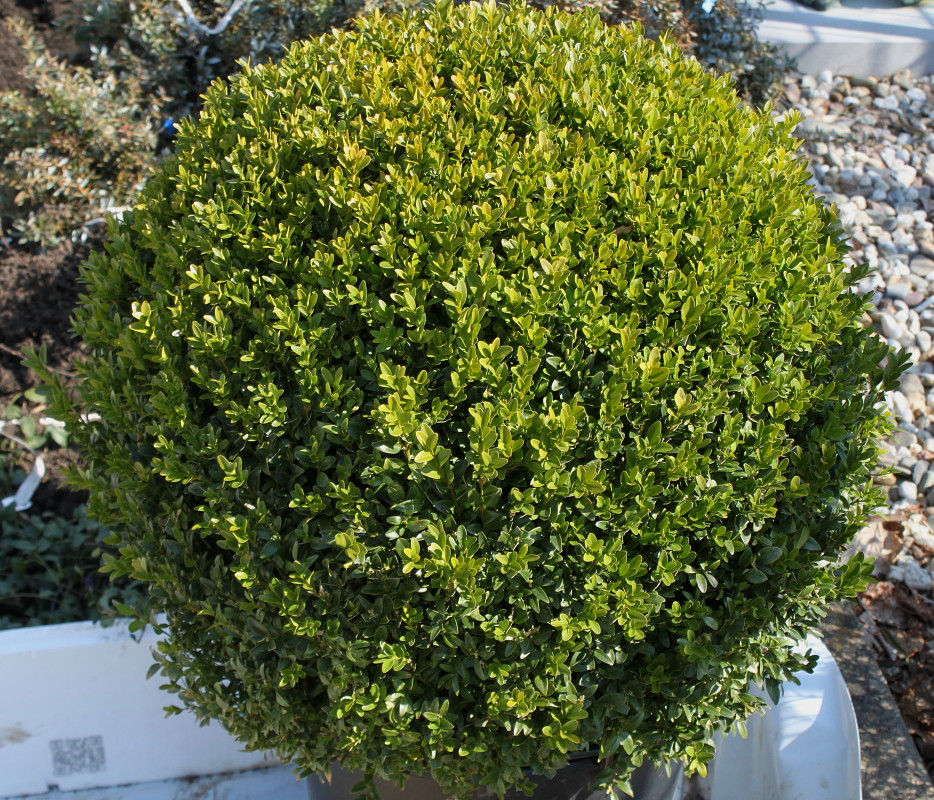
Boxwood evergreen (Buxus sempervirens L.). Germany, Kempen
In cultivation since ancient times. Often mentioned by classical authors. According to the ancient Roman poet Ovid, the goddess Athena made a flute from boxwood.
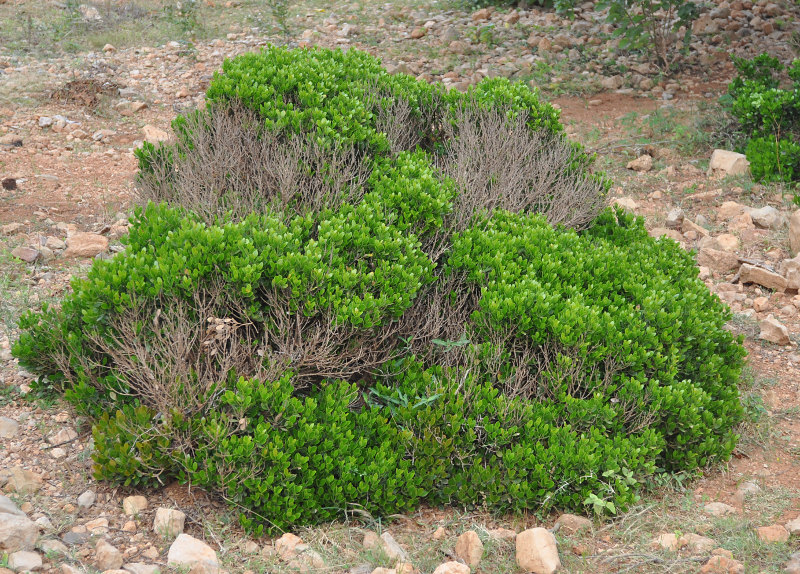
Buxus hildebrandtii Baill. (Hildebrandt's boxwood). Socotra, Homh plateau.
Widely distributed worldwide. It has three main ranges: African (forests and forest-steppes of the southern part of Equatorial Africa and on Madagascar – 15 species), Central American (tropics and subtropics in the southern part of North Mexico and on Cuba – 30 species), Euro-Asian (from the British Isles to Southern Europe, Minor and Near East, Transcaucasia, through China, Japan and to Sumatra – 20 species). Most species grow in the tropics.
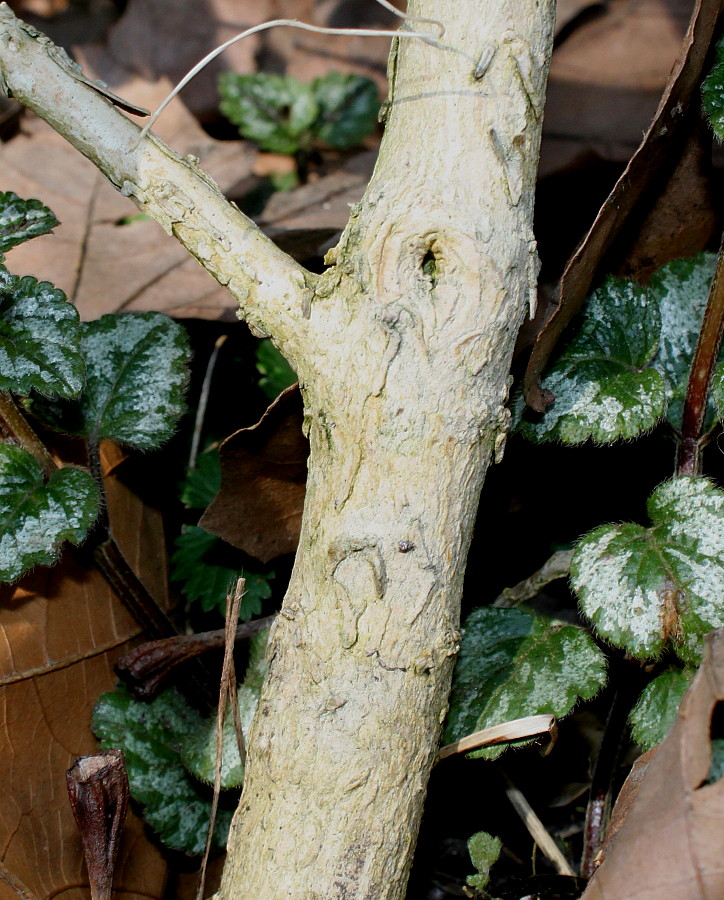
Buxus henryi Mayr (Henry's boxwood). Germany, Krefeld, botanical garden.
They are evergreen shrubs or subshrubs (rarely perennial herbs) or small trees 2-12 (15) m tall. The trunk diameter of 100-year-old trees reaches only 5- cm. Crown rounded, compact, dense, less often sprawling. Bark gray-brown (rarely whitish-gray), young shoots light green. In nature the trunk and branches are covered with a layer of moss, which helps retain needed moisture during hot periods and protects from frost in winter. Grows slowly (up to 1 mm per year); can live up to 500 years.
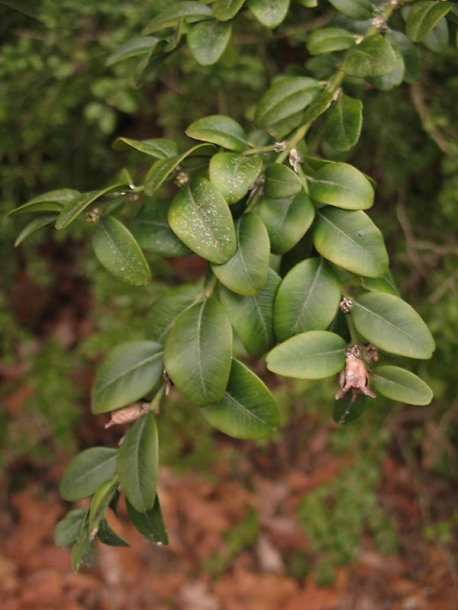
Buxus hyrcana Pojark. (Hyrcanian boxwood). Branch with fruits. Azerbaijan, Hyrcanian National Park.
Leaves opposite, 1-5 cm long (depending on species), entire, elliptic or rounded, entire-margined, sessile or shortly petiolate, leathery, glossy, in semi-shade dark green, in sun light green, when lacking moisture – yellowish.
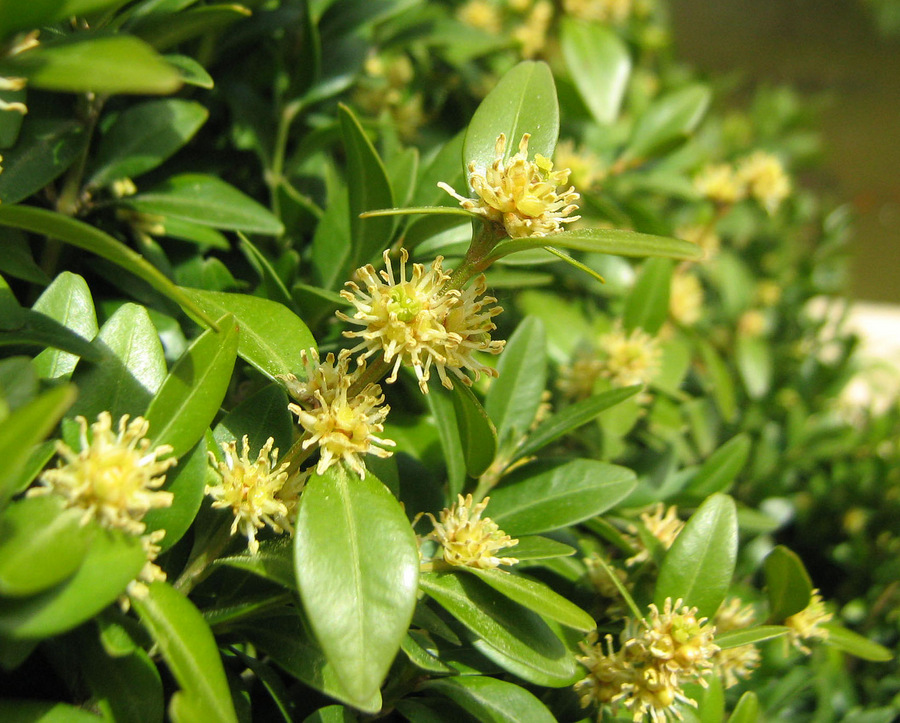
Buxus sempervirens L. (evergreen boxwood). Shoot tip with inflorescences. Southern coast of Crimea, Nikitsky Botanical Garden.
Flowers in spring (depending on conditions from March to May). Flowers unisexual, small, inconspicuous, yellowish-green, borne in axillary inflorescences, fragrant. Male flowers have 4 sepals and 4 stamens; female flowers have 6 sepals and 3 styles. Flowers are insect-pollinated; self-pollination is also possible.
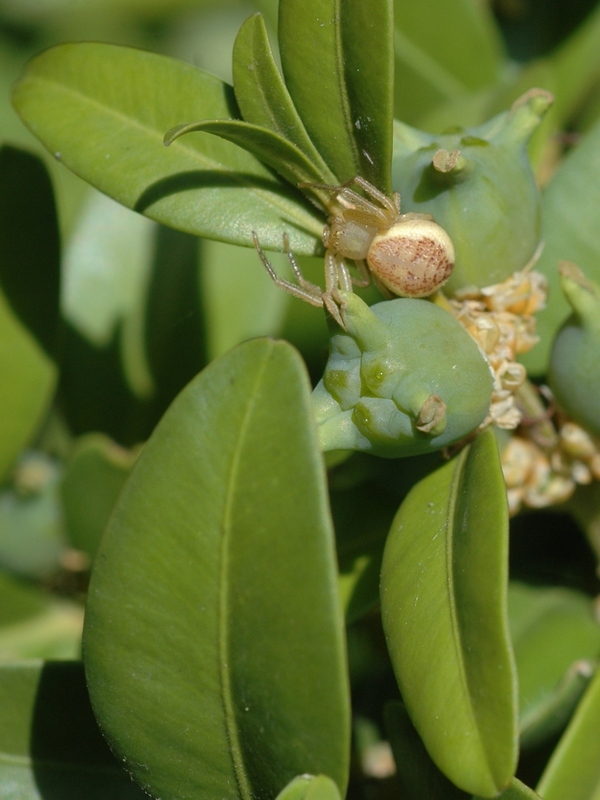
Buxus sempervirens L. (evergreen boxwood). Developing fruit. Almaty, introduction nursery. .
Fruits – small globose-ovoid three-celled capsules that, when ripe, open and eject shiny black seeds (the inner layer of the perianth sharply bends and quickly separates from the outer layer).
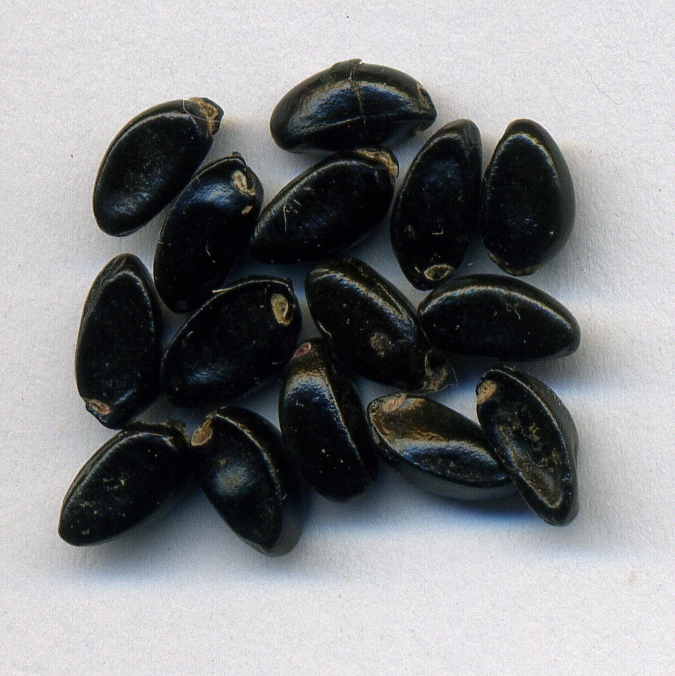
Buxus colchica Pojark. (Colchic or Caucasian boxwood). Seeds. Abkhazia, Gudauta district, New Athos, Armenian Gorge.
All parts of the plant, and especially the leaves, are very poisonous.
Species: according to various sources the genus comprises from 40 to 104 species. Some of them:
Buxus balearica Lam.
Buxus cephalantha H.Lev. & Vaniot
Buxus harlandii Hance
Buxus liukiuensis (Makino) Makino
Buxus microphylla Siebold & Zucc.
Buxus microphylla var. japonica
Buxus microphylla var. microphylla
Buxus microphylla var. tarokoensis
Buxus rugulosa Hatus.
Buxus rugulosa var. prostrata
Buxus rugulosa var. rugulosa
Buxus sempervirens L. (including Buxus colchica Pojark. and Buxus hyrcana Pojark.)
Buxus sinica (Rehder & E.H.Wilson) M.Cheng
Buxus sinica var. insularis
Buxus sinica var. sinica
Buxus stenophylla Hance
Buxus vahlii Baill.
Buxus wallichiana Baill.
Hardiness zone: some species tolerate frosts down to -20 to -23 °C (zone 5b).

Location: undemanding; can grow on forest edges, rocky screes, in shrub thickets and dark deciduous forests. Shade-tolerant, warmth-loving. In nature grows on slightly acidic soils. Most decorative on calcareous, well-drained, dry fertile loams. Does not like prolonged low air humidity.
Planting: preferably plant in spring so young plants have time to root and prepare for cold. Mature trees are transplanted in summer with a root ball. Autumn plantings are possible a month before the first frosts. Soil mix: leaf mold, humus and sand in ratio 1:2:2.
Care: In hot periods watering is necessary – 1-2 buckets per plant. When young they need protection from winter desiccating winds and the burning spring sun. Boxwoods are most sensitive during long winters with alternating frosts and thaws, and with changes between cloudy and bright sunny days. During this period the root system is dormant while the aboveground parts become active and the leaves do not receive sufficient moisture. Mulching with peat or decomposed conifer needles is recommended. When temperatures drop to -10 °C, it is recommended to shade the crown – globular forms are completely covered with plastic or wooden boxes with ventilation holes; standards are tied to supports and completely wrapped with conifer boughs or non-woven fabric. Woody trunks can be whitewashed with garden paint. Low hedges and borders are covered with burlap or non-woven fabric in 2-3 layers; to prevent breakage shrubs can be tied. When warm spring weather arrives the covering should be removed, otherwise plants may rot. Remaining snow should be shaken off and cleared from around the plant to warm the soil faster. The covering should be removed in cloudy weather, leaving one layer of non-woven fabric or a small amount of conifer boughs. After 7-10 days the plant can be completely uncovered.
Pruning: tolerates clipping and pruning well. Pruning is done several times per season; if necessary, trimming can be done at any time of year.
Propagation: in nature reproduces vegetatively and by seed. In cultivation propagated by summer and autumn cuttings. Seed propagation is rarely used because seeds have a very long dormancy period. When sowing, seeds are sown immediately after collection, in July-August. Summer cuttings are taken immediately after lignification at the base – late June – early July. Autumn cuttings are taken at the end of August – beginning of September, 5-10 cm long (2-3 internodes). Cuttings are planted in a loose substrate of peat and garden soil in a 1:1 ratio and covered with jars or film. With regular watering, cuttings root by the 3rd week. After that young plants are planted into a nursery for growing on at a spacing of 10x10 cm. Rooting success of cuttings depends on the species and ranges from 80-100%. By autumn small bushes form that are ready to be transplanted to a permanent place. Layering can be used: on young shoots growing near the surface make an oblique cut and insert a small stone. The shoot is bent to the ground and fixed with staples. Shoot tips should be tied to stakes so that the layers grow upward.
Diseases and pests: resistant to diseases and pests.
Uses: seven species are used in ornamental gardening. They are used in solitary and group plantings, for creating free-growing or clipped hedges and borders, compositions, and for growing in tubs or containers. Also widely used in topiary art and bonsai. Valued for the dense beautiful crown, glossy foliage, and good tolerance of clipping. Catholics decorate their homes with boxwood branches on Palm Sunday. Good honey plant (the honey is poisonous). The wood is highly valued as the hardest and most dense among European plants and is used in wood carving, for making chess pieces, small utensils, machine parts, musical instruments, measuring instruments, smoking pipes, surgical and optical instruments, and many other items where wood with an ideally smooth surface and high wear resistance is required. Used rarely in medicine due to high toxicity.