Flowers for the garden
Bupleurum
Bupleurum
Bupleurum (lat. Bupleurum) — a genus of plants of the Umbellifer family (Umbelliferae).
Perennial or annual herbaceous plants. They grow on wet meadows, on slopes, and on sea cliffs.
The root is strong, a taproot. Stem erect, up to 1 m tall. Basal leaves are longer, the middle and upper ones shorter than the lower ones. Bupleurum leaves, resembling cucumber leaves, have a bluish sheen because they are covered with a waxy bloom.
Flowers with petals bent inward, yellow. Calyx larger than the flower, green. Fruit — a achene. Flowers in June — July, fruits in July — August.
The following species are most commonly found in cultivation:
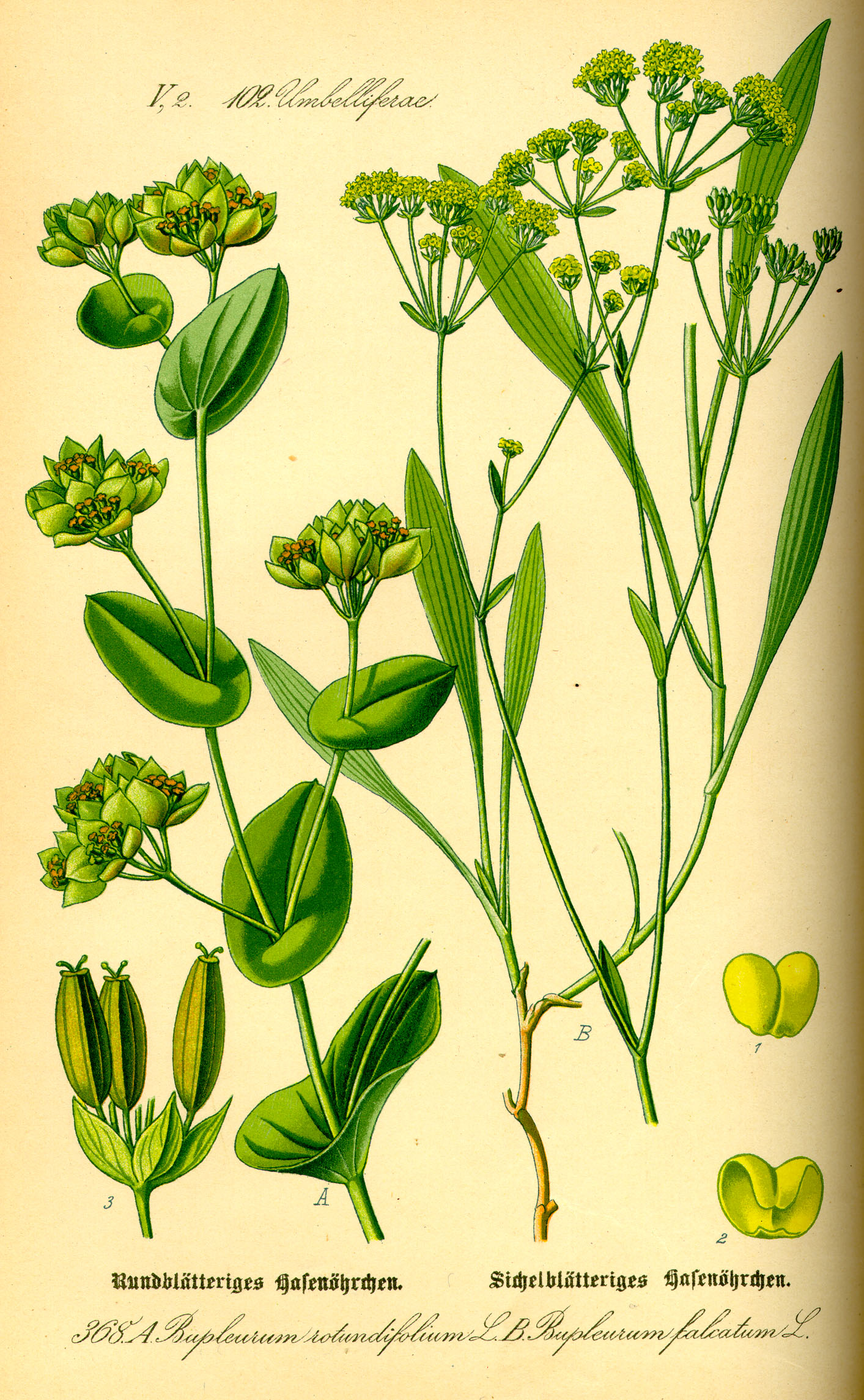
Round-leaved Bupleurum - Bupleurum rotundifolium
An annual plant reaching a height of 25 to 70 cm. Root a taproot; stems branched in the upper part, hollow, smooth, glabrous. Basal leaves without petioles. Stem leaves simple, without petioles, ovate, rounded or elliptic, flat or cup-shaped. Inflorescence - an umbel, several on the flowering stem, corymbose. Petals yellow or yellowish-green, glabrous, entire at the apex, bent inward. Flowers from June to August.
Long-leaved golden Bupleurum - Bupleurum longifolium aureum
Perennial plants 25 to 150 cm tall. Stems branched in the upper part, hollow, smooth, glabrous. Basal leaves gradually tapering into the petiole. Leaf blades oblong-obovate, entire, glabrous, 10-15 cm long. Stem leaves simple, without petioles, cordate at the base. Umbels several on the flowering stem, corymbose, 5-10 cm in diameter. Petals yellow, glabrous, entire at the apex, bent inward. Fruits 4-6 mm long.
Location: Requires a well-lit site; in shade the plant loses its appearance and becomes leggy.
Soil: Not demanding with regard to soil; grow well in all soils except acidic and strongly alkaline ones.
Propagation: by seeds, which are sown in April-March into the ground or sown for the winter.