
Deciduous shrubs
Thunberg barberry Kelleriis
Berberis Thunbergii Kelleriis
Synonyms: Berberis thunbergii 'Green Mantle', Berberis thunbergii 'Green Marble'
Thunberg barberry Kelleriis – a cultivar of Thunberg barberry. It was developed in Denmark. It is presumed to be a hybrid of Berberis thunbergii and Ottawa barberry.
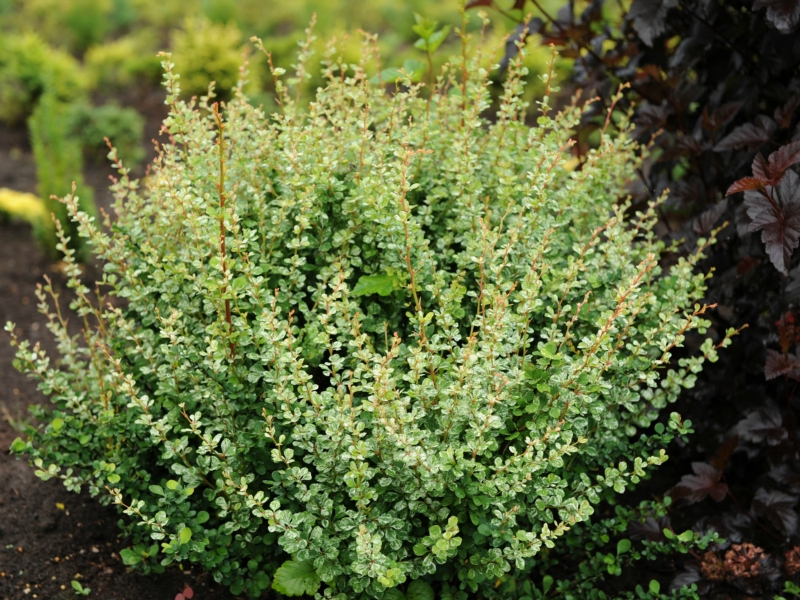
It is a tall deciduous shrub 1.5-2 (2.5-3) m high and 1.5-2 m wide, with a spreading, broadly open crown. Shoots are gray-brown, grow vertically with slightly drooping tips; new growth is bright green, later turning red. Grows fairly quickly, annual growth up to 15 cm. Spines are small, stiff, and sharp.
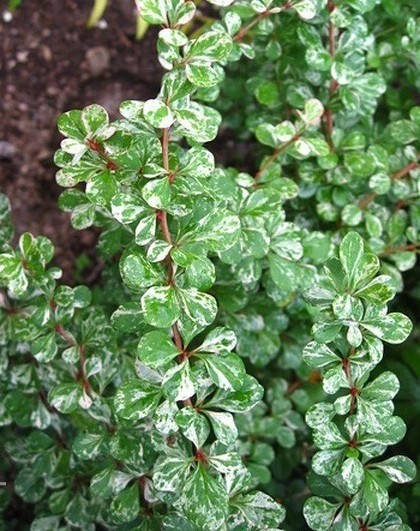
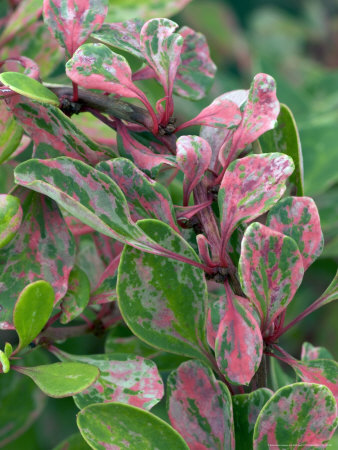
Leaves alternate, oblong-ovate, deep green with white spots. In autumn the white parts of the leaf develop pink and dark chestnut tones.
Blooms in April – May. Flowers are small, up to 1 cm in diameter, in clusters of 2-5 or solitary.
Fruits rarely. Fruits are elongated, coral-red, glossy. They ripen in September-October and persist on the branches for a long time.
Hardiness zone: 5b - 8b (-20°C).
Location: sun-loving, but can tolerate light partial shade. Heat-tolerant, winter-hardy, drought- and wind-resistant, relatively smoke-tolerant. Does not tolerate prolonged waterlogging. Undemanding to soil, but prefers fertile, moderately moist, acidic or slightly alkaline (pH = 4.5 – 7). Performs well in urban conditions; hardy.
Planting: planting is best carried out in spring or autumn. If soil pH is above 7, liming of the soil is recommended. Planting mix: peat, topsoil, humus in a ratio of 1:1:1, 400 g of slaked lime (if pH>7) and 200 g of wood ash. Planting hole size: 40x40 cm. For single plantings, spacing between plants should be 1.5-2 m. To create a hedge, prepare a trench and place shrubs at a rate of 2 shrubs per 1 linear meter.
Care: care consists of shallow cultivation of the root circle and mulching. Watering is recommended at least once a week with 2-3 buckets per plant. In spring, one year after planting, nitrogen-containing fertilizers can be applied. Further nitrogen feeding should be done no earlier than every 3-4 years. In the first 2-3 years it needs to be covered with conifer boughs.
Pruning: tolerates pruning well.
Propagation: by cuttings, division of the bush, root suckers.
Diseases: bacterial canker, powdery mildew of leaves, leaf spot, powdery mildew. Resistant to rust fungus.
Pests: barberry aphid, barberry sawfly, barberry fruit moth, leaf-eating insects.
Uses: used as a specimen plant, in group plantings, in hedges, and in compositions.