
Deciduous shrubs
Berberis thunbergii 'Golden Dream'
Berberis Thunbergii 'Golden Dream'
Berberis thunbergii 'Golden Dream' – a cultivar of Thunberg's barberry. The breeder of the cultivar is the Czech selector Michal Andrusiv (Michal Andrusiv). The cultivar originated in Litomyšl (Czechia) from an unknown Thunberg barberry cultivar as a result of open pollination in 2003 under a program of breeding the female parent. In 2005 a single unique plant with the required characteristics was selected from the obtained seedlings.
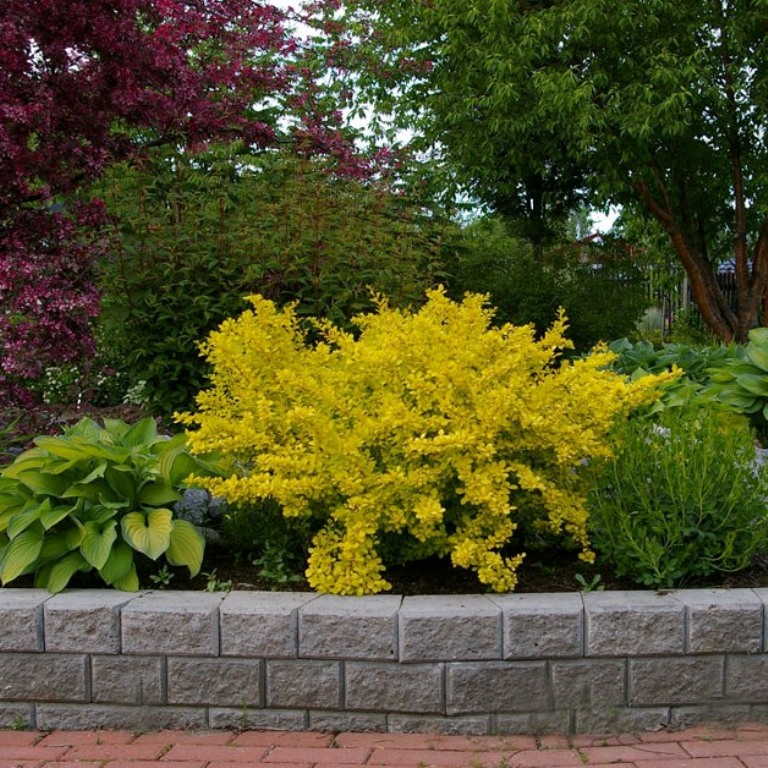
It is a perennial deciduous shrub with a spreading crown. Shoots are red-brown, growing upright with arching tips. It reaches 50-70 cm in height and up to 80 cm in width. Growth rate is moderate, 10-20 cm per year, while the crown becomes denser with shoots. Thorniness is moderate, thorns up to 7 mm long and 1 mm wide.
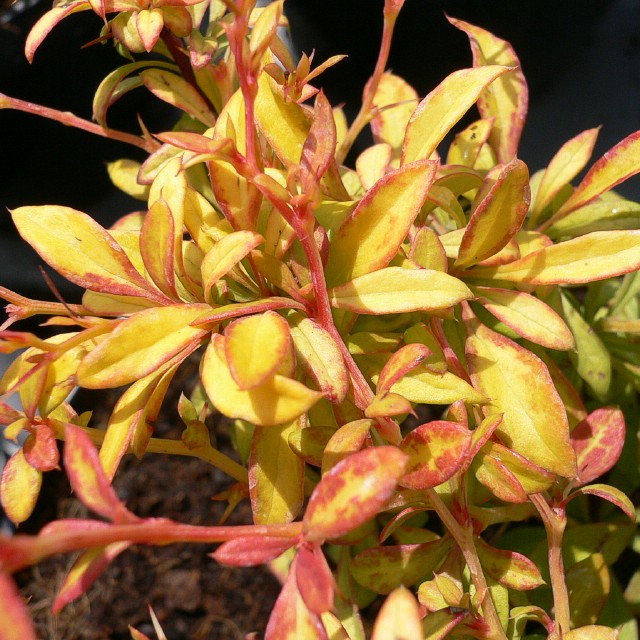
Leaves are almost sessile, small, 1.9 cm long and 0.7 cm wide, from obovate-lanceolate to obovate, bright yellow. In late summer – early autumn they acquire orange-coral tones. Roots are short, up to 1 cm in length and in diameter.
Does not flower and does not set fruit.
Hardiness zone: 5
Location: sun-loving, but tolerates partial shade. Heat-resistant, winter-hardy, drought- and wind-resistant. Does not tolerate prolonged waterlogging. Prefers fertile, moderately moist soil. Tolerates urban conditions well.
Planting: planting is best done in spring or autumn. If acidity is above pH 7, liming the soil is recommended. Planting mix: peat, sod/topsoil, humus, 400 g hydrated lime (if pH>7) and 200 g wood ash. Planting hole size: 40x40 cm. For solitary planting, spacing between plants should be 1.5-2 m. For creating a hedge, prepare a trench and place shrubs at a rate of 2 plants per linear meter.
Care: care consists of shallow loosening of the root circles and mulching. Watering is recommended at least once a week, 2-3 buckets per plant. In spring, one year after planting, nitrogen-containing fertilizers may be applied. Subsequently, nitrogen feeding should not be carried out earlier than after 3-4 years. In the first 2-3 years it needs to be sheltered with conifer boughs.
Pruning: does not require clipping, as it forms a beautiful dense crown.
Propagation: in Litomyšl (Czechia) in 2000 it was propagated by green cuttings, and it was established that the cultivar's characteristics are stable and are well reproduced vegetatively. It is not propagated by seeds.
Diseases: bacterial canker, powdery mildew, septoria leaf spot, infectious branch dieback, Phyllosticta leaf spot, leaf spot, rust fungus Puccinia graminis.
Pests: barberry aphid, barberry sawfly, barberry fruit borer, leaf-chewing insects.
Uses: one of the best barberry cultivars for creating borders, decorating small home plots, and as an element in color compositions that changes its hues depending on the season or climate.