
Deciduous shrubs
Thunberg's barberry
Bérberis thunbergii
Thunberg's barberry – the most beautiful shrub species of the genus Berberis (Berberis) of the family Berberidaceae (Berberidaceae). In nature it occurs in the Far East (mountain slopes of China and Japan). Naturalized in North America and Europe. Cultivated worldwide. In cultivation since 1864.
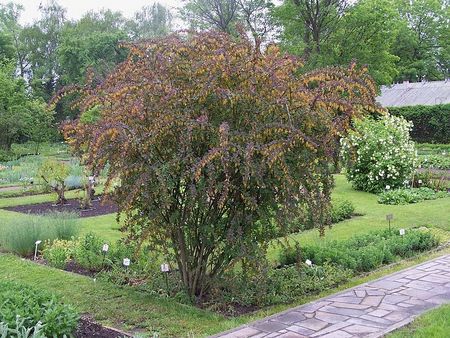
It is a small deciduous shrub up to 2.5 m in height. Branches are arching and ribbed. Shoots are red-orange or bright red, later becoming brown or dark brown. Shoots are covered with spines up to 1 cm long, rigid, simple.
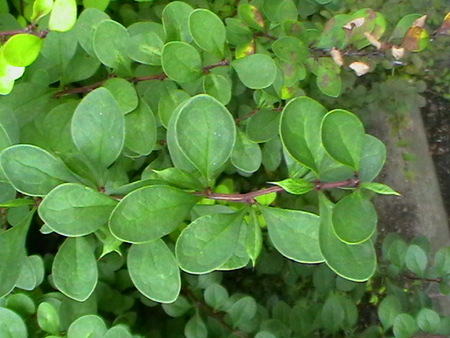
Buds ovoid in shape, with an acute tip, 0.5 mm long, reddish. Leaves graceful, small, 1-3 cm long and up to 1 cm wide, rhombic-ovate, spatulate or rounded, with an acuminate or rounded apex, narrowed toward the base and passing into a short petiole, entire-margined, bright green above, bluish below, turning bright red in autumn.
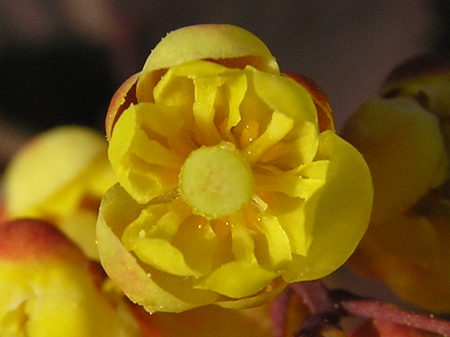
Flowers are gathered in few-flowered short racemes of 2-5 in clusters or solitary, yellow in color, reddish outside, up to 1 cm in diameter, with a sweet, tart aroma. Blooms in May for 8-12 days.
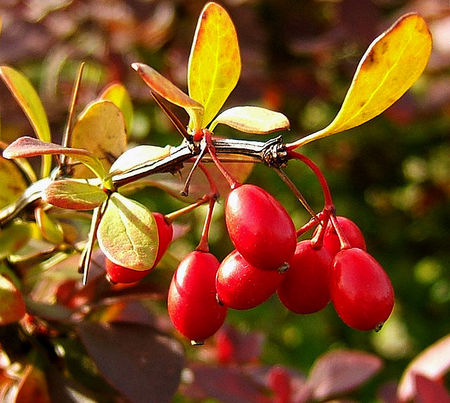
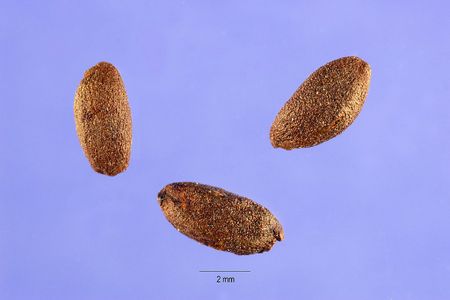
Fruits – coral-red berries of ellipsoid shape, glossy, up to 1 cm long, have a slightly bitter taste, therefore not suitable for eating. 1 kg = 5.9 thousand fruits, or 88.5 thousand seeds; weight of 1,000 seeds 9—17.6 g. It fruits annually, fairly abundantly. Fruits ripen in September-October and persist on the branches for a long time.
Forms: f. minor Rehd., f. pluriflora Koehne, f. argentea-marginata С. K. Schneid., f. Maximowiczii Rgl, Berberis thunbergii var. atropurpurea Chenault
Cultivars: Dwarf - 'Kobold', 'Minor', 'Aurea', 'Atropurpurea Nana' ('Crimson Pygmy'), 'Bagatelle', 'Admiration'; tall - 'Atropurpurea', 'Golden Ring', 'Dart's Red Lady', 'Erecta', 'Green Carpet', 'Green Ornament', 'Vermillion', 'Red Chief', 'Helmond Pillar', 'Electra'; variegated - 'Harlequin', 'Pink Queen', 'Rose Glow', 'Rozetta', 'Silver Beauty', 'Kelleriis'.
Hardiness zone: 4-8. In severe winters the non-woody parts of shoots may freeze. Young plants are recommended to be covered for the winter.
Location: winter-hardy, drought-tolerant. Not demanding on soil, can grow on poor soils. Grows well on dry and sandy soils. Prefers soil with normal acidity, but can also grow on higher acidity. Does not tolerate waterlogging. Light-loving. Tolerates urban conditions well.
Planting: planting is best done in spring or autumn. If acidity is above pH 7, it is recommended to lime the soil. Planting mix: peat, topsoil, humus, 400 g of slaked lime (if pH>7) and 200 g of wood ash. Size of planting hole: 40x40 cm. For single planting, the distance between plants should be 1.5-2 m. To create a hedge prepare a trench and place bushes at a rate of 2 bushes per 1 linear meter.
Care: care consists of shallow loosening of the root circles and mulching. Watering is recommended at least once a week with 2-3 buckets per plant. In spring, one year after planting, nitrogen-containing fertilizers can be applied. Subsequently nitrogen feeding is carried out no earlier than every 3-4 years.
Pruning: tolerates trimming well.
Propagation: for spring sowing of seeds stratification is required at a temperature of 1 - 5°C for 3-4 months. Seeds can also be sown in autumn without stratification immediately after collection or cleaned of pulp. Sowing depth 2-3 cm. Rooting percentage of summer cuttings 80-90%. Seed viability 92%.
Diseases: bacterial canker, powdery mildew, septoria leaf spot, infectious dieback of branches, phyllosticta leaf spot, leaf spot. Not affected by rust.
Pests: barberry aphid, barberry sawfly, barberry fruit moth, leaf-eating insects.
Uses: Good honey plant. Has versatile use in landscape design. Planted near water bodies and in rock gardens, in formal sites and in landscape compositions, for creating low hedges. Look good as accents in dwarf plantings and as elements in large compositions. Also planted in borders among perennial flowers. In cold regions can replace boxwood. Decorative in autumn due to the intense leaf coloration and bright red fruits.