
Deciduous shrubs
Ottawa barberry
Berberis × ottawensis
Synonyms: Berberis × ottawensis var. purpurea C.K.Schneid. ex Rehder, Berberis × ottawensis C.K.Schneid. ex Rehder
Berberis ottawensis – a species of Berberis (Berberis) in the family Berberidaceae. An ornamental hybrid of B. thunbergii and the purple-leaved form of common barberry (B. thunbergii х B. vulgaris f. atropurpurea). The hybrid was obtained in the early 20th century in Ottawa (Canada). In cultivation since 1889.
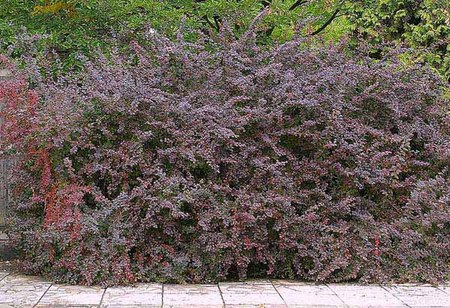
It is a deciduous shrub with densely branched and broadly spreading crown. Reaches 1.5-2 (3-4) m in height. Grows rapidly. Branches long, brown, upright when young, later spreading. Shoots yellowish-brown, less often red, ribbed, arching, smooth. Spines small, up to 1 cm long, single, three-divided, simple, thin.
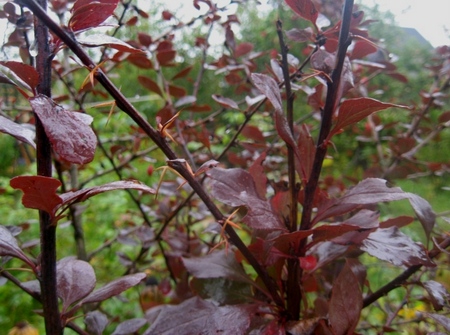
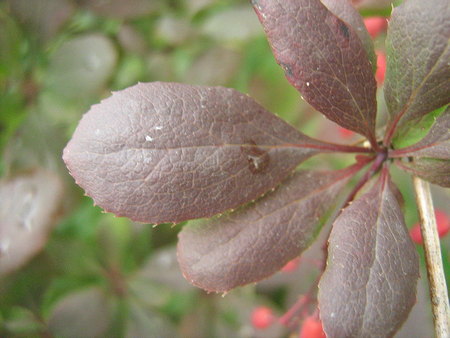
Leaves obovate or almost rounded, 35 cm long, unevenly finely serrated or entire, with a shortly spinose apex, narrowed into a short petiole, decoratively colored throughout the growing season (depending on the cultivar color varies from greenish-purple and red-purple to dark pink-purple or almost black). In autumn they turn crimson and remain on the plant for a long time.
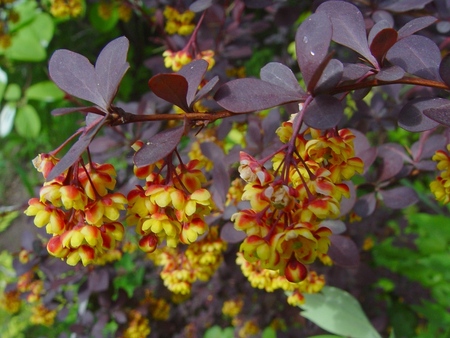
Blooms in early June – early May. Flowers externally yellow, less often red and inside yellow or yellow-red, small, up to 1 cm in diameter, collected in inflorescences of 5-10 flowers.
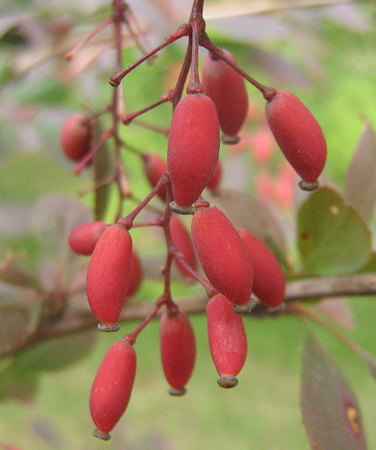
Fruits elliptical or oblong-ovoid, up to 1 cm long, shiny, red, edible.
Cultivars: "Аурикома" ('Auricoma'), "Суперба" ('Superba'), "Серебрянная миля" ('Silver Miles').
Hardiness zone: 4-9 (-29 °C).
Site: light-loving but tolerates partial shade. Heat-resistant, winter-hardy, drought- and wind-resistant, relatively smoke-resistant. Does not tolerate prolonged waterlogging. Prefers fertile, moderately moist soil. Tolerates urban conditions well.
Planting: planting is best done in spring or autumn. If soil acidity is above pH 7, liming of the soil is recommended. Planting mixture: peat, turf soil, humus, 400 g of slaked lime (if pH>7) and 200 g of wood ash. Planting hole size: 40x40 cm. For single planting, the distance between plants should be 1.5-2 m. To create a hedge, prepare a trench and place shrubs at a rate of 2 shrubs per linear meter.
Care: care consists of loosening the soil in the root circles, but not deeply, and mulching. Watering is recommended at least once a week with 2-3 buckets per plant. In spring, one year after planting, nitrogen-containing fertilizers may be applied. Thereafter nitrogen feeding is carried out no sooner than every 3-4 years. In the first 2-3 years it needs to be covered with conifer boughs for winter protection.
Pruning: sanitary pruning
Propagation: for spring sowing stratification is required at 1 - 5 °C for 3 - 4 months. Seed sowing depth 2 - 3 cm. Seed germination 5-12%, viability 60%. Rooting of summer cuttings 50%.
Diseases: bacterial canker, powdery mildew, septoria leaf spot, infectious branch dieback, phyllosticta leaf spot, leaf spot, rust fungus Puccinia graminis.
Pests: barberry aphid, barberry sawfly, barberry fruit borer, leaf-eating insects.
Uses: used in single plantings, in groups, in parks and gardens, for creating tall hedges, in containers. Popular due to high winter hardiness, fast growth rate and unpretentiousness.