
Conifers
Banks' pine
Р. banksiana Lamb.
The species was named in honor of the well-known English botanist and naturalist Joseph Banks. Cultivated in Europe since 1785. In the wild it grows in the eastern part of northern America from Mackenzie and "Bear Lake" in Canada to northern Maine (USA) and Vermont. The northernmost pine of the Americas. Lives up to 150 years (sometimes up to 300 years).
A medium-sized tree 18-20 (25) m tall and 6-10 m wide. Trunk 0.6-1.5 m in diameter, often branching in a bushy manner. In youth the tree is fast-growing, 60-90 cm per year, later it grows mainly in width. By age 50 it reaches about 12 m in height with a trunk diameter of 20 cm. Crown loosely ovoid, dense, in old trees broadly spreading. Root system deep, sensitive to flooding and compaction. Bark reddish-brown, covered with thick scaly plates. Whorled branching not pronounced. Buds up to 8 mm in length, brown or light-brown in color, covered with resin, shiny, oblong-ovoid, scales closely appressed. Shoots flexible, thin, light yellow or green, slightly pubescent when young, later glabrous, from reddish to brown. Aromatic resin exudes abundantly on the shoots.
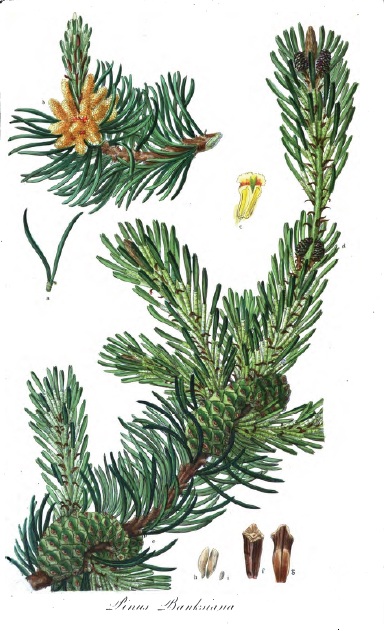
Needles curved, in fascicles of 2, short, 2-4 cm long, 1-1.5 mm thick, twisted, serrated at the edge, yellowish at first, later dark green, persist on the tree for 3-5 years.
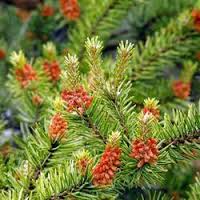
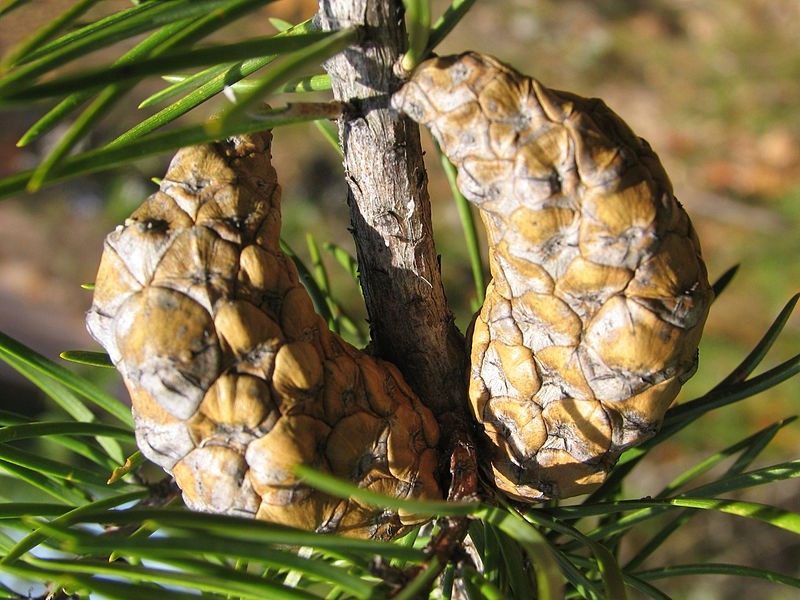
Flowers in the first ten days of May. Cones short, lateral, very strongly curved, borne about 1-3 (text states 13 but usually 2) per shoot, oblong-ovoid, 4.5 cm long, matte-gray to glossy. They often remain closed on the tree for many years. Seed scales rhomboidal, shields protrude on the outer side, apex flat, sometimes depressed. Seeds small, 2.5-4.5 mm long, 2.5 mm wide, dark-brown, strongly obtuse. Seed wing transparent, 12 mm long.
Hardiness zone 4.
Cultivars: Anna (f. Annae), Abs WB, Arctis, Banska Stiavnica, Bety, Chippewa, Gola WB, Gosia, Jiskra WB, Kimmerholz, Kocourok, Kysihybl WB, Manomet, Martin Novak, Mini Blato, Nana, Neponset, Novak, Pendula, Pospisil, Repens, Schneverdingen, Schoodic, Skolka, Stubka, Tear Drop, Uncle Fogy, Vladar, Welch, West Lake, Winnipeg, Wisconsin
Site: Drought- and frost-resistant. Undemanding to soil, can tolerate slight salinity and compaction. Susceptible to damage from heavy snow loads, so it is recommended to plant it under shelter or near larger deciduous or coniferous trees. Less light-demanding than Scots pine. Tolerates dry air. Wind-resistant. Can be used for soil stabilization (sand fixation).
Planting: Planting is recommended from November to February. Planting hole depth 0.8-1 m. Distance between plants at least 4 m. On heavy soils with excess moisture it is recommended to make 20 cm drainage. Soil mix: sand, peat and topsoil in ratio 2:1:1 – for planting into neutral reaction soils. For acidic soils add 200-300 g of lime per hole. Add superphosphate 150 g/hole to the planting mix; in autumn apply phosphorus-potassium fertilizers. Transplants well.
Care: In the second year after planting apply a complete fertilizer, and in the second half of summer use phosphorus-potassium fertilizers 40-50 g per 10 l of water.
Pruning: Sanitary pruning. For formative pruning it is recommended to remove no more than 1/3 of the green mass. To increase crown density remove one-third of the current year's growth while preserving the crown shape. Do not leave bare branches without needles. Formative pruning should not be done earlier than one year after planting. Pruning is recommended from early spring to late autumn.
Propagation: Easily propagated by seed. May produce abundant self-seeding, naturally regenerating and spreading.
Uses: Used in shelterbelts, parks, gardens. Looks effective in groups. Recommended for planting near sanatoriums or holiday homes. Wood used in construction. In forestry can be used for soil stabilization.