
Herbs
Arundo (reed)
Arundo donax
Arundo (Latin: Arundo) — a small genus of perennial herbaceous plants of the grass family (Poaceae).
Often grows in dense stands along riverbanks and in still waters, in silty substrate in the tropical and subtropical zones of Eurasia and Africa.

Perennial 1.5—4 m high, with a long thick rhizome. Stems with numerous nodes. Leaf blades linear-lanceolate, 2.5—6 cm wide. Panicles 20—70 cm long, fairly dense, after flowering somewhat silvery from long hairs arising from the lower floral glumes; spikelets 0.8—1.2 cm long, with 3—5 flowers; lower floral glumes with a broad-lanceolate base, awl-shaped, without awns. Flowers in autumn.

In favorable conditions of southern frost-free regions (Southern Crimea, Transcaucasia) it reaches 5 m! It resembles our native reed and often grows the same way — along ditches. It also sticks out and unfurls flat stiff leaves in the wind and is crowned with a luxuriant panicle. In northern regions, where its development is limited by the need to be moved in for the winter, it is less impressive — at best it grows to 2 m.

A variegated form is known — Arundo donax var. Variegata. It has beautiful white stripes on the leaves, but is not as tall and is less winter-hardy.
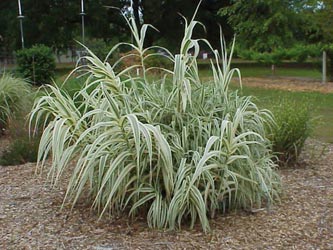
Location: develops well in sun, in loose sandy or peat soil. Recommended for decorating the shoreline of a pond. In this case the container is placed in the pond so that it is fully or partially submerged. However, in open sites, in dry soil the rhizomes mature better and overwinter more successfully.
Care: in more southern areas the leaves are cut in autumn and the plant is given shelter. Only under these conditions can the plant be protected from freezing. Further north, plant in large containers so that it can be taken indoors for the winter into fertile light (sandy or peat) soil. For summer choose a warm and sunny location. Move to a cellar in time before severe frosts begin.
Propagation: by division of the rhizomes and by offshoots.
