
Flowers for the garden
Armeria
Armeria
Armeria (Lat. Armeria) - a genus of perennial herbaceous plants of the family Plumbaginaceae (Plumbaginaceae). The genus includes more than 100 species, mainly occurring in the Mediterranean.
The name comes from the Celtic 'ar' — near, close to and 'mor' — sea — referring to the habitat of one of the species of the genus.
Perennial herbaceous plants 30-40 cm tall, with numerous linear leaves forming a basal rosette. Flowers small, pink, lilac, or white in terminal head-like inflorescences surrounded by dry membranous bracts. Scapes erect, slender, pubescent. Blooms from May to August.
In cultivation:
Sea thrift — Armeria maritima
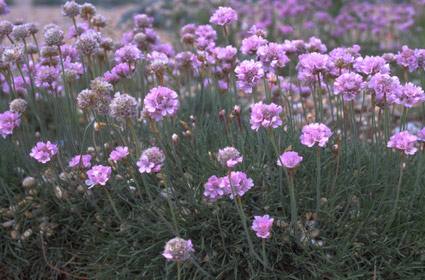
A perennial cushion-forming plant 15-20 cm high and 15 cm across, with narrow, flat, blue-green leaves. Flowers lilac-pink, grouped in capitula, covered by membranous bracts. Scapes up to 20 cm tall, villous. Flowers from May, sometimes reblooming in autumn. In cultivation since 1627.
There are cultivars and forms with white, pink, carmine-red and dark-red flowers, as well as a dwarf form with very narrow leaves.
Alpine thrift — Armeria alpina
A perennial plant forming dense cushions 20-30 cm across and 8-15 cm high. Leaves in a basal rosette, linear-lanceolate. Some leaves overwinter. Flowers small, pale pink, in a capitulum up to 3 cm in diameter. Scapes 20-30 cm tall, leafless. Flowers in June. In cultivation since 1768. It has many cultivars grown in rock gardens, for example: 'Alba' with white flowers, 'Rosea' with carmine-pink flowers, 'Laucheana' with carmine-red flowers, and others.
Turf Armeria — Armeria juniperifolia
A perennial plant forming a dense cushion 5-15 cm high, 15-20 cm across. Narrow, linear leaves are gathered in a rosette. Flowers red or pink in capitula, surrounded by dry membranous bracts, creating such an abundance that they completely cover the green rosettes. Scapes 5-6 cm tall. Flowers from July. Older cushions usually break up starting from the center. In cultivation since 1893. Does not tolerate waterlogging.
Location: prefer sunny sites. Most species overwinter without cover.
Soil: light sandy, slightly moist soil, preferably acidic. Do not tolerate lime.
Care: remove inflorescences immediately after flowering. Cover with fir branches for the winter. Divide the clump every 5-6 years.
Propagation: by seeds, division, and cuttings. Take cuttings from spring to autumn. Small rosettes are used for cuttings.
Zone: 3-9.