
Fruit trees
Apricot
Armeniaca
Synonyms: kuraga, morelya, uryuk, zherdel, zheltoslivnik.
Apricot or Common Apricot (Prúnus armeniáca) is a species of the genus Plum (Prúnus) of the family Rosaceae. The name originates from Armenia. The apricot was brought from ancient Sogdiana (Central Asia) to the countries of the Mediterranean. The Arabs called it 'attaikuk', the Spaniards adapted it to 'albaricoque', the French renamed it 'abricot', which led to the German 'Abrikosse', and later the Russian "абрикос". The homeland of the apricot is considered to be the Tian Shan region in China or Armenia. It reached Ukraine from the Middle East in the 17th century. It is widely distributed throughout the world, predominantly in the temperate climatic zone.

It is a deciduous tree 5-8 m high and 5-8 m wide. Crown wide, spreading, may be rounded, somewhat flattened or slightly elongated. Bark gray-brown, longitudinally fissured. Young shoots glabrous, shiny, reddish-brown in color with numerous small lenticels.
Leaves simple, medium-sized (up to 12 cm long), rounded, ovate, attenuate at the apex, doubly- or finely-toothed, smooth, green in color, with long petioles.
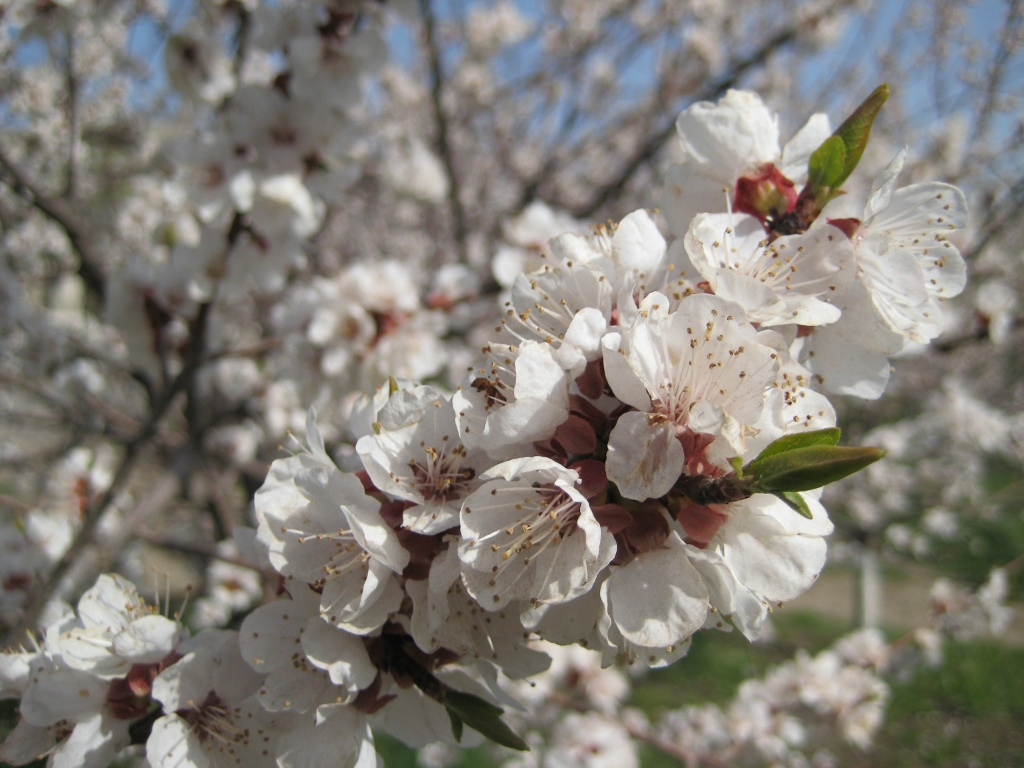
Apricot blooms before the leaves appear, for 5 to 9 days. Flowers white or pink, similar in structure to those of the plum, fragrant. Flowers form on short spur shoots, one bud per shoot. Flowers of all apricot varieties are self-fertile and do not require pollination. It fruits on one-year shoots, which are divided into continuation shoots, fruiting shoots and bouquet spurs. Fruiting shoots are small and thin; bouquet spurs are short (1-5 cm long). One generative flower bud can form only one flower. The bulk of the yield is formed on continuation shoots.
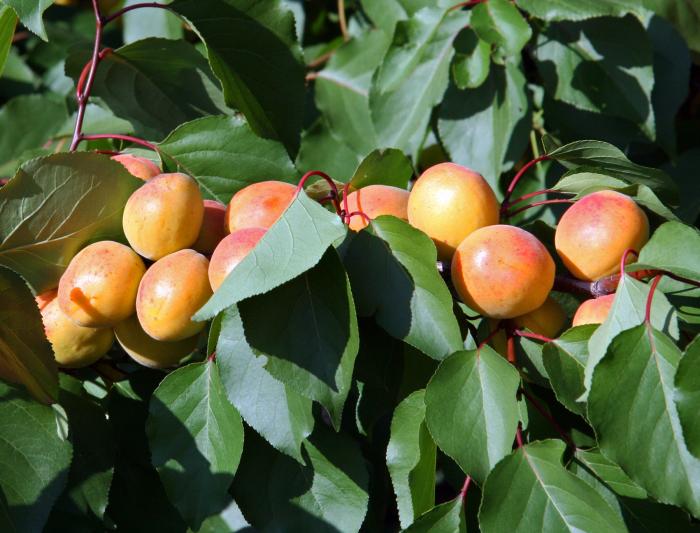
Fruits are drupes of golden-yellow color, round, elliptical or obovate in shape, flattened on the sides, with dense flesh. Average fruit weight – 40 g. The stone is hard, smooth, thick-walled. Fruits ripen in July-August.
Apricot fruits contain: malic and lactic acids, inulin, starch, a small amount of salicylic and tartaric acids, mineral salts, iron and silver, carotene (provitamin A), and vitamin C. The seeds contain up to 50% non-drying fatty oil and vitamin B15. They also contain poisonous substances – the glucoside amygdalin in the amount of 8.43% and hydrocyanic acid (prussic acid) – 0.011%. Amygdalin decomposes in the digestive tract and produces hydrocyanic acid, which is one of the strong poisons.
The tree is frost-hardy (down to -25 degrees Celsius) and drought-resistant. It does not tolerate spring temperature fluctuations during flowering – flowers are damaged even with a short-term drop in temperature to -4 degrees Celsius. Not demanding regarding soil quality, it can grow on clay, dry and rocky soils. It does not tolerate waterlogged soil. Prefers sunny locations protected from wind.
More than 50 cultivars are known, propagated by seed and grafting. The most well-known: Early-ripening – «Самбурский ранний», «Ветеран Севастополя», «Червневый» Mid-season – «Полеський крупноплодный», «Краснощекий», «Шаламарк», «Ботсадовский», «Цегледи Бибер», «Особлывый Дегисюка» Late-ripening – «Искра», «Киевский красень», «Костюженский», «Киевский консервный», «Выносливый», «Сирена
Location: prefers sunny sites protected from cold winds. Undemanding to soils, but needs moist soils.
Planting: seedlings should be planted at a distance of 7x5 m. Planting can be done in spring or autumn, preferably in the second half of April.
Diseases and pests: the most common diseases are monilial blight and powdery mildew. Also dangerous are fungal pathogens of the bark and wood, brown rot, aphids and caterpillars. Infection can be prevented with proper care and treatment with appropriate chemical preparations.
Care: the most optimal crown forms for apricot are the reduced-leader and vase-shaped forms. After entering the fruiting period, one-year shoots are shortened by half or by a quarter depending on their length. Summer pruning can be applied, during which wounds on pruned shoots heal better. When terminal growth decreases to 30 cm, a light rejuvenation pruning is carried out, and when growth decreases to 10-15 cm, rejuvenation pruning to five-year-old wood is performed.
Propagation: apricot is mainly propagated by grafting. Seedlings of apricot, cherry plum (alycha), plum are used as rootstocks, sometimes almond or peach.
Uses: Apricot fruits are used fresh, dried and canned. Seeds are used as food. The wood is used for making musical instruments.