
Climbing plants
Aristolochia or Birthwort
Aristolochia
Aristolochia, or Birthwort (lat. Aristolochia) — a genus of perennial herbs and woody climbers of the family Birthworts (Aristolochiaceae). It includes about 350 species, mostly in the tropics and less often in temperate zones.
The name comes from the Greek 'aristos' - best, and 'lochein' - to bring forth. In old times the plant was regarded as a protector of childbirth.
Most species of birthwort occur in tropical regions of the Americas, Africa and Asia, and only a few species are found in temperate zones.
Birthworts are perennial herbaceous plants with smooth erect or climbing shoots or woody lianas. Leaves simple, alternate, in many species cordate in shape.
Flowers are grouped in short inflorescences in the leaf axils, distinctive, shaped like a strongly curved tube with a wide limb; the fruits are elongated capsules. The following species are widely used for ornamental purposes:
Woolly aristolochia, or Woolly birthwort — Aristolochia tomentosa Sims.
A climbing shrub up to 10 m high. Young shoots pubescent; older shoots dark gray, wrinkled. Leaves large (16 x 13 cm), broadly ovate, rounded at the tip, dull green above with sparse hairs, woolly-pubescent beneath. Flowers solitary, axillary, tubular (up to 3.5 cm) on long pedicels (up to 5 cm), pubescent outside, yellowish-green, with a wrinkled, three-lobed, yellow limb. Capsules hexagonal up to 8 cm long.
Large-leaved aristolochia, or Pipe birthwort — Aristolochia macrophylla Lam.
A climbing shrub over 12 m long with glabrous, green shoots and very large, up to 30 cm, heart-shaped leaves, light green above, glaucous beneath. Flowers solitary, in the form of a V-shaped tube, about 3 cm long, yellow-green, ending in a three-lobed brownish-purple disc-like limb. Pollinated by flies. Fruit — a six-angled capsule (up to 8 cm), hanging on a long stalk.
Aristolochia elegans, or Elegant birthwort — Aristolochia elegans
This species is very similar to Aristolochia macrophylla. Its main attraction, along with the very decorative broad heart-shaped leaves, is the unusual flowers. They reach 10-12 cm in length and 8-10 cm in width, and have a truly remarkable shape — resembling the horn of an old-fashioned gramophone. Flowers are reddish-brown, "mottled", with a pattern on a white background. Flowering begins in mid-summer and ends in September, when it becomes noticeably cooler, especially at night.
Aristolochia, or Clematis-leaved birthwort — Aristolochia clematitis L.
A long-rhizomed herbaceous climber. Shoots up to 150 cm long are covered with attractive matte leaves, from the axils of which numerous pitcher-shaped yellow flowers emerge. The plant is ornamental from May to September. It flowers at the end of May — June for about 30 days; fruits are rarely set; it is propagated by pieces of rhizome, not prone to disease, and cold-hardy. Aristolochia clematitis is very promising for vertical greening of semi-shaded areas and is drought-tolerant.
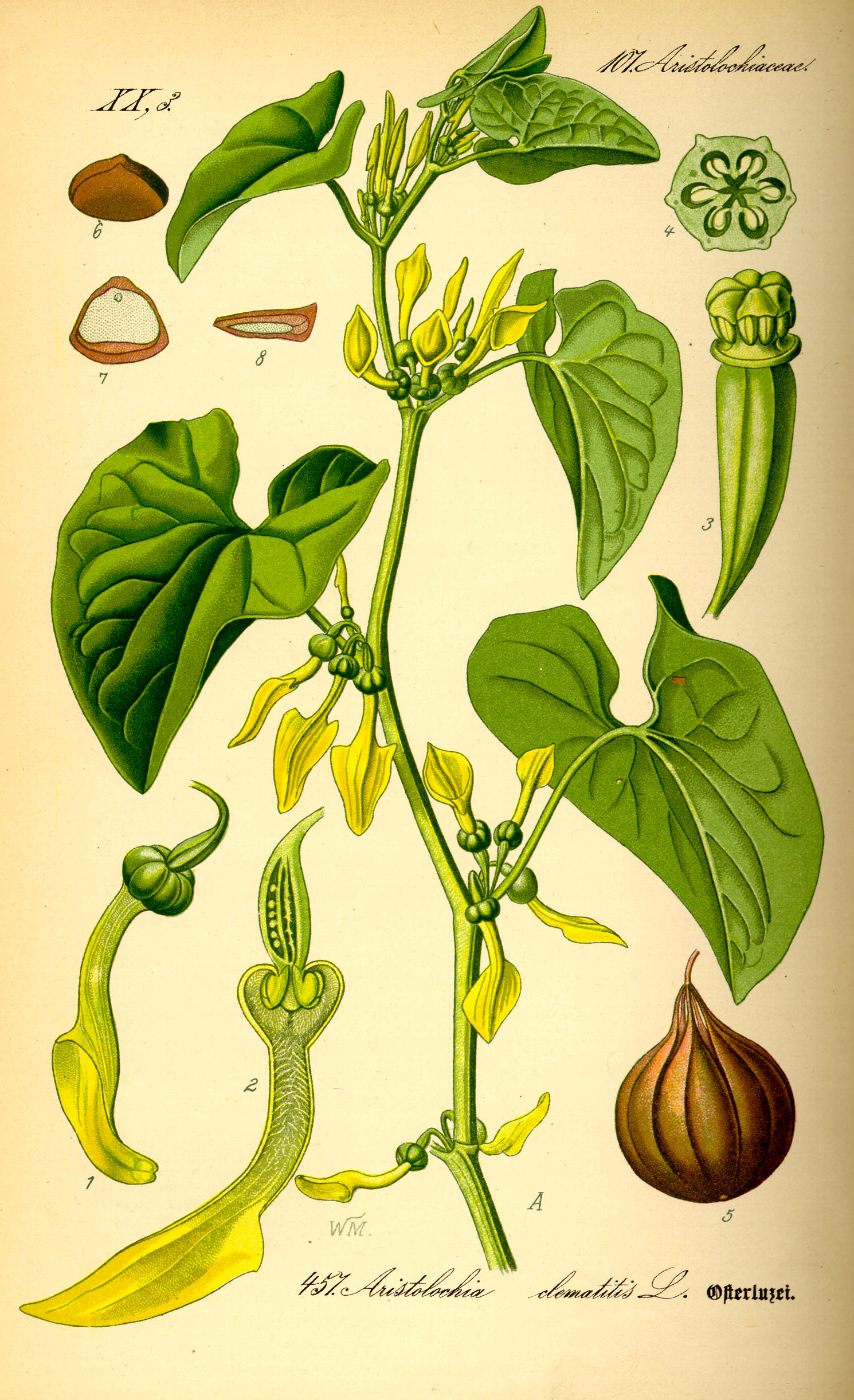
Location: Prefers shady places but can also tolerate good sunlight. Not demanding as to soil, but grows well and quickly on fertile, moist soils. The plant requires a sturdy support.
Care: Feed (cow manure solution 1:10) once or twice during the growing season; regular watering throughout the season is essential. It is also necessary to loosen the soil and mulch, and to prune and train the plant. Young plants are wintered under a 6-8 cm layer of dry leaves.
Propagation: vegetatively and by seed. Cuttings are taken in spring or autumn using mature annual shoots, although semi-lignified cuttings can also be rooted. Birthwort can be propagated by layering, laying the layers down in spring. Seeds are best sown in open ground late in autumn in a semi-shaded place. In spring uniform seedlings appear; as they grow they are pricked out and grown on for one to two years. For spring sowing stratification at 5-8 °С is necessary.