
Flowers for the garden
Arabis or Rockcress
Arabis
The origin of the name is not exactly known. Possibly from 'Arabia' — Arabia, a plant of sandy or rocky places; or from the Greek word 'arabos' — scraping.
The genus includes more than 100 species, widely distributed from Arctic to tropical latitudes of Europe, Asia and South America. Annual or perennial plants with trailing and rooting stems. Leaves entire, densely pubescent. Flowers white, pink, lilac or yellowish up to
Арабис альпийский — Arabis alpina L. = Arabis flaviflora Bunge
In the wild it grows in the Polar Urals, the Far East, northern Scandinavia, the highlands of Western Europe and North America.
A perennial up to
Garden form schneehaube (f. schneehaube) 10-
There is also a double variety (var. florе-pleno hort.), morphologically little different from the original, but its inflorescences are significantly larger and resemble wallflower inflorescences. Flowers up to
Арабис мхообразный — Arabis bryoides Boiss.
Native to the mountains of Yugoslavia, Greece and Albania, where it grows at subalpine and alpine levels.
A cushion-forming perennial 5-
Арабис выбегающий — Arabis procurrens Waldst. & Kit.
Occurs in the Balkans.
A groundcover plant with small rosettes and inconspicuous flowers, 10-
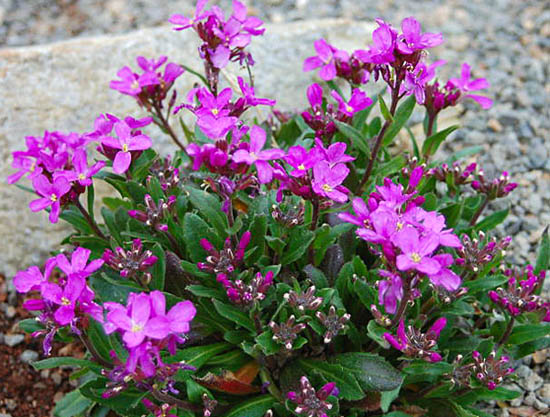
An interesting cultivar is ' Variegata' with white-striped leaves. In the center of the small leaf rosettes with a white margin, clusters of purple buds appear in spring. At first they are sessile, without petioles, later opening on stems 5 to
Арабис кавказский — Arabis caucasica Schlecht. = A. albida.
Some botanists consider Arabis caucasica to be a variety of Arabis alpina.
Grows in the Caucasus, Crimea, the mountains of Central Asia, the Mediterranean and Asia Minor. A perennial plant reaching
Арабис проломниковый — Arabis androsacea Fenzl
Native to the rocky slopes of the mountains of Turkey, where it grows at 900-
A cushion-forming perennial 5-
Арабис реснитчатолистный — Arabis blepharophylla Hook. & Arn.
Native to the mountains of California, where it grows at about
A perennial
Site: requires open, sunny locations; they can also grow in partial shade, but in a sunny spot the plant is more compact and flowers more profusely, and it spreads rapidly, covering a large area.
Soil: not wet sites; loose, sandy, well cultivated soils.
Care: in the conditions of northern Ukraine on exposed sites they require light winter covering. Care is the same as for other perennials. Pay particular attention to weeding. Arabises spread quickly sideways and can smother neighboring plants, so it is necessary to shorten overly vigorous and outward-growing shoots, which significantly improves flowering the following year. They perish from winter waterlogging. With early snowmelt they suffer from drying out of shoots — shading is required.
Propagation: by seed; double forms — by dividing the clump and by cuttings. Sow seeds in spring or before winter; seedlings flower in the second year. Divide 3-4 plants, from which up to 20 well-developed "divisions" can be obtained. Sometimes clumps are divided without lifting, by separating a part. Planting is done in spring or autumn (August — first half of September), maintaining a spacing of 30-
Cutting is carried out from mid-May to early June. Cuttings are taken from the upper part of the green shoots of the current year 6-