
Indoor plants
Anthurium André
Anthurium andraeanum Linden ex André
Synonyms: Anthurium venustum Sodiro, flamingo flower
Anthurium André (Anthurium andraeanum Linden ex André) – a species of evergreen plants of the genus Anthurium in the arum family (Araceae). It was discovered in 1876 by the French botanist Édouard André. The species was first described by Linden in «Ill. Hort. 24: 43–44, pl. 271» in 1877.
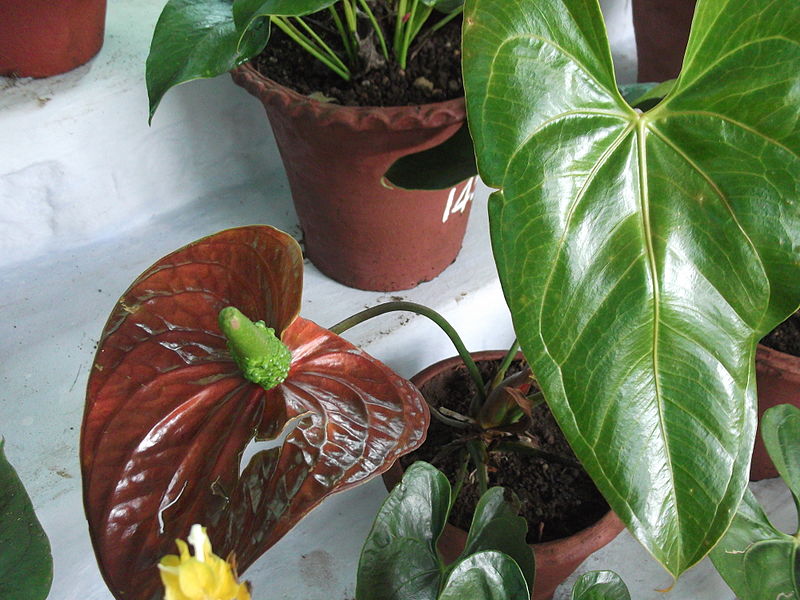
They are found in Colombia and Ecuador. They grow in warm, shady and humid locations, mainly in moist tropical forests.
They are terrestrial or epiphytic plants with a short stem up to 1 m tall.
Leaves are ovate-lanceolate, with a deeply cordate base, 25-30 cm long and 10-12 cm wide, hanging downwards. Petioles are 25-36 cm long, with bends in older leaves.
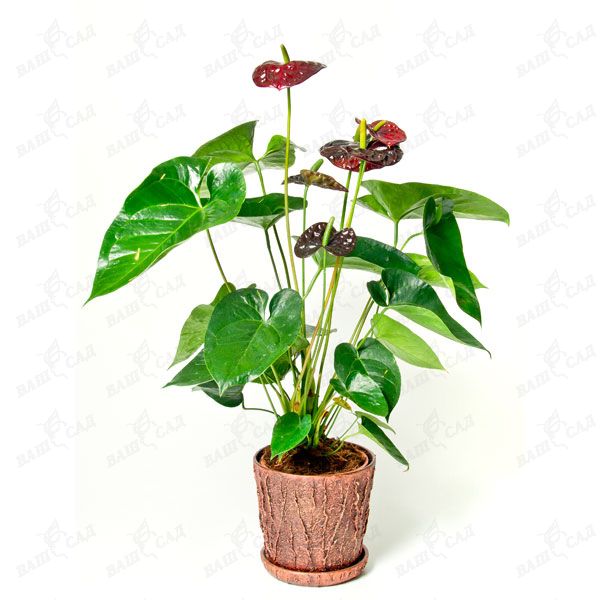
The inflorescences are spadices up to 15 cm long, slightly drooping or erect, yellowish with a bright bract or spathe. The spathe of Anthurium André is glossy, large, broadly heart-shaped, slightly wrinkled, less often blistered, with well-visible veins, and is pink, white or red. It blooms for about a month; as it fades the spathe turns green.
The fruits are yellow or orange berries of obovoid or globose shape, partially protruding from the spathe.
Varieties:
- Anthurium andraeanum var. andraeanum
- Anthurium andraeanum var. atropurpureum
- Anthurium andraeanum var. divergens
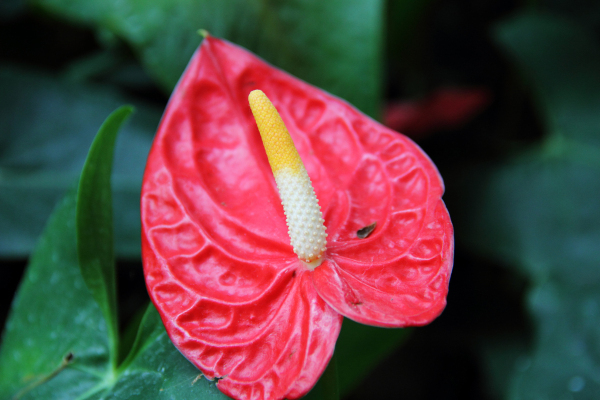
Cultivars: 'Royal Flush',
Hardiness zone: 10a (+1°C)
Temperature: Houseplants are kept at 18-20°C, but isolated from heating systems. Minimum winter temperature 15°C.
Light: Adapts well to indoor conditions but does not like direct sunlight. For more intense flower coloration it requires a sufficient amount of light.
Watering: Moderate but regular watering during the active growth period.
Fertilization: Nutrient requirements are low; from March to August the plant can be fertilized once every two weeks.
Humidity: It is recommended to spray with water regularly (morning and evening), as anthuriums require very humid air (80-85%). It is also recommended to wrap the plant stems with sphagnum moss, which is kept moist.
Repotting: After purchase it is recommended to repot into a larger container within the first 3 days. Repotting is best done in the spring-summer period. For repotting use a plastic or glass pot; when repotting into a ceramic pot choose one glazed on the inside. The pot should be wide but not deep. Remove the plant from the old pot, trim all dead or diseased roots, treat with Fitolavin, place the plant in the new pot and add substrate, tapping the pot (fresh substrate will settle more densely). The soil should not reach the edge of the pot by 2-3 cm. Repotting can also be done during flowering. After repotting, especially protect from direct sunlight, spray frequently and water carefully.
Soil: You can use commercial orchid substrate or a mixture of light turf soil, peat moss and forest soil. The most optimal option is a mixture of peat, coniferous and leafy soil, and sand with the addition of conifer bark and charcoal in the ratio 1:1:1:0,5.
Diseases: root and stem rots, anthracnose, false powdery mildew, rust.
Pests: aphids, spider mite, scale insects.
Propagation: Anthuriums are propagated by long-stemmed apical cuttings that have a small number of aerial roots. They can also be propagated by side shoots, seeds and division of an overly large clump.
Use: In Ukraine it is grown as a houseplant, in greenhouses, for creating arrangements, and for cut flowers.