
Indoor plants
Anthurium
Anthurium
Synonyms: Podospadix Raf., flamingo flower
Антуриум (Anthurium Schott.) - a genus of evergreen plants of the family Araceae. The Latin name comes from Greek words that translate as «flower» and «tail». It was first described by Schott in Wiener Z. Kunst in 1829.
In nature it occurs in tropical and subtropical regions of Central and South America. To the north it reaches Mexico, to the south — Paraguay and northern Argentina. They are widespread in the Andes (South America) and the Cordilleras (Central America). They can occur in mountains up to 3400 m above sea level. High-altitude species are mainly epiphytes. At elevations of 100—300 m above sea level there is a special group of Anthuriums that inhabit savannas.
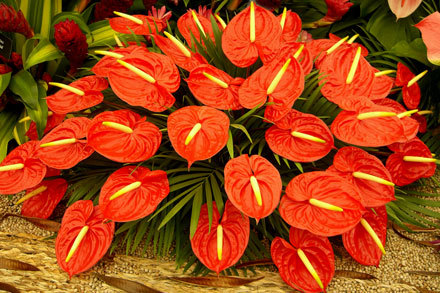
They are evergreen herbaceous plants, less often climbing or tree-like. Most often they are epiphytes growing on trees, with roots descending to the leaf litter of the tropical rainforest. There are also terrestrial species, hemi-epiphytes (plants that germinate in the forest canopy and send roots down to the ground or germinate on the ground and climb into the canopy), and lithophytes (growing on rock surfaces). Some can live in symbiotic relationships with ant colonies. For species growing in savannas the stem is reduced; the coarse thick leaf blade is relatively narrow and strongly elongated, the petiole very short; at the base of the plant there are aerial root nests with upward-pointing root tips covered by velamen.
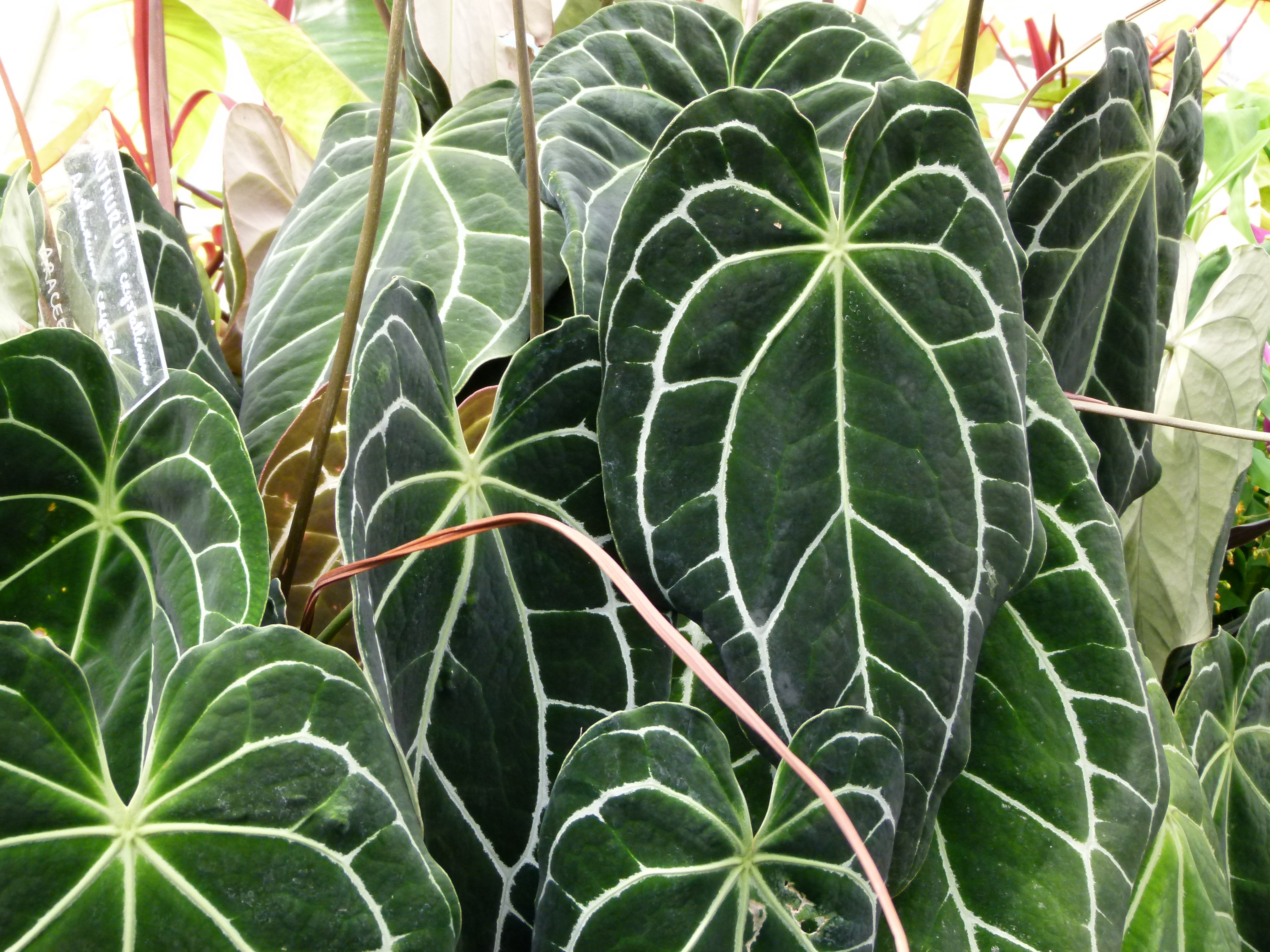
Stems are thick, often shortened with short internodes, less often elongated, 15-30 cm long. Leaves vary in shape – spade-shaped, rounded, with blunt tips and divisions ranging from entire to deeply divided. Petioles with a geniculum. Leaves are mostly located at the ends of stems, they are vertical or arranged in a rosette, up to 100 cm long. Leaf surfaces may be matte, glossy or semi-glossy, texture from leathery to fragile (paper-like). In the humid tropical forest leaves have the unique ability to orient toward the sun. In dry environments leaves form a rosette that accumulates plant debris, creating fertilizer and retaining water. Terrestrial species and epiphytic Anthuriums often have cordate leaves or grow as vines with rosettes of lanceolate leaves or have pinnate leaves.
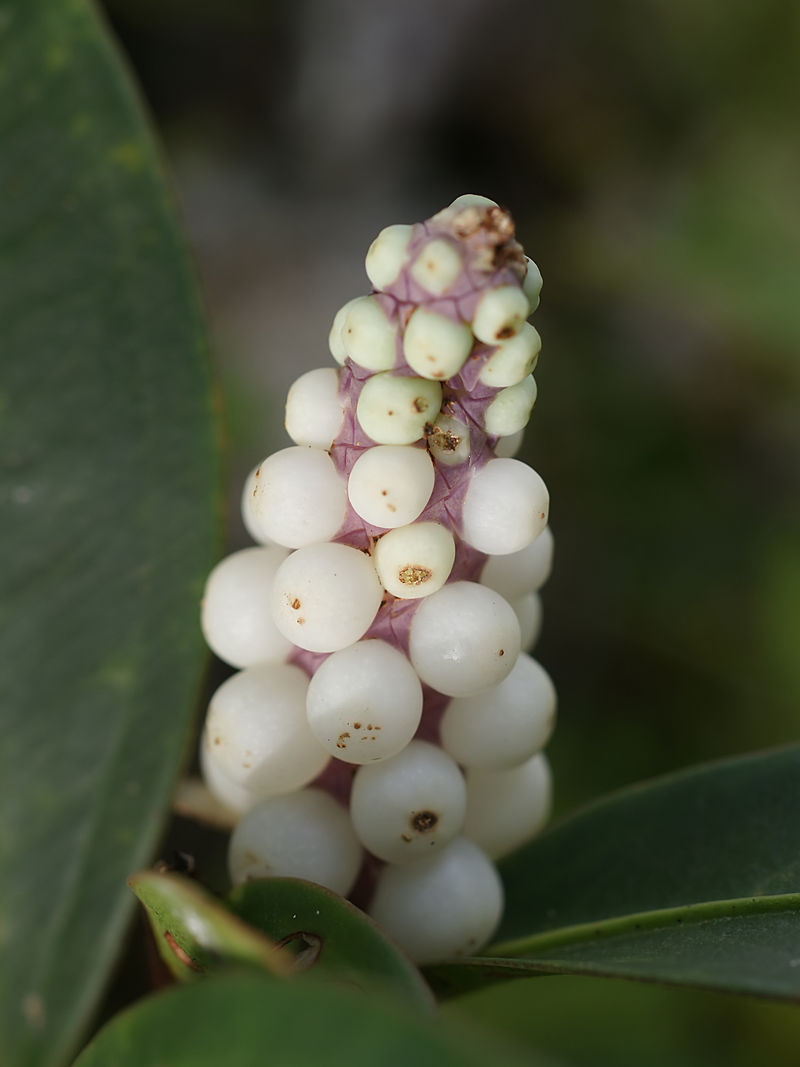
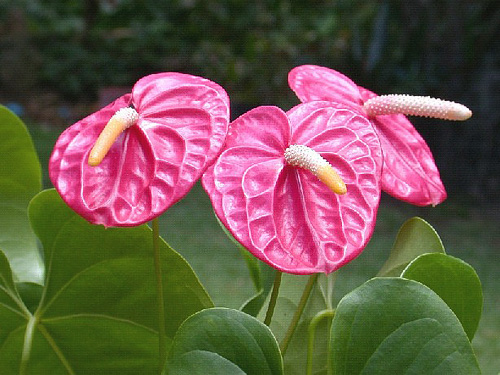
The spathe of the inflorescence is often green or white, but is frequently brightly colored, similar to a perianth, in red, purple or pink, and may be multicolored. Spathe color can range from pale green to white, pink, orange or bright red. The inflorescence is a spadix of club-shaped, conical, spiral or globose form; the flowers are white, green, red, pink, purple or combinations of these colors. Flowers are densely arranged on the spadix in spiral series, resembling rhombi and squares. Flowers are bisexual, perianth four-parted, stamens 4. Gynoecium syncarpous; stigma disc-shaped; ovary two-locular, with 1—2 ovules in each locule. Blooming lasts from several hours to several days. The flowers attract various insects.
Fruits are juicy, fleshy berries containing one or many seeds. Berry color ranges from bright red to black, may be bicolored or striped. Seeds are flattened-convex with fleshy endosperm.
Species: the genus includes about 500 (900) species. The most popular:
- Антуриум Андрэ - Anthurium Andreanum – under our conditions a greenhouse plant 70-90 cm in height.
- Антуриум Шерцера - Anthurium scherzerianum – suitable for indoor cultivation. Reaches 30 cm in height and has a spirally twisted spadix. Inflorescences are bright red, but there are also white-flowered forms – album.
- Антуриум Родшильдианум – Anthurium – hybrid. Color ranges from white to dark red. Flowers are large.
- Антуриум хрустальный - Anthurium Crystallinum - can be grown as an ornamental foliage plant. Leaves hang down, with bright silvery veins, and with age change color from bronze-purple to dark green.
Hardiness zone: 6-10 (-15°C)
Temperature: houseplants are kept at 18-20°C, but isolated from heating systems. Minimum winter temperature 15°C.
Light: adapts well to indoor conditions but does not like direct sunlight. For more intense flower color it needs a sufficient amount of light.
Watering: Watering during the active growth period should be moderate but regular.
Fertilization: Nutrient requirements are small; from March to August the plant can be fertilized with fertilizer once every two weeks.
Air humidity: It is recommended to mist regularly (morning and evening), as Anthuriums need very humid air. It is also recommended to wrap the plant stems with sphagnum moss, which is kept moist.
Repotting: after purchase it is recommended to repot the plant into a larger container within the first 3 days. Repotting is best done in spring-summer. Use a plastic or glass pot; if repotting into a ceramic pot, choose a glazed interior. The pot should be wide but not deep. Remove the plant from the old pot, trim off any dead or diseased roots, treat with phytolavin, place the plant in the new pot and add soil, tapping the pot (fresh soil will settle more densely). The soil should not reach the rim of the pot by 2-3 cm. Repotting can also be carried out during flowering. After repotting, especially protect from direct sunlight, mist frequently and water gently.
Soil: you can use commercial orchid substrate or a mix of light turf soil, peat moss and forest soil. The most optimal option is a mixture of peat, coniferous and leafy soil, sand with the addition of conifer bark and charcoal in the ratio 1:1:1:0.5.
Diseases: rots, anthracnose.
Pests: aphids, spider mites, scale insects.
Propagation: Long-stemmed Anthuriums are propagated by apical cuttings that have a small number of aerial roots. Short-stemmed Anthuriums are propagated by division when lateral shoots develop, and also by seeds.
Uses: grown in Ukraine as a houseplant.