
Flowers for the garden
Anisodontea capensis
Anisodontea capensis
Synonyms: indoor mallow, Princess of Africa, Malva capensis L., Malvastrum capense Gray & Harv., Malvastrum capense var. glabrescens Harv., Malvastrum divaricatum Gray & Harv., Malvastrum virgatum Gray & Harv., Malvastrum virgatum var. dillenianum Harv.
Anisodontea capensis (Anisodontea capensis (L.) D. M. Bates) – a species of evergreen herbaceous plants of the genus Anisodontea (Anisodontea) of the mallow family (Malvaceae). The species was first described by Carl Linnaeus, and the name was given in 1969 by the American botanist David Martin Bates in his work Gentes Herbarum 10: 327. In cultivation since 1789.
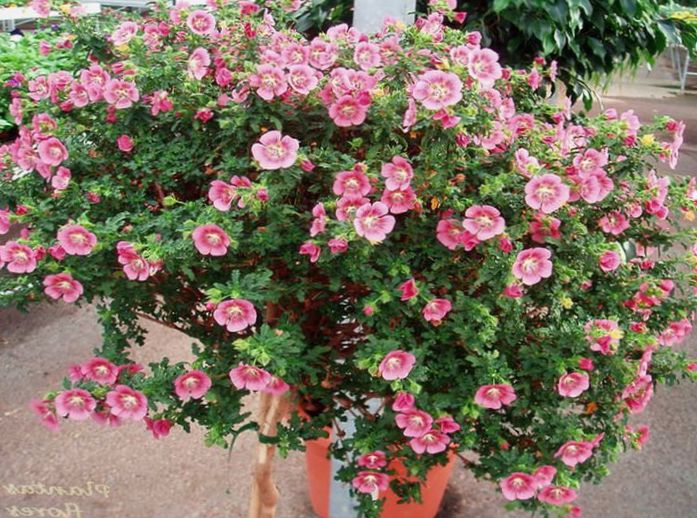
Native to South Africa – in the Western Cape Province and the Eastern Cape Province. Occurs on the upper slopes of hills. Ascends into mountains to elevations of 670-2167 m above sea level.
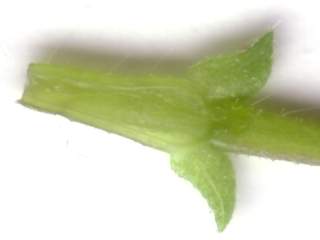
An erect, branched subshrub 100-180 cm in height (no more than 1 m in indoor conditions). Stems are branched, at first green or purplish-red-brown, later gray-brown, covered with long hairs (up to 0.75 mm long).
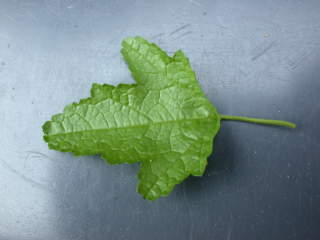
Leaves alternate, simple, ovate-lanceolate in shape, 3-lobed, sticky. Lobes triangular, irregularly toothed, covered with bristles on the veins on the upper and lower sides, ciliate at the base, up to 6.5 cm in length and width. Petioles up to 2.5 cm long, green, hairy. Stipules 1-2 mm long, glabrous, triangular-ovate.
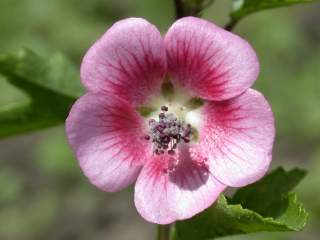
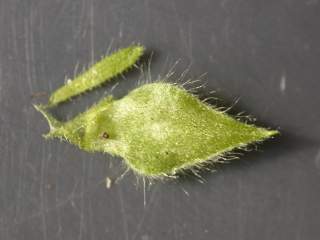
The flowers resemble mallow flowers, located in the axils of the upper leaves and side shoots. Blooms from April through autumn. Peduncles up to 4 cm long, covered with hairs. There are 3 bracts; they are asymmetrically arranged, lanceolate, pubescent, up to 6 mm long, ciliate, situated 1 mm below the calyx. Calyx lobes 5, fused for a third of their length, triangular-ovate, pointed at the tips. Corolla pale pink with darker veins; petals 5, arranged spirally, not overlapping each other, up to 15 mm long, tips rounded, base clawed. Stamens up to 10 mm long, filaments pink, anthers black, kidney-shaped, unilocular. The intensity of the vein coloration varies seasonally, most intense in spring.
Fruits – many-seeded.
Hardiness zone: zone 11 (+10°C).
Location: Prefers bright light. In summer can be placed outdoors; in winter keep in a cool room at 10-12°C.
Air humidity: not demanding.
Soil: not fussy, but prefers deep fertile soil, tolerates even saline conditions. Requires good drainage.
Watering: does not tolerate drying out of the root ball. With insufficient moisture leaves and buds drop. In winter moderate watering is necessary – once every 10 days.
Repotting: carried out in spring.
Care: practically does not require special care. Fertilize during the growing period once every two weeks.
Pruning: pruning is carried out annually or twice a year to form a compact plant. Often formed into a standard (single-stem) form or bonsai. Pruning is done in autumn after flowering; shoots are cut by two-thirds of their length. Throughout the active growth period it is recommended to regularly pinch the shoot tips.
Propagation: by seeds and cuttings. For cuttings, remove side shoots and plant them in a soil mixture of moist peat and sand and root at +20°C. After 3 weeks cuttings root and can be planted into separate containers. Green cuttings are rooted in spring and summer.
Diseases and pests: spider mite
Uses: In summer it looks impressive as a front-facing container plant, and in winter complements the indoor space. It can also be used for planting flower beds and borders (creates an avenue effect). Indoors it is placed on sunny windowsills or specially illuminated shelves. Suitable for cultivation in a winter garden.