
Indoor plants
Angraecum
Angraecum
About 200 species of epiphytic, epilithic, and more rarely terrestrial orchids, distributed in Africa, Madagascar and adjacent islands.
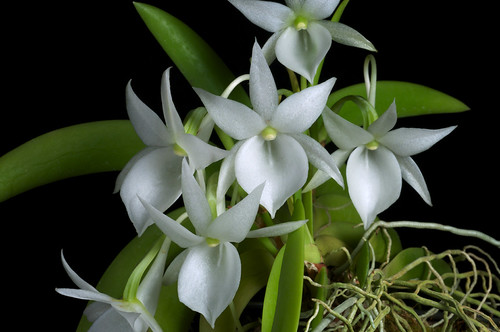
They belong to the group of monopodial orchids, which as a rule have a simple unbranched stem that grows in height very slowly. The leathery strap-shaped leaves, arranged in a two-ranked rosette, overlap each other like shingles at their bases. The flowers are in large axillary erect or curved racemes, rarely solitary, usually with a well-developed spur at the base, slightly waxy, mostly white or ivory-colored, and emit a strong fragrance at night.
Angraecum yellowish-white - Angraecum eburneum

A robust plant with a strong erect, densely-leaved stem from which numerous aerial roots arise. Leaves are strap-shaped, keeled at the base, and unequally two-lobed at the apex. Stout, compact racemes that form in the leaf axils bear up to 15–30 greenish-white fragrant flowers about 10 cm in diameter, the lip oriented upwards. Sepals and petals are linear-lanceolate, greenish. The lip is rounded, shell-like, shortly acuminate at the apex, white. The spur is very thin, 6–8 cm long, green. Flowers in October–November. (in the photo on the left)
Angraecum one-and-a-half-foot - Angraecum sesquipedale

Sturdy erect stems up to 60 cm high (rarely up to 1 m) are densely covered with broad strap-shaped leaves up to 50 cm long and 7 cm wide. Racemes barely longer than the leaves, loose, with 2–4 flowers. The flowers are the largest in the genus, 12–15 cm (up to 18 cm) in diameter, star-shaped, fleshy, ivory-colored or slightly yellowish, with a very long, up to 30 cm, almost thread-like hanging spur. Flowers in December–February.
Angraecum Eichler - Angraecum eichlerianum

A large epiphytic plant with a reclining or pendulous, slightly flattened stem up to 1 m long with numerous aerial roots. Leaves elliptical with a short two-lobed apex. Flowers solitary or in pairs on thin, curved or pendent, relatively short peduncles, 7–8 cm in diameter, yellowish-light-green with a white, shell-like, indistinctly three-lobed lip with a longitudinal keel in the center. Spur 4–5 cm long, wide-funnel-shaped at the base, kinked in the middle, and narrowly cylindrical and slightly compressed at the tip.

Location: uniformly warm, with slightly lower temperatures in winter, high air humidity, careful shading in hot weather and a constant supply of fresh air. Grow in substrate for epiphytic orchids. It is useful to cover the surface of the substrate with fresh moss to retain moisture. Small species are more convenient to grow on blocks of bark or compressed fern roots.
Lighting: bright light
Watering: the substrate should always be moist. Watering is reduced in winter. Water with soft warm water.
Humidity: require high air humidity. Occasionally spray the leaves.
Propagation: by division at repotting, leaving at least three growths in each division; the repotted plant is tied to a support.
Repotting: do not worry if roots begin to grow through the drain holes of the pot. Orchids are repotted only when growth is halted due to the pot being too small.

Possible problems:
Brown spots on the leaves.
If the spots are dry and hard - the plant has been sunburned. Shade it, do not remove the damaged areas. If the spots are soft - this is a fungal disease; the damaged parts should be removed immediately.
Plants grow horizontally or droop.
The most likely cause is insufficient light; orchids are light-loving. If the plants are languid despite good lighting, the cause may be incorrect watering.
Mold on the leaves.
Gray rot can affect the leaves if they are sprayed at low temperature and moisture does not evaporate quickly.
The plant does not bloom.
If the plant looks unhealthy, the cause may be any care mistake. If the plant appears healthy, the most likely reason is insufficient light.