Indoor plants
Pineapple
Ananas
Pineapple (Ananas) — a genus of herbaceous tropical plants of the bromeliad family (Bromeliaceae). The genus includes about nine species, distributed in the tropical part of South America and southward to Argentina and Paraguay.
Pineapple is a terrestrial herbaceous plant with a spiny stem and leaves. Numerous adventitious roots develop directly in the leaf axils, absorbing the moisture that accumulates there. The leaves are broadly linear, toothed along the margins, up to 80 cm long, fleshy and succulent (water-storing), covered by a thick epidermis. Beneath the epidermis is a layer of large water-storing cells where moisture accumulates during the rainy season. Inside the leaf is a network of air channels surrounded by chlorophyll-bearing cells. Thus, gas exchange processes in the pineapple can occur even with closed stomata.
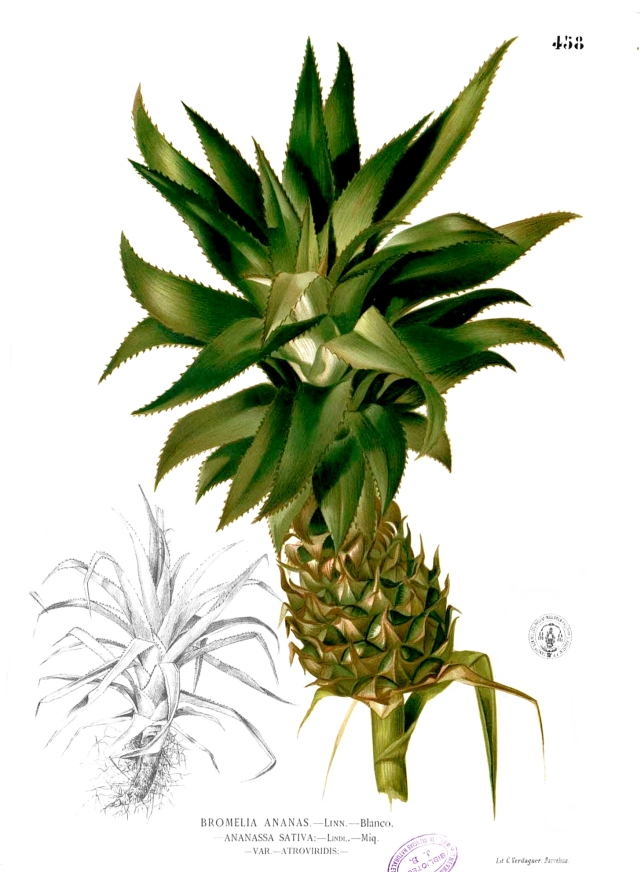
When the leaf rosette is formed, the growing point produces an inflorescence stalk up to 60 cm long, densely covered with bisexual flowers. Flowering lasts 15—20 days, and as a result an infructescence is formed, consisting of the fused bases of the ovaries, the floral bracts and the axis of the inflorescence. The infructescence is substantial, cone-shaped, golden-yellow. A cluster of vegetative leaves — the "crown" — always develops at the top. Pineapple cultivars do not form seeds when self-pollinated, which is used to obtain high-quality seedless fruits.
In cultivation:
Large-crowned pineapple, or crested pineapple, or true pineapple - Ananas comosus
A species of the genus Ananas, family Bromeliaceae. The true pineapple is represented in cultivation by a wide variety of cultivars not only in South America, where members of the genus Ananas occur, but throughout the tropical countries of the world.
A tropical perennial herb up to 60 cm tall, with a rosette of long, narrow, coarse and at the same time juicy (succulent) leaves, toothed along the edge.
Flowers are borne on an inflorescence stalk at the top, densely spiraled so that an inflorescence — a spike (pineapple head) — is formed. Flowers are bisexual, zygomorphic, with 1 pistil and 6 stamens, and about 3 perianth segments. All flowers fuse together, leaving only the tips of the perianth segments and the covering bract free. The stamens form a filamentous bundle that wraps spirally around the style. The ovary consists of 3 carpels, is three-loculed, and the placentation with ovules is located on the septa at the fusion lines of the carpels.
At the stage when the pineapple is used as a fruit, it is a large (up to 2 kg), cone-like infructescence of golden-brown color, with a tuft of short leaves at the top that develops due to proliferation — the protrusion of the inflorescence axis through the infructescence. The infructescence consists of a fairly juicy but somewhat coarse axis and the very juicy and tender fruits fused to the sides of that axis, bearing at their tips the persistent and hardening parts of the flower and the covering bract.
An unripe pineapple infructescence has caustic properties, can burn the lips and acts on the stomach as a strong laxative. The ripe fruit loses its caustic properties and acquires an excellent taste and a strong pleasant aroma.
Pineapple tolerates a range of growing conditions fairly well, and only cold drafts are very poorly tolerated. If you want to grow a beautiful and bright plant, remember that it needs direct sunlight, and also follow the following tips:
Temperature: in summer – 22–25°C, in winter – 16–18°C. Minimum winter temperature – 15°C.
Lighting: this plant loves light; it develops well in both partial shade and sunny locations. It can be grown on east and west windowsills. On south-facing windowsills provide artificial shade during the hottest periods of the day in summer. However, do not forget that variegated pineapples need brighter locations; otherwise their color intensity may be lost.
Watering: like other bromeliads, the pineapple is watered directly into the leaf rosette (fill to about 2/3). The water must be well-settled (allowed to stand) and at room temperature. In warm seasons, spring and summer, water should remain in the leaf rosette constantly and be refreshed with new water at least once a month. During this period the plant is fertilized with special fertilizers every two weeks; the fertilizer is diluted in water and poured into the rosette. In winter the plant is watered approximately once a week into the soil.
Air humidity: this plant should be misted regularly, especially if it is kept in a very warm place.
Repotting: a plant that has never flowered is repotted after about a year. After flowering, daughter rosettes form at the base of the mother plant; these are repotted at the next opportunity. Potting mix: light turf soil (3 parts), humus (1 part, with a little sand). Soil pH – in the range 4.5–5.0. You can also buy a soil mix intended for orchids. It is better to use wide containers, as the planting container should not be too deep.
Propagation: pineapples are propagated by lateral shoots (offsets). They are cut off when they have developed their own roots. The plant can also be propagated from seeds, which are sown in a loose soil mix consisting half of leaf mold and half sand. It can also be propagated from the leaf crown carefully removed from the fruit. It should be undamaged and is rooted in a light soil mix or sand.