
Indoor plants
Kampelia
Сampelia
A large herbaceous plant with sturdy, erect stems swollen at the nodes, sparsely branched, up to 2 m tall. Leaves alternate, sessile, with a tubular sheath bearing a vertical row of hairs and long cilia along the margin; broadly elliptic or broadly obovate-lanceolate with a long-acuminate apex, large — up to 25 cm long, 5–6 cm wide, glabrous, with only the margin having a narrow pink edging with dense short cilia. Flowers small, white, in paired cymes provided with leaf-like, boat-shaped folded bracts. A few cymes are gathered into a long, sparsely branched paniculate inflorescence on a long peduncle. There are 3 sepals and 3 petals, free or slightly fused at the base; stamens 6, their filaments with long hairs. Grows in the understory of moist tropical forests, less commonly on limestone rocks and cliffs in shaded places. A garden form known as "Mexican Flag" (sometimes incorrectly attributed to the genus Dichorisandra) has white or slightly yellowish leaves with a narrow purple margin at the edge, speckled with longitudinal light- and dark-green lines and stripes. Recently introduced into cultivation.
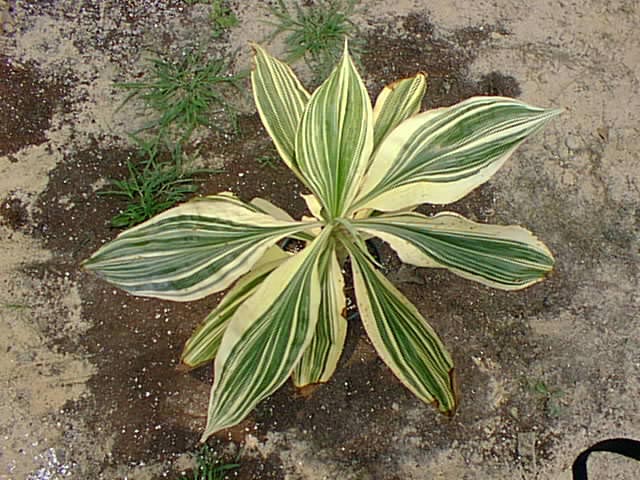
Location: Kampelia prefers bright but diffused light. Exposure to direct sunlight on the leaves causes yellowing and dropping of older leaves and the appearance of a purple tint on young leaves. Kampelia requires an air temperature of +20 °C to +23 °C. In winter the minimum air temperature is +18 °C.
Lighting: prefers bright, diffused light.
Watering: During the growing season the potting soil should always be moist but not waterlogged. In winter watering is reduced; ensure that the top layer of soil in the pot dries out before the next watering.
Humidity: Needs high humidity. Do not place the pot near central heating radiators or heaters. Kampelia requires frequent misting of the leaves with warm, soft water.
Fertilizer: The plant should be fed from spring to autumn. Fertilize with a mineral fertilizer once a month, or less often. Stop feedings at the end of summer; otherwise the plant will become too susceptible to diseases.
Propagation: Propagated by cuttings. Cuttings root well in a light soil mix or in clean water. Cuttings can be rooted at any time of year, but the best time is winter.
Repotting: Needs repotting only when the previous pot becomes too small. The tips of the shoots should be pinched to encourage better branching. The soil for repotting should be slightly acidic, fertile, and light with added sand.