Indoor plants
Amorphophallus
Amorphophallus
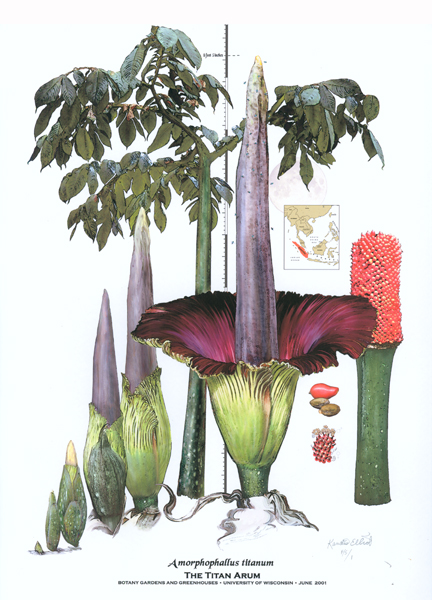
Аморфофаллус (Amorphophallus) The name comes from ancient Greek μορφος, «shapeless», and φαλλός, «phallus» — a genus of the Arum family (Araceae), comprising about 170 tropical and subtropical tuberous species. Amorphophallus is a typical lowland plant, growing in tropical and subtropical zones from West Africa to the Pacific islands.
Perennial herbaceous plants ranging from small to gigantic. They grow from underground tubers 5–12 cm or more in size and weighing around 5 kg, some from rhizomes or stolons. These plants have a period of dormancy; some of them are evergreen herbs. The tuber is compressed-globose, sometimes unevenly cylindrically elongated, turnip-shaped or conical.
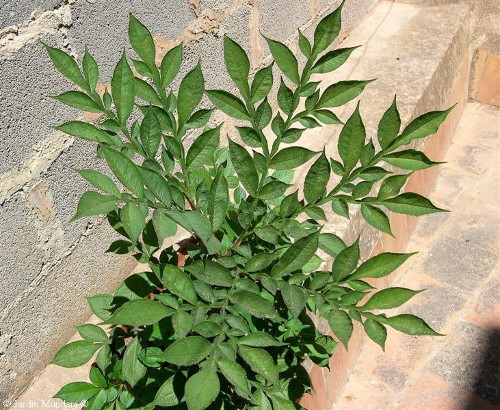
From the upper part of the tuber a single leaf (rarely two or three) grows on a long, smooth petiole, which can reach several meters in width. The leaf persists for one growing season; each following year it grows somewhat taller and becomes more divided. The leaf blade is thrice-divided.
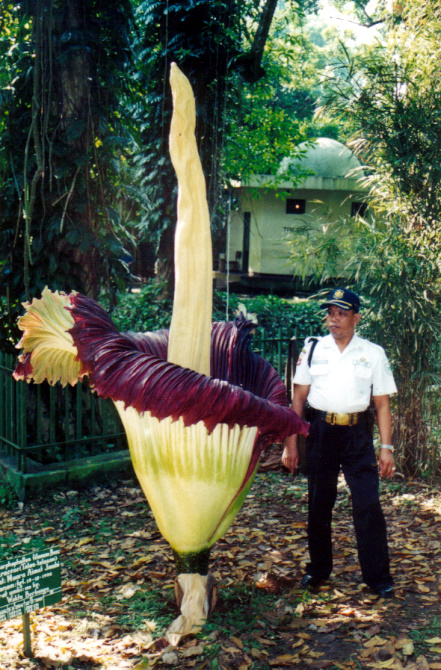
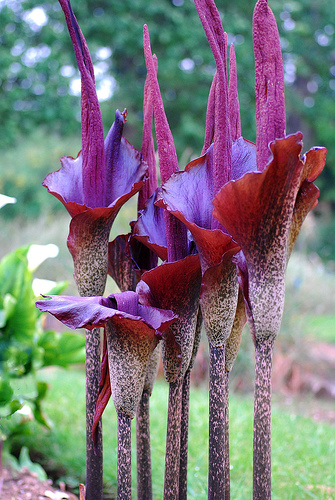
The inflorescence of Amorphophallus develops after the next dormancy period before the appearance of a new leaf and is always solitary. Flowering lasts about 2 weeks and ends before the new roots appear. During this time the size of the Amorphophallus tuber decreases significantly due to the large expenditure of nutrients required for inflorescence formation. The scape ranges from very short to long, similar to the petiole.
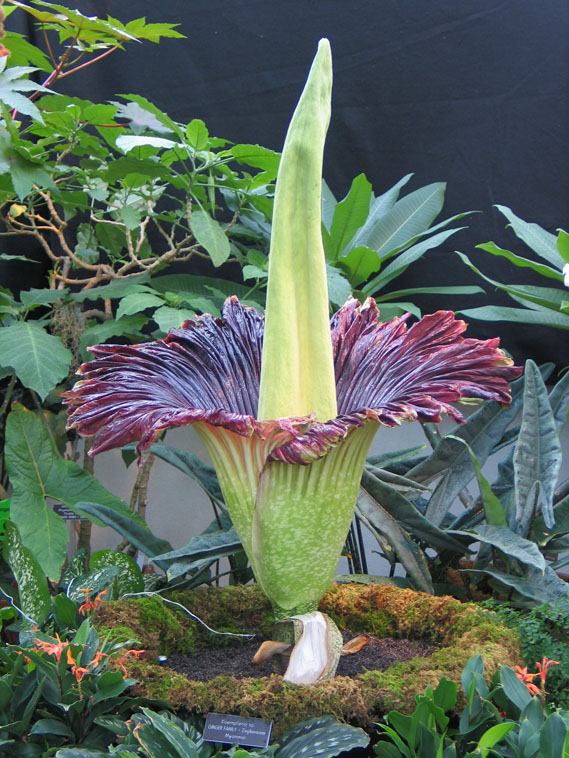
The inflorescence consists of an elongated or oval spadix and a "spathe." The spathe may be caducous or not, barely rolled and oval, or differentiated into a tube and blade, sometimes with a constriction between them; the tube may be bell-shaped to cylindrical, smooth inside or longitudinally corrugated, at the base covered with dense scales or irregularities resembling hairs that serve as insect traps, or smooth; the spathe blade from erect to spreading, smooth, ribbed or variously undulate, its margin often ornamented with frills.
The spadix is shorter or much longer than the spathe. Flowers are monoecious, without a perianth. Once the spadix opens, pollination must occur the same day. The inflorescence often emits the smell of rotting flesh to attract insects, although some Amorphophallus species release a pleasant scent. Insects caught in ingenious traps remain inside the spadix to preserve the pollen they brought for the female flowers. Female flowers remain receptive for only one day, while the male flowers are still closed. They open the next day when the female flowers are no longer receptive, preventing self-pollination. Male flowers shed their pollen onto the trapped insects, after which the insects are released and can pollinate another flower.
Pollinated flowers then develop into globose berries. They can be orange to red, rarely white or blue, one- or many-seeded. The infructescence is more or less cylindrical. Seeds are ellipsoid.
In cultivation:
Аморфофаллюс коньяк (Amorphophallus konjac)
A perennial herbaceous plant with a flattened-globose tuber up to 12–20 cm in diameter. Leaf petioles about one meter long, dark olive colored with dark and light spots. Leaves are pinnately divided, lush green. The flowering stalk is about 50–70 cm long. The spathe is 25–30 cm long, the spadix up to 50 cm long, warming to 40°C during flowering. The color is burgundy or purple-red. It emits a strong unpleasant odor. In Japan, the starch-rich tubers are used to make a national food — konnyaku. In cultivation it usually flowers but does not set fruit.
Аморфофаллюс луковиценосный (Amorphophallus bulbifer)
Has a hemispherical tuber about 7–8 cm in diameter. A single leaf on a petiole about 1 meter long, which is dark olive with light spots. The leaf is segmented, 3-lobed, with a bulb at the leaf base. The flowering stalk is usually no more than 30 cm long, the spathe 10–12 cm long. The color is dirty green with pink spots. The spadix is shorter than the spathe.
Temperature: Moderate, about 13°C during dormancy, minimum 10°C.
Light: Bright light with shading from direct sun in summer.
Watering: Abundant during the growth period. After the leaves begin to wither in autumn, watering is stopped.
Fertilizers: Feed about 1.5 months after new shoots emerge in spring. Note that Amorphophallus requires a relatively high dose of phosphorus. Choose a fertilizer with an N:P:K ratio of about 1:4:1 or similar. Responds well to organic fertilizer such as well-rotted cow manure.
Air humidity: Spraying the leaves is mainly hygienic, but the plant responds very well to misting, as it is accustomed to a humid climate.
Repotting: After tubers are taken out of winter storage, usually in March, plant them in nutrient soil. Soil mix: 1 part clayey garden soil, 1 part humus soil, 1 part leaf soil, 1 part peat and 1 part sand.
Propagation: By daughter tubers, which are separated at the beginning of the dormancy period, i.e., when the plant has lost its leaves.