
Indoor plants
Alocasia or Arum
Alocasia
Alocasia or Arum (Alocásia) — a genus of perennial plants of the Arum family (Araceae). The genus includes about 70 species of evergreen tropical plants.
Plants of the genus are found from tropical and subtropical Asia to eastern Australia as well as in Central and South America. They grow in primary and secondary forests, among young shoots, in open swampy areas, and occasionally among rocks.
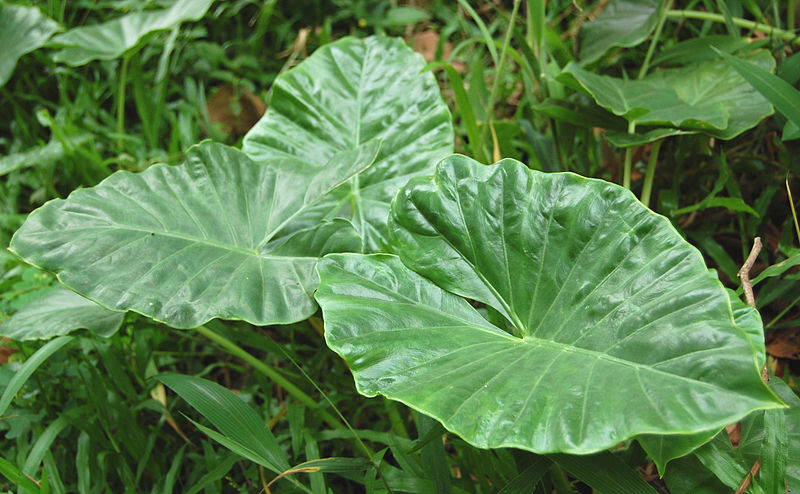
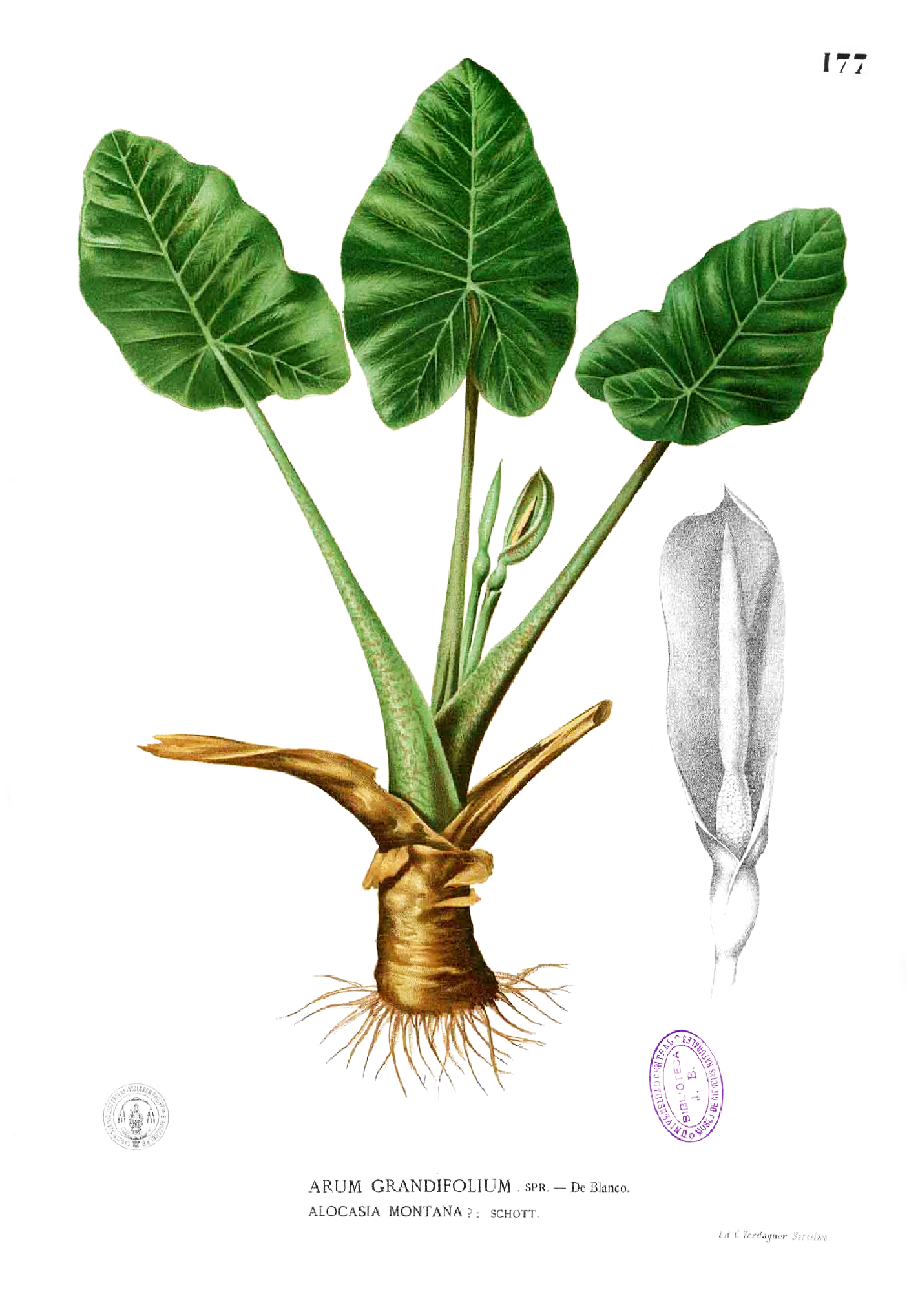
Height varies among species from 40 cm to 2 meters and more; some species have a well-developed above-ground stem. At the top of the stem, on long fleshy petioles (from 20 cm to 1 m), there are several large, often ovate-sagittate leaves; leaf length can range from 35-40 cm to 1 meter. Leaves are thick almost leathery, with prominent veins. Leaves have water stomata—hydathodes, through which droplets of water are released in humid weather or with excessive watering.
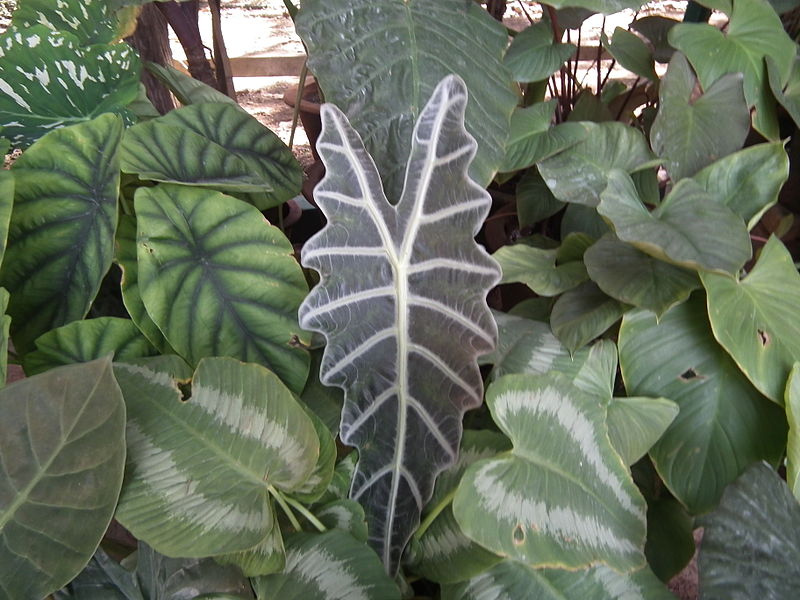
the photo shows at least 5 varieties of Alocasia
Flowering in cultivation is rare. The flower stalk is long and graceful, from 10-15 to 30 cm and more in height; the inflorescence is a spadix of whitish-pink color, wholly or partially covered by a spathe. The spathe is colored whitish-green to pinkish-white.
Alocasia, distinguished by its magnificence and exotic beauty, is deservedly considered one of the most outstanding foliage ornamental plants. Large specimens reaching several meters in height are a fine decoration for interiors: bright halls, foyers, winter gardens, artificial ponds and fountains.
In cultivation:
Alocasia Sander - Alocasia sanderiana W. Bull
Occurs in wet tropical forests at altitudes of 300-600 m above sea level on the Philippine Islands. Plants have a short tuberous rhizome. Leaves up to 30-40 cm long and about 15 cm wide, elongate-sagittate with sinuate pinnate lobes, green with a dark metallic sheen; lateral veins and margins are whitish. Petiole brownish-green, 25-60 cm long. The species is cultivated in warm greenhouses. It has been widely used in Alocasia hybridization work.
Alocasia Low - Alocasia lowii Hook.
Native to Borneo, Malaysia. Reaches about 1 m in height; stem is rather short; produces underground root offshoots. Leaves on long petioles, oval or sagittate, uniformly green or with white veins, the underside of the leaf purplish-violet. Petiole attaches at the center of the leaf. Blades are glaucous-green with a characteristic metallic sheen; spots and veins are silvery.
Alocasia cucullata - Alocasia cucullata
Native to China, India, Sri Lanka. Plant height from 60 to 100 cm — see photo. Stem 3-6 cm in diameter. Petioles usually up to 30 cm long, rarely up to 50-80 cm. Leaves large, up to 1 m long and 60-80 cm wide, thick, usually pendulous; blade base cordate, apex shortly acuminate, glossy, from bright to dark green. At the point of petiole attachment on the upper side of the leaf there is a characteristic swelling. Only vigorous plants with a large number of leaves bloom. Flower stalk up to 20-30 cm high; spathe fleshy, up to 10-15 cm long, 3-8 cm wide; spadix shorter than the spathe. Berries hemispherical, small, 6-8 mm in diameter. Forms daughter tubers that are located close to the main one.
Temperature: prefers warmth; in summer not below 20°C, in winter not below 18°C.
Lighting: likes light; in summer it must be protected from direct sunlight. Alocasia amazonica, copper-red and large-rooted forms require additional lighting during the winter period.
Watering: abundant in summer, moderate in winter. Do not allow the soil to dry out. Overwatering can be fatal.
Fertilizer: in spring and summer Alocasia should be fed every 2-3 weeks using a balanced fertilizer.
Air humidity: frequent misting and careful wiping of the leaves.
Repotting: soil for Alocasia should be nutritious. Repot every year in spring, and mature plants every two years. Clay soil is not permitted. Soil composition: 1 part leaf soil, 1 part coniferous soil, 0.5 part sand and 1 part peat. For Amazonian and copper-red Alocasias, conifer bark is added to the soil.
Propagation: division during repotting, offsets, and eyes (buds) cut out with some tissue from the herbaceous stem.