
Flowers for the garden
Onion or Allium
Allium
There are two versions of the origin of the genus name. Some researchers believe the genus owes its name to garlic: in Ancient Rome garlic was called Allium. Others connect the origin of this generic name with the Celtic word all — meaning pungent.
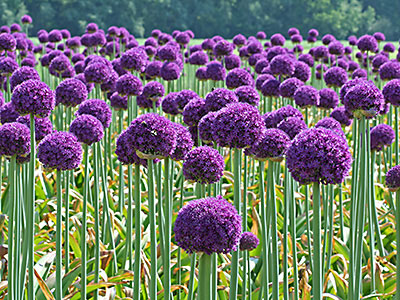
Plants of this genus have a characteristic odor and a pungent taste caused by the presence of volatile essential oils. The genus includes about 600 species. Many allium species have very attractive and striking flowers. They have long been used to adorn gardens, parks, and household plots. Decorative alliums are traditionally present in rock gardens, rockeries, stony beds, mass plantings, and borders. They are suitable for cutting, including for dried arrangements, and for forcing flowers out of season. Alliums vary greatly in appearance, size, the shape and structure of inflorescences and leaves. Allium flowers come in a wide range of colors. Nowadays a lot of planting material of bulbous plants has been imported into Ukraine from abroad — daffodils, tulips, hyacinths, as well as ornamental alliums, without which the palette of bulbous flowers would be incomplete.
Occurs wild in Central Europe.
This is a well-known ornamental plant flowering in June for 11-18 days. Its almost perfectly round umbels measure about 4-7 cm in diameter. In the center of the star-shaped, wine-red flowers are striking dark anthers seated on purple filaments. Scapes rise to a height of 40 to 70 cm. Leaves are linear, shorter than the scape. Fruits set.
Occurs wild in semi-deserts, on saline flats and scree slopes of the Mediterranean and steppe regions of Western Siberia, Central Asia and north-western China.
Stem 15—80 cm high. Leaves semi-cylindrical, hollow, 2-3 in number. Flowers bell-shaped, blue-gray, less often white, 0.4—0.6 cm long, aggregated in hemispherical or spherical inflorescences up to 6 cm in diameter. A brownish-green vein runs down the middle of each perianth segment. 2n = 16, 32. Flowers from late June to early July for 18-30 days. Fruits set. It can be planted in full sun as well as in light partial shade. Winters without cover. In cultivation since 1876.
Allium christophii, or white-haired — Allium christophii Trautv = A. albopilosum.
Grows on shallow-soiled slopes from desert foothills to the montane-steppe belt of Turkmenistan. Named after the entomologist Christoph, who first collected it.
Bulb rounded, 2—4 cm in diameter, covered with thin membranous scales of a grayish color. Leaves flat, strap-shaped, up to 3 cm wide, glaucous-green, hairy along the margins. Scape about 15-60 cm tall, about 1.5 cm in diameter, with the base set into the ground. Inflorescence a very large spherical umbel averaging about 20 cm in diameter. Flowers star-shaped, 1—1.8 cm long. Color ranges from light to bright violet with a metallic sheen. Perianth segments narrow, lanceolate, with pointed tips. After flowering they become rigid and do not fall off. Flowers in June for up to 30 days. The stem with seeds adorns the garden until autumn, the foliage dies back after flowering. Gardeners call the inflorescences of this allium "porcupines." In cultivation since 1901, used in breeding
Allium hollandicum
Bulb broadly ovoid, up to 5 cm in diameter, in a thin papery tunic. Scape robust, distinctly ribbed only in the lower part, height 60 (90) cm. Leaves erect, up to 5 cm wide, green or somewhat glaucous. Inflorescence dense, hemispherical or almost spherical, up to 12 cm in diameter. Flowers pink or pink-purple, filaments evenly colored. Perianth segments up to 1 cm long, narrow, curling and bending back after flowering. Flowers in May - June. Traditionally may be sold under the name "Allium aflatunense."
Allium jesdianum
Bulb broadly ovoid, up to 3.5 cm in diameter, in a papery tunic with distinct longitudinal veins. Scape up to 1 m tall with distinct but spaced ribs, especially in the lower part. Usually no more than 4 (6) leaves, up to 3.5 cm wide, dark green or glaucous. Inflorescence many-flowered, hemispherical, up to 12 cm in diameter. Flowers bright, pink-purple, filament tips white. Perianth segments up to 0.9 cm long, very narrow, bending back after flowering. Blooms in June.
Allium karataviense Regel
Grows on limestones and screes of the Altai foothills and western Tien Shan. The species name derives from the Karatau Mountains.
One of the most ornamental and distinctive species of the genus. Bulb large, spherical or flattened-globose, covered with dark membranous dry scales. The scape is deeply set in the ground, the above-ground part reaching 25-30 cm. Sometimes it rises above the spreading leaves, sometimes it is shorter than them. Leaves 2-3 in number, oblong, up to 30 cm long, fairly wide (up to 20 cm), glaucous-green with a thin purple stripe along the smooth margin. Flowers light pink-violet with a darker vein on the perianth segments, aggregated in a spherical, many-flowered, dense inflorescence up to 12 cm across. Blooms from late May for about 20 days. After flowering pink fruit capsules form, also quite decorative. Fruits set in July. In cultivation since 1876.
Allium oreophilum S. A. Mey = A. ostrowskianum Regel
An extremely decorative low-growing ephemeroid species occurring on scree slopes of the subalpine and alpine belts of the Caucasus, mountains of Central Asia and north-western China.
Considered one of the most beautiful low-growing species. Bulb ovoid, 1—1.5 cm in diameter, with gray membranous tunic scales. Leaves narrow (0.8—1 cm), flat, folded along the midrib, dark green in color. Scapes 15—20 cm tall, occasionally up to 30 cm. Inflorescences large, up to 10 cm in diameter, in the form of a hemispherical loose umbel. Flowers large, broadly campanulate, crimson-pink, with a persistent, atypical for alliums aroma. A distinct dark purple central vein is visible on the perianth segments. Blooms in June. This species is more demanding in cultivation conditions than Allium moly. Light-loving, but tolerates slight shading. It grows well in light, fertile, well-drained soil. Good for rock gardens. Spent plants are attractive in dried bouquets.
Allium rosenbachianum Regel
Occurs wild in the shade of rocks and trees on shallow-soiled sites of the mid-montane belt of the southwestern Pamir-Alay.
Bulbs spherical, up to 3 cm in diameter, with dark membranous tunics. Scape slender, ribbed, up to 70 cm tall. Leaves linear-lanceolate or broadly linear, 2-3 in number, considerably shorter than the flower stem. Flowers up to 1.5 cm in diameter, lilac-pink, star-shaped, with pointed perianth segments, gathered in a large, spherical, loose inflorescence up to 12 cm in diameter. Blooms in June for 2-3 weeks. Fruits set. In cultivation since 1888. There is a form with white flowers (Album) and the cultivar Colanda, whose flower segments are purple on the inner side and bright violet with a light edging on the outside.
Grows as solitary specimens, but due to its ability to reproduce actively it can spread throughout the garden. Prefers partial shade, but also grows well in full sun. Not demanding about soil. Extremely popular and good for cutting and for planting in flower beds.
Location: most alliums are sun-loving, so choose sunny sites and south-facing slopes with well-drained loose fertile soils. Better illumination determines the intensity of flower and leaf coloration. A soil reaction close to neutral is preferable. If pH drops below 5, the soil should be limed. When preparing a site for planting alliums, the soil is enriched with well-rotted compost and a complete mineral fertilizer with microelements is applied, based on its fertility. Like all bulbous plants, ornamental alliums are very sensitive to potassium deficiency in the soil.
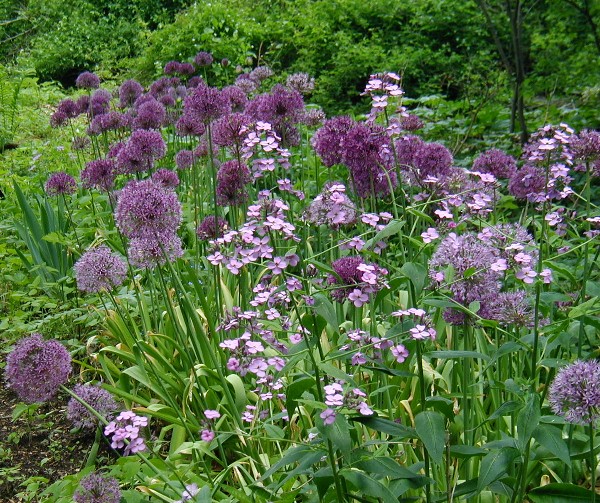
Soil: prefer loose soil rich in organic matter.
Care: when cultivating bulbous Allium species in a temperate climate zone, it is best to dig up the bulbs annually after the seeds mature and the leaves wither, and replant them in autumn. The reason is that ephemeroid alliums and many xerophytic bulbous species originate from the mid-mountain belt of Central Asia — a zone with hot dry summers and winters with frequent thaws. In their native habitat after the end of the growing season in late June, the bulbs of these species remain in warm dry soil until autumn. Rainfall is virtually absent during this period. In the temperate zone, if the second half of summer turns out wet and cool, bulbs left in the ground may be affected by diseases and rot. Therefore it is better to dig them up, dry them well and store them until autumn at room temperature in a dry, ventilated place. In sites with favorable ecological conditions, bulbs may not need annual lifting, but if overcrowded the plants become smaller and flower poorly.
In autumn bulbs are planted after the soil and air temperatures have dropped steadily, usually in the third ten-day period of September. The optimal soil temperature for root establishment is about 10 °C in the rooting zone. Planting depth is determined so that a layer of soil equal to three times the height of the bulb covers its top. Accordingly, large bulbs are planted much deeper than small ones.
It is better to plant into a moistened furrow. Cover the plantings with mulch such as compost or peat to prevent crusting of the soil. In autumn root growth continues until the soil temperature in the root zone falls to 2—3 °C. Bulbs of some species — moly, Ostrowsky's, pink, blue, blue-gray — can be planted either in autumn or in spring after storage in a cool dry place. Small bulbs are better stored in peat or sawdust to prevent them from drying out.
Bulbous-rhizomatous species are grown in permanent plantings and propagated by dividing the clumps. Plants are transplanted every 3—5 years, sometimes even after 7 years, but in that case the plantings should be thinned and self-seeding prevented. Optimal times for dividing are early spring and late summer, so that the divisions root well before frost. Each spring the site should be deeply loosened, cleared of plant debris and snow mold. Care during the growing season is conventional — weeding, loosening and mulching the soil. Water only when there is a clear lack of moisture; feed in spring after leaf emergence, as well as at bud stage and bulb formation, and in late summer with phosphorus-potassium fertilizers to improve winter hardiness. For spring feeding use complete mineral fertilizers (NPKMg) with microelements, selecting formulations with a higher content of nitrogen in nitrate form. In summer apply liquid feedings of mineral fertilizers. For an August dressing, granular phosphorus-potassium fertilizers are applied in dry form. For winter, plantings can be mulched with peat or compost.
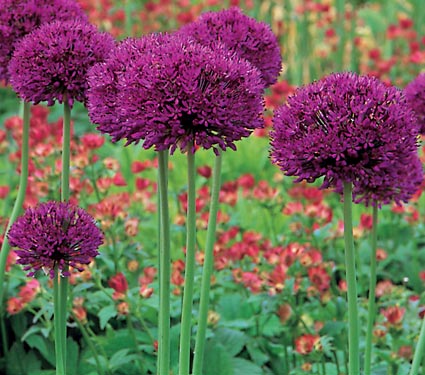
Propagation: by seed and vegetatively. Seeds are sown in spring or autumn. Seedlings are pricked out to well-lit beds. When propagating by seed two important points should be considered. First, seeds of many species, for example xerophytic ephemeroids — giant alliums, aflatunense, stipitatum and others — germinate only after pre-winter sowing, after exposure to the sequence of conditions of the autumn-winter-spring season. This is not always successfully replaced by the same period of storage in a refrigerator. And second, when grown from seed many allium species — anzyrs, ramsons and others — bloom in the 3rd to 8th year only after the bulbs attain a mass sufficient for reproductive development. Ephemeroid alliums with a short annual growing period have the longest juvenile phase.
Vegetative propagation of bulbous species occurs by division of bulbs and formation of bulbils developing on the basal plate and stolons of the parent bulb. The degree of bulb branching and the ability to form bulbils are species characteristics. Rhizomatous species, which actively branch shoots, are mainly propagated by division of the clump. When raising plants from seed, clumps can be divided from the third year of life. Divisions are pieces of rhizome with two to three undamaged shoots and well-developed roots. In all species small bulbils may form on the inflorescences. Their formation can be artificially stimulated by cutting the buds and treating with growth regulators. Bulbils can be used for planting. This is valuable, a more juvenile planting material and freer of phytopathogens.