
Indoor plants
Allamanda
Allamanda
Allamanda (Allamanda) — a genus of flowering plants that includes about 15 species of evergreen shrubs and lianas of the family Apocynaceae (Apocynaceae). The genus was named after Professor Frederik Allamand of Leiden University. It is distributed in the forests of tropical North, Central and South America. Used as an ornamental flowering plant for vertical greening.
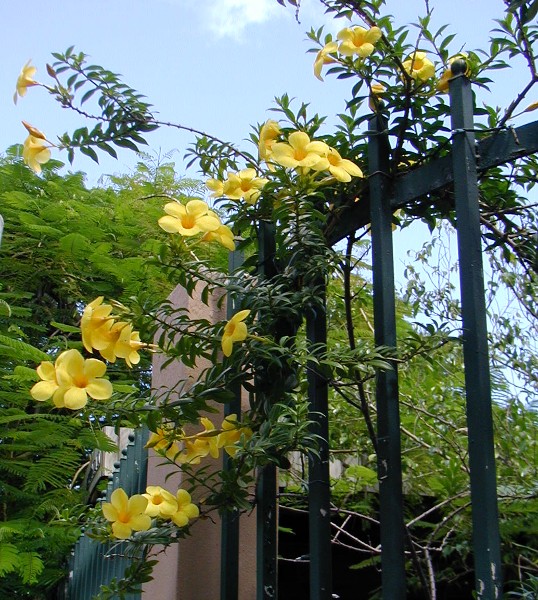
Most species are shrubs. Leaves are opposite or arranged in a rosette. Flowers are gathered in curly clusters, large, yellow or purple, consisting of a five-lobed calyx and a five-part corolla, fused below like a funnel or bell, five free stamens and a one-locular ovary. The seed capsule is two-valved, spiny, with numerous seeds.
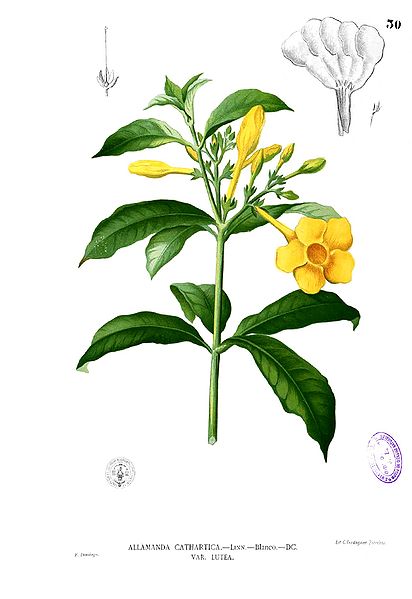
Purgative allamanda - Allamanda cathartica
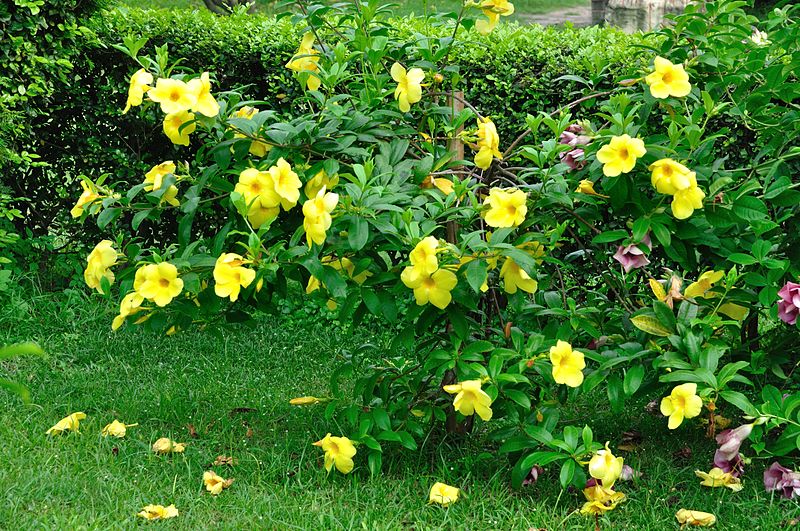
The most commonly cultivated species. A climbing plant up to 6 m long. Opposite leaves ovate-elongated, large (up to 14 cm long, 2-4 cm wide), mostly glabrous, only on the lower part of the shoot pubescent along the veins.
Tubular-funnel-shaped large (5-6 cm wide) golden-yellow flowers with a whitish base are borne at the tips of the shoots.
In cultivation it has numerous forms, which some authors consider to be separate species.
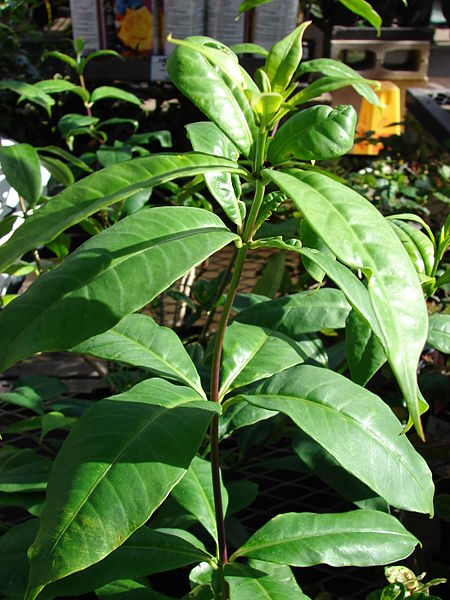
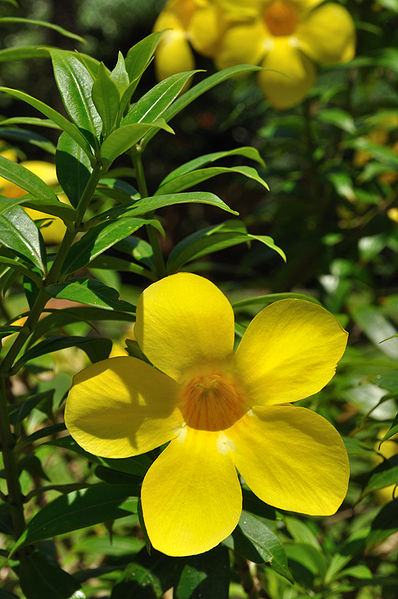
Allamanda, popularly called the Golden Trumpet (the name comes from the appearance of the flower), grows very quickly, so when you buy a small young plant in spring be sure to repot it. Thereafter monitor how the plant grows and if roots appear from the drainage hole another repotting may be required. Sometimes young plants need to be repotted three times during the summer. Even after that the allamanda should be repotted again the following year. When the plant has been repotted into a pot about 20 cm in diameter, at the next repotting you may not need a larger container; instead trim the roots and replace the remaining old exhausted soil with fresh potting mix.
Temperature: Allamanda is warmth-loving. In summer 20-25 °C, in winter not below 14 °C.
Light: Light-demanding; in summer it needs full sun. But from October, as temperatures fall, the plant is kept in a bright place protected from direct sunlight.
Watering: Abundant in the summer period; the soil must not dry out. From autumn to early spring water moderately, i.e. reduce about twofold and water only when the topsoil has dried well.
Fertilizer: In spring and summer (March to August) feed the allamanda every week. Use a balanced fertilizer for ornamental flowering houseplants.
Air humidity: During the growing period from March to August mist frequently, but so that water does not get on the flowers.
Repotting: Repot annually in spring, in February-March. Prune shoots at the same time to stimulate flowering. Soil for allamanda should be fertile: 2 parts clay-loam topsoil, 1 part leaf mould, 1 part humus and 1 part sand.
Propagation: By semi-hardwood cuttings taken in spring. Cuttings are rooted in an indoor propagator with soil heating.