
Indoor plants
Aglaonema
Aglaonema
Aglaonema (lat. Aglaonema) — a genus of evergreen herbs and subshrubs of the family Araceae, originating from Southeast Asia.
Aglaonema is a relative of Dieffenbachia and therefore somewhat resembles it; it differs mainly by its narrower leaves, Aglaonema's size is considerably smaller than that of Dieffenbachia, and the plant itself has a bushy form. In addition, aglaonemas bloom for a fairly long time and produce fruits. This is one of the most suitable plants for hydroponic culture.
Variable aglaonema - Aglaonema commutatum
A bushy plant with erect stems. Leaves on long petioles are oblong-elliptic or lanceolate in shape, about 20-30 cm long and 5-10 cm wide. Several cultivars of various variegated coloration. When flowering it produces up to 6 flower stalks up to 20 cm long. The inflorescence is a spadix with a light-green spathe, 5-6 cm long.
Ribbed aglaonema - Aglaonema costatum
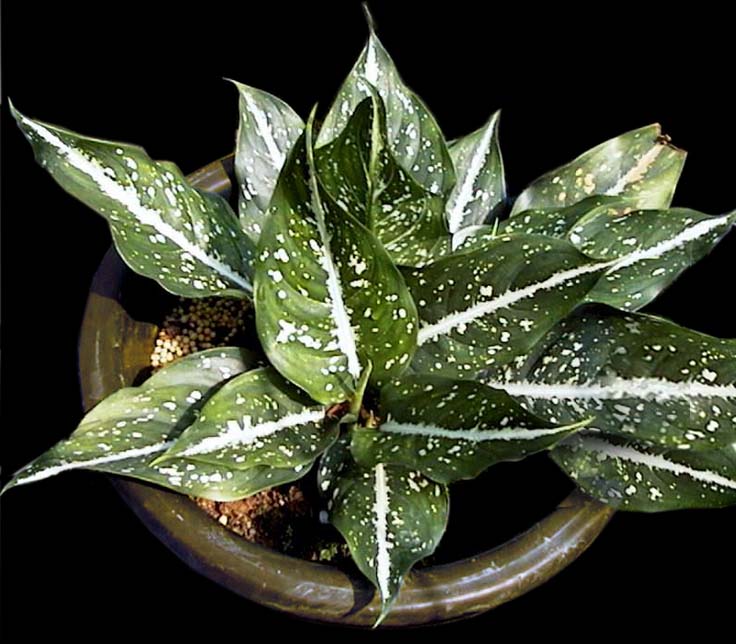
A low-growing plant with a prostrate underground stem. It has broader leaves on short petioles, with a pronounced central vein and light spots and streaks. The flower stalk is single, up to 15 cm long; the spadix about 3 cm long.
Curly aglaonema - Aglaonema roebelinii
A strongly branching large bush with leaves up to 30 cm long, elliptical in shape with a rounded base. The leaf surface is grayish-silvery. Spadix about 3 cm long.
Modest aglaonema - Aglaonema modestus
With purely green leaves, the most shade-tolerant species. It is very often mistaken for Spathiphyllum.
Temperature: Develops well only in warmth, not below 18°C, optimal temperature 22-23°C. Does not tolerate drafts.
Light: Shade from direct sunlight in summer; good lighting in winter.
Watering: Abundant from spring to autumn, moderate in winter. For watering use only soft, well-settled water at room temperature or warm.
Fertilizer: From March to September feed every two weeks with a special fertilizer for houseplants that does not contain lime, for example "Azalievye", "Tsvetochek" and similar products.
Air humidity: Likes very humid air; regular spraying and washing of the leaves is required. Before spraying, make sure the room is warm and there are no drafts, otherwise you may harm the plant.
Repotting: Since aglaonema grows slowly, repot only as needed - young plants every year, plants older than 3 years every 2-3 years, in spring. Plant in wide but not deep pots. Soil - 2 parts turf soil, 1 part leaf mold, 1 part peat and 1 part sand. It is good to add a little charcoal and brick grit to the soil. Aglaonema grows well and, moreover, flowers only in a cramped pot.
Propagation: In spring and summer by apical and stem cuttings; also when repotting separate offshoots with several leaves and roots.