
Indoor plants
Agave
Agave
Agave (Lat. Agáve from Greek Αγαυε — the name of Cadmus's daughter, the mother of Pentheus) — a genus of plants of the Agave family (Agavaceae).
Native from South America to the southern states of the USA.
Very attractive ornamental plants, but most species, due to their large size, are suitable for decoration only in flower beds and small flower gardens. In indoor conditions, dwarf forms or only young plants are grown. More than 50 species of agave are in cultivation.
The most common species:
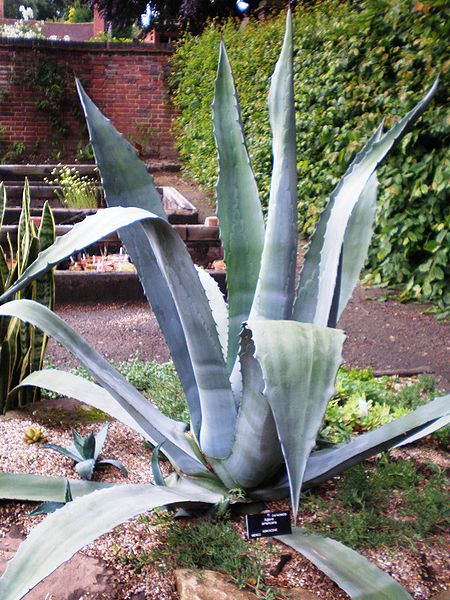
American agave - Agave americana
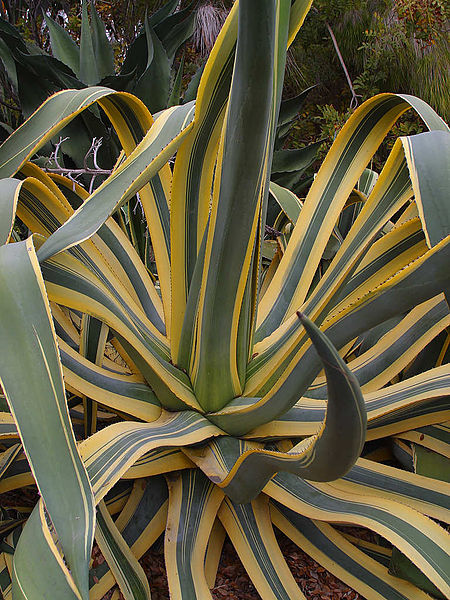
Large gray-green or bluish-gray strap-shaped leaves, under favorable conditions often reaching 1–1.2 m in length, with sharp spines; in our Caucasus they reach 2–3 m in diameter. The leaf margins bear straight or slightly curved strong brown teeth. The upper surface of the leaf is flat, the lower convex. Inflorescence - a huge apical panicle, in large specimens 10 m tall or more, bearing over 10,000 flowers. Flowers are yellowish, up to 7 cm in diameter. It is believed that it blooms once every hundred years. In fact it blooms once in its life, at about 15 years of age; the flowering stem bears numerous flowers in a panicle or raceme, then after flowering the plant gradually dies, producing offsets used for propagation. Forms of this species differ mainly in leaf coloration: A. marginata - leaves with bright yellow margins; A. mediopicta - leaves with a longitudinal central broad yellow stripe. Because of their size and sharp spines they are poorly suited for a small room.
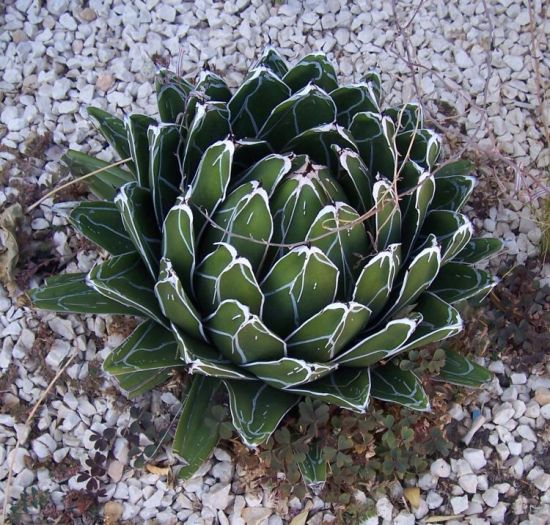
Agave "Queen Victoria" - Agave victoriae-reginae.
Its rosette is significantly smaller than that of the previous species, more or less regularly globose. Leaves are very stiff, narrowly triangular or lanceolate, 10–20 cm long, 3–6 cm wide, with a short brown rigid tip at the apex. Along the leaf margins are thin white lines that comparatively easily peel off as white fibers.
Agaves are very undemanding plants. Although a cool temperature would be desirable for them in winter, this plant should not be dismissed: they can overwinter at normal room temperatures, but they need plenty of light. In addition, agaves, as they spread (in width), take up a lot of space, so it is worth ensuring they have enough room on the windowsill.
Temperature: In winter agaves do very well at temperatures we would tolerate only in winter coats, 4–10 °C. At other times of the year, normal room temperatures are fine.
Lighting: Lighting should be bright; shading is not necessary. A south-facing windowsill is best. In summer it is desirable to keep agaves in the sun outdoors. In winter, when there is little light, agaves stretch and lose their attractiveness if they do not receive enough light. Therefore, in winter the brightest place is especially needed.
Watering: In summer the plants are watered moderately but regularly. In general, winter watering depends on the temperature: if the plant is kept in cool conditions — up to 10 °C — watering is infrequent — once a week, so that the soil does not dry out completely. If it is not possible to keep the agave in cool conditions in winter, and it is kept at nearer to room temperature or higher, then watering is more frequent — 2–3 times a week. Thus, the soil should dry out somewhat in winter, but not dry out completely.
Fertilizers: From May to August, feed every three to four weeks with a fertilizer for cacti or succulents.
Repotting: Young agaves are repotted annually, mature ones every 2–3 years, which over the years produces lush plants. Soil — 3 parts clay-loam topsoil, 1 part leaf mold, and 1 part coarse river sand. Drainage is essential.
Propagation: by seeds, cuttings and offsets.