
Flowers for the garden
Agastache
Agastache
This magnificent plant has become known quite recently, but it undoubtedly has a bright future. Since most species of the genus are not sufficiently frost-hardy in the northern part of Ukraine, it is recommended to grow them either as annuals or as perennials with a dry winter cover. In the southern regions of the country Agastache overwinters successfully.
Agastache barberi - Agastache barberi
In cultivation the cultivar 'Firebird' is usually encountered. The origin of Agastache 'Firebird' is actually not exactly known: some experts believe it is a hybrid A. ruprestris x A. coccinea, although others consider its progenitor to be A. barberi. All three listed species occur wild in the hot dry regions of northwestern Mexico and the southwestern United States, and their domesticated descendants therefore prefer a warm sunny climate. Unlike the wild forms, garden cultivars of these plants tolerate light frosts and, where winters are mild, can grow outdoors year-round. Hardiness zone (according to Western catalogs): 6-9.
Anyone who sees it even once will never forget the lush orange sultans of its inflorescences. Despite the dazzlingly bright flower color, it does not give a vulgar impression. On the contrary, the shoots of this Lamiaceae member combine excellently with other plants. The modest gray-green foliage emphasizes the decorative value of the flowers. They cover the shoots of Agastache abundantly, which reach 60 cm in height, from July to October. This Agastache is propagated only vegetatively — by stem cuttings or by dividing the clump.
Agastache rupestris - Agastache rupestris
In the wild it occurs from southeastern New Mexico to south-central Arizona.
An erect perennial 45–90 cm high with a plant diameter of about 45 cm. Leaves linear-lanceolate, gray-green, thread-like, very decorative and aromatic. Corolla toothed, the flower about 4 mm in diameter. One of the most frost-hardy species of the genus. Hardiness zone (according to Western catalogs): 5-9. Cultivars that bloom in the year of sowing have been developed. In temperate regions it is recommended to grow them as annuals, as the plant only tolerates mild winters well. In perennial culture, good drainage and preventive dry winter protection are essential.
Agastache mexicana - Agastache mexicana
A perennial plant. Hardiness zone (according to Western catalogs): 6(7)-10; it is considered not to tolerate severe winters very well. Nevertheless, the species itself overwinters quite successfully in the temperate zone, self-seeds and naturalizes. Plants that die back are easily restored by sowing from seed. During the summer the clumps have time to spread and at the end of summer and early autumn ornament the garden. Cultivars are primarily of decorative value.
The cultivar 'Carlile Carmine' is notable for a long and abundant flowering. Carmine-red or bright-pink flowers develop on fairly tall stems up to 75 cm, which contrast strikingly against the tender green foliage. When planting this plant it should be noted that it does not combine well with other flowerbed inhabitants, overshadowing them with its flashy beauty. This plant forms a dense clump and spreads over a large area by underground runners. Nevertheless it will not take over the whole garden, since most young plants die in winter during frosts. In spring, seeds ripened in the previous season often germinate in the places of last year’s plantings.
Agastache rugosa - Agastache rugosa = Agastache anisata
This is a popular perennial plant. Hardiness zone (according to Western catalogs): 6(7)-11. It is considered insufficiently cold-hardy and is therefore often recommended to be grown as an annual. Self-seeding is moderate, though sometimes the plant naturalizes. This Agastache is often planted in large containers. The green parts of plants of this species, whose stems reach 1 m in height, smell of licorice, and the leaves have a mild anise flavor. Sometimes they are added to green salads. The species is not outstandingly decorative and is of interest as a culinary and medicinal plant, and as a nectar source.
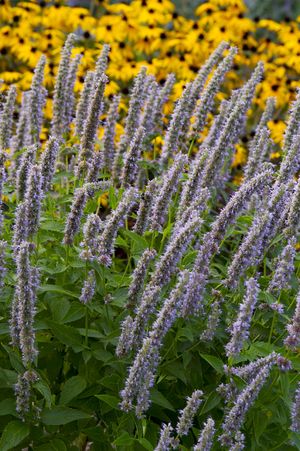
In the cultivated variation 'Blue Spike' the flowers have a purple-blue color. A new cultivar of Agastache rugosa — 'Honey Bee' — is grown as an annual. By sowing seeds in autumn or early spring and providing the seedlings with additional artificial light, abundant flowering can be achieved in young plants already by late spring. Artificial lighting is necessary because Agastache requires a day length of at least 14 hours for flower bud formation. Young bushes will bloom from May until the onset of winter. Two varieties of the cultivar are most successful. One of them, 'Honey Bee Blue', grows stems up to 70 cm but retains a compact bush form. Stems are densely covered with leaves that have the scent of peppermint and anise. The plants are good nectar sources, and their small blue or sky-blue flowers, collected in racemes about 10 cm long, attract insects. This cultivar is more winter-hardy than the species provided the soil is not too wet. Seeds spread successfully by self-seeding.
Location preferably a well-lit warm, even hot site.
Soil: grows well on poor, well-drained sites. On heavy wet soils it may fail.
Care: in the temperate zone for successful overwintering it is necessary to provide light soils, drainage and preventive dry winter covering. The plant does not tolerate winter-spring waterlogging. It is important to cut back the above-ground parts no later than mid-September, leaving 10 cm of stems so that the root buds wake up, which overwinter well.
Propagation: by seed and vegetatively. Cultivars are usually propagated only vegetatively. Sow outdoors in May. Seeds germinate at 20°C. Seedlings develop slowly and when sown directly outdoors plants may bloom only in August–September. To get young bushes to bloom in July–August they should be raised as transplants. Sow seeds in March–April, placing boxes with soil in a warm room.